AI SEO explained: how six AI search engines find and cite your pages
AI SEO means getting your pages found, cited and recommended by AI search: Google AI Overviews and AI Mode, ChatGPT, Perplexity, Gemini and Copilot. Each one searches an index before it answers, so crawl access and solid SEO come first. What changes is whose index, which crawler and which sources it trusts.
Search engine optimization used to have one audience: Google’s crawler and its ten blue links. Now the same question can be answered by an AI Overview, by AI Mode, by the Gemini app, by ChatGPT, by Perplexity or by Microsoft Copilot, and each of them decides on its own which pages to read and which to credit. Google said in July 2026 that AI Mode had passed 1 billion monthly users and the Gemini app 950 million. OpenAI put ChatGPT at 900 million weekly users in February.
This guide takes the six systems one at a time, with what each company’s own documentation says and the date it said it. Then it covers what they share, where they part ways and what to do for each. To see how often two of them agree, we put 8 questions to ChatGPT and to Google on October 28, 2026. They agreed less than you might hope.
What AI SEO means, and the second meaning people search for
AI SEO, short for AI search engine optimization, is optimizing for search that answers with AI, so that ChatGPT, Google’s AI features and the rest find your pages, trust them and cite or recommend you. The same two words also describe the reverse: using AI tools to do SEO work. Google’s results mix both.
On October 28, 2026, the US top results for the phrase included two reviews of AI SEO tools, a Reddit thread asking what the term even means, a university guide on using AI to write search content and an agency selling AI-driven SEO. Google’s own AI Overview for “what is ai seo” split the term into those two strategies and then asked which one we were after. ChatGPT answered the same question without running a search, straight from training, and described only the first meaning.
Most of this guide is about that first meaning, because that is where the rules changed. Using AI inside an SEO workflow gets its own section near the end, together with Google’s policy on AI-written content.
How AI search works: four steps every engine shares
Every system in this guide answers in roughly the same way. It reads the question, decides whether it needs fresh information, searches an index and then writes a reply with some of the pages it used attached. The big difference sits in step three, the index.
- Decide whether to search. Settled facts often come straight from the model’s training. Anything recent, local, priced or ranked usually sends it to the web. ChatGPT skipped the search for one of our 8 questions, the definition of AI SEO, and searched for the other seven.
- Rewrite the question. One question becomes one or more queries, often with a year, a place or brand names added. Google calls this query fan-out, and our query fan-out guide lists real examples.
- Retrieve pages from an index. Google’s AI features pull from Google’s index through its core ranking systems. Copilot runs on Bing’s index. Perplexity keeps an index of its own, and ChatGPT uses outside search providers plus partner content. A page that is missing from the index an engine uses cannot be picked, however good it is.
- Write and cite. The model drafts one answer and shows a handful of the pages behind it as links, footnotes or source cards. How it chooses those few is the part every company describes only loosely.
There is a second road into an answer that skips search entirely: training data. A model that has read about your brand in many places may name you before it looks anything up. That is the ground covered by entity SEO for LLMs, and our piece on where ChatGPT gets its information shows how the two sources blend in practice.
One side effect touches every business. When the answer sits on the page, people click less, and rankings alone stop telling you how visible you are. Our guide to zero-click searches has the numbers and the alternatives worth tracking.
Google, ChatGPT, Perplexity, Gemini and Copilot, one by one
Here is what each company says about how its AI search finds and credits pages. Where a claim comes from a study or from our own check rather than official documentation, the text says so.
Google AI Overviews and AI Mode
Google documents both features on a single Search Central page, last updated December 10, 2025. They draw on the regular Google index and may use query fan-out, running several related searches across subtopics to gather supporting pages. AI Overviews appear only when Google’s systems judge them useful, AI Mode is a separate conversational experience, and the two can run on different models, so their links differ. On January 27, 2026 Google began rolling out, on mobile and worldwide, a way to jump from an Overview straight into an AI Mode conversation.
The entry requirements are the ordinary ones: the page has to be indexed and eligible to show with a snippet. Google lists no extra technical requirements, files or schema. Its longer guide to generative AI features, updated July 10, 2026, calls the whole effort SEO, puts content with a first-hand or expert view at the top of the list and names llms.txt, chunking pages into tiny pieces and rewriting text for machines as things you can skip for Google Search.
Two newer controls matter. Since August 31, 2026 every site has a Search generative AI setting in Search Console that removes it from AI Overviews, AI Mode and the AI features in Discover without touching regular rankings. August 31 also opened the Generative AI performance report to all sites: impressions in those features by page, country, device and date. Clicks are not among the metrics Google announced on June 3.
The Gemini app
Gemini is Google’s assistant rather than its search engine, and its rules differ in one important way. Google’s crawler documentation, updated October 15, 2026, says Gemini Apps ground their answers in content from the Google Search index, and that the Google-Extended token in robots.txt decides whether your pages can be used for that grounding and for training future Gemini models. Blocking Google-Extended leaves Google Search, Overviews included, untouched.
Gemini shows a Sources button when links are available, and its help center notes that not every response includes them. The Search Console report covers Search and Discover, not the Gemini app, so the simplest way to see what Gemini says about you is to ask it yourself.
ChatGPT search
OpenAI added search to ChatGPT on October 31, 2024, built on third-party search providers plus content that partners supply directly. Pages reach those answers through OAI-SearchBot. OpenAI’s crawler documentation states that sites opted out of OAI-SearchBot are not shown in ChatGPT search answers, apart from navigational links, and that a robots.txt change takes about 24 hours to register.
GPTBot is a separate crawler used for training; blocking it does not remove you from search answers. ChatGPT-User, which fetches a page when a person asks for it, may not follow robots.txt because the request comes from a user. To see whether citations turn into visits, filter your analytics for the tag utm_source=chatgpt.com, which 23 of the 38 links cited in our check carried.
Perplexity
Perplexity crawls and keeps its own index. In September 2025 it described that index as covering hundreds of billions of pages, processing tens of thousands of updates every second and splitting documents into smaller units that are scored one by one against the query. Its help center says every answer carries numbered citations, and the Research mode runs dozens of searches and reads hundreds of sources for a single report.
Perplexity’s crawler page describes PerplexityBot as the bot that surfaces and links websites in its results, and says it does not collect content for training foundation models. Perplexity-User, which fetches pages for a live question, generally ignores robots.txt. Changes can take up to 24 hours. A July 2025 Semrush study of 5,000 keywords found that more than 91% of the domains Perplexity cited also ranked in Google’s top 10 for the same keyword, the closest match of the four systems compared.
Microsoft Copilot and Bing
Microsoft is the most open about its plumbing. A post by Bing product manager Krishna Madhavan on the Microsoft Advertising blog, dated October 8, 2025, describes Copilot as powered by Bing’s search index. It explains that assistants break pages into smaller pieces, a step it calls parsing, and then choose which pieces earn a place in the answer. Its advice: clear headings, lists, tables, question and answer pairs and schema, with no answers hidden in tabs and no key facts left only in images.
Bing also hands publishers the most data. Its AI Performance report, in public preview in Bing Webmaster Tools since February 10, 2026, counts citations in Copilot, in Bing’s AI summaries and in some partner integrations, lists the pages cited and shows a sample of the grounding queries the AI used to find them. The same post points to IndexNow for reporting page changes and Bing Places for local details. To limit AI use, Bing said in September 2023 that a NOARCHIVE tag keeps a page out of what was then Bing Chat and out of training, while NOCACHE restricts it to the URL, title and snippet; both kinds of page still appear in normal Bing results.
AI search engines compared: sources, links, crawlers and opt-outs
Three of the six systems sit on Google’s index, one on Bing’s, one on its own and ChatGPT on a mix of providers. That alone explains why a page can show up in one assistant and be absent from the next. The table lines up the official details.
| System | Where pages come from | Links in answers | Crawler or token | How to opt out | Publisher data |
|---|---|---|---|---|---|
| Google AI Overviews | Google index, core ranking systems, query fan-out | Yes, about 3 sites per answer (Semrush, 2025) | Googlebot | nosnippet, max-snippet, noindex or the Search Console AI setting | Search Console Generative AI report (impressions) |
| Google AI Mode | Same index and fan-out, possibly another model | Yes, about 7 sites per answer (Semrush, 2025) | Googlebot | Same as AI Overviews | Same report |
| Gemini app | Grounding in the Google Search index | Sometimes, under Sources | Google-Extended (a token, not a crawler) | Disallow Google-Extended; Search unaffected | Not in the Search Console report |
| ChatGPT search | Third-party search providers and partner content | Yes, inline citations | OAI-SearchBot (GPTBot is training only) | Disallow OAI-SearchBot, about 24 hours | Referrals tagged utm_source=chatgpt.com |
| Perplexity | Its own index of hundreds of billions of pages | Yes, numbered citations on every answer | PerplexityBot | Disallow PerplexityBot, up to 24 hours | Referral visits in your analytics |
| Microsoft Copilot | Bing index | Yes, citations | Bingbot | NOARCHIVE or NOCACHE meta tags | Bing AI Performance report (citations, grounding queries) |
Sources: Google Search Central (December 10, 2025; July 10 and October 15, 2026), Search Central Blog (June 3, 2026), Search Console and Gemini Apps Help, OpenAI (October 31, 2024, and crawler docs), Perplexity (September 25, 2025, and crawler docs), Microsoft (October 8, 2025), Bing Webmaster Blog (September 22, 2023; February 10, 2026), Semrush (July 21, 2025). Checked October 28, 2026.
Two lessons fall out of that table. There is no single “AI crawler” to let in: a site can welcome Googlebot and Bingbot and still be invisible in ChatGPT because a firewall rule blocks OAI-SearchBot. And keeping your content out of training is a different decision from keeping it out of answers.
GPTBot and ClaudeBot, Anthropic’s training crawler, only concern training. Google-Extended covers Gemini training plus grounding in the Gemini app, yet has no effect on Google Search. OAI-SearchBot and PerplexityBot decide whether you can appear in those engines’ answers at all, and Claude-SearchBot plays that part for Claude. A robots.txt along these lines keeps a site in the answers and out of training:
# Stay visible in AI answers
User-agent: OAI-SearchBot
Allow: /

User-agent: PerplexityBot
Allow: /

User-agent: Claude-SearchBot
Allow: /

# Stay out of model training
User-agent: GPTBot
Disallow: /

User-agent: ClaudeBot
Disallow: /

# Gemini training AND Gemini app grounding (Google Search unaffected)
User-agent: Google-Extended
Disallow: /
One possible setup. Blocking Google-Extended also removes your pages from grounding in the Gemini app, so leave it open if Gemini answers matter to you.
Before you change anything, check what your current file and server actually allow. The free AI crawler checker from Slibur.com reads your robots.txt bot by bot.
Same question, two engines: what ChatGPT and AI Overviews cited
They rarely agreed. We asked 8 everyday questions on chatgpt.com, logged out, from the US, and ran the same words through Google US to read the AI Overview and the organic top 10. Among the 6 questions where both sides cited sources, only 3 had even one website in common.
Our own check, run on October 28, 2026. AI answers change over time, so the same question may get a different answer today.
The set covers a home project cost, a software shortlist, a money decision, a local rule, a loan, a logistics problem, a timing question and the definition of AI SEO itself. One Google search, the HR software question, came back without readable results, so the Google figures rest on 7 searches. All 7 showed an AI Overview.
| Question | ChatGPT cited | AI Overview cited | In common |
|---|---|---|---|
| how much does it cost to finish a basement | HomeGuide, NerdWallet, Angi | Two YouTube videos, a cabinet store | None |
| best way to ship a car across the country | Move.org, ConsumerAffairs, the FMCSA, three auto transport companies | Three moving and auto transport companies | amerifreight.net |
| how to get a small business loan | The SBA, Illinois state business programs | Three YouTube videos | None |
| what is ai seo | No search, no sources | Search Engine Land, Salesforce, a YouTube Short | n/a |
| how to choose a financial advisor | Investor.gov, the SEC, FINRA BrokerCheck, the CFP Board, NerdWallet | NerdWallet, Reddit, Vanguard | nerdwallet.com |
| best HR software for a 50 person company | Five HR software vendors, three review and comparison sites | Google result not readable | n/a |
| do I need a permit to build a deck | Three Virginia county building pages | Two YouTube videos, a Reddit thread | None |
| best time to buy a used car | Edmunds, iSeeCars | Ten links: Edmunds, CarPro, a TV station, dealers, YouTube, Facebook, Instagram and others | edmunds.com |
Vértigo Marketing, October 28, 2026. chatgpt.com logged out and Google, both from the US, one run per question. Answers change between runs.
What stood out
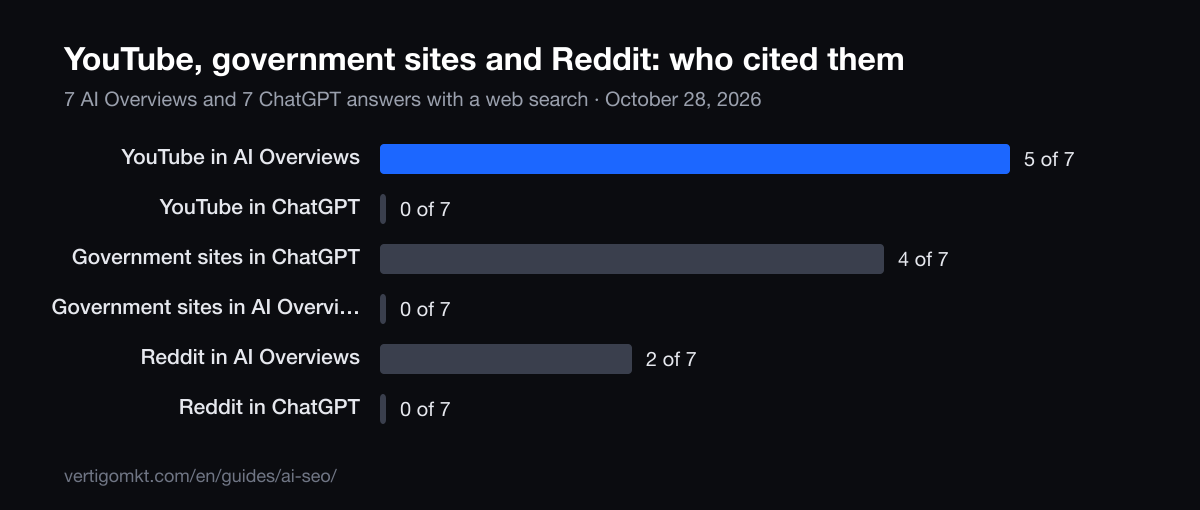
- Video carried Google’s summaries. Nine of the 28 links in the Overviews pointed to YouTube, spread over 5 of the 7. For the small business loan, the Overview cited three videos and nothing else. ChatGPT’s 38 citations included no video at all.
- ChatGPT went to the rulebook. It cited a government site in 4 of its 7 searched answers: the SBA for loans, the SEC and Investor.gov for advisors, the federal motor carrier agency for car shipping, and county building departments for the deck. No Overview cited a .gov page.
- A first-page ranking was no ticket into the Overview. Only 7 of the 28 Overview links also ranked in Google’s organic top 10 for the same words, 6 of 19 once the videos are set aside. For the financial advisor question all three did; for the loan, the definition and the used car, none did. Semrush measured far higher overlap across 5,000 keywords in 2025, about two in three cited URLs, and an earlier check of ours found half. With samples this small, read it as a caution rather than a rate.
- ChatGPT supplied a location nobody typed. For the deck permit it read pages from Virginia counties and closed by asking which county the property was in. For the loan it added Illinois programs. The likely cause is the US connection our data provider uses, and the lesson is simple: local rules get answered from local official pages.
- Google’s Overview gave advice Google’s documentation does not. Asked what AI SEO is, it recommended schema markup so AI crawlers can parse facts and claimed AI systems favor pages refreshed within the last quarter. Google’s own guide says no special schema is needed for its AI features. AI answers about AI search deserve the same scrutiny as any other source.
Put plainly, earning a ChatGPT citation and earning a spot in an AI Overview are two separate jobs, even for the very same question. Video and community threads weighed heavily in Google’s summaries, while primary and specialist sources weighed more in ChatGPT’s. Our Reddit SEO guide found the same split for opinion searches.
What every AI search engine rewards, and where the advice splits
Be reachable, be present in the index each engine searches and publish something worth quoting that other sites back up. Those conditions hold for all six systems, and most of the work serves several engines at once.
- Access for every crawler that matters
- Googlebot, Bingbot, OAI-SearchBot and PerplexityBot each need to reach the page, and so do the CDN and firewall rules in front of it. Google asks for crawlable, semantic HTML; Microsoft warns that AI systems may not render content hidden in tabs or menus.
- A place in the index they search
- You earn it the familiar way: relevant titles, clear headings, internal links, authority. Semrush found AI Overviews and Perplexity citing domains that mostly rank in Google’s top 10, with ChatGPT overlapping least, which is why ranking still matters even where it is not enough.
- Facts nobody else has
- Google’s guide calls content with a first-hand or expert view the most important long-term factor. Prices, measurements, local rules, original data and honest comparisons are what both engines in our check reached for. Covering a subject in depth also gets a site read more than once, as our guide to topical authority explains.
- Agreement from other sites
- Engines cross-check. Review platforms, trade publications, forums and directories that describe you consistently make you a safer citation. Google warns that chasing inauthentic mentions does not help, so this is reputation and PR work rather than link buying.
Chunk or not? Google and Microsoft disagree
There is one genuine disagreement between the companies. Google says its AI features need no chunking and no special markup. Microsoft describes assistants parsing pages into pieces and recommends headings, tables, question and answer blocks and schema.
In practice both positions lead to the same page. Write it for people, give each question its own heading, answer in the first lines below that heading and add structured data that matches what is visible. Google loses nothing, and Copilot gets clean pieces to lift. That is most of what SEO for AI search looks like on the page itself.
Optimizing for AI search engines one at a time
Do the shared work once, then add the few steps each system rewards. This is the order we would follow for a typical business, along with the place where you can check progress.
| System | What to do | How to check |
|---|---|---|
| Google AI Overviews and AI Mode | Keep pages indexed and snippet-eligible, answer questions with original detail, add images and video, keep Business Profile and Merchant Center current | Search Console Generative AI report; search your buyers’ questions |
| Gemini app | Leave Google-Extended open if you want to be used for grounding; otherwise the same Google SEO | Ask the app your buyers’ questions and open Sources |
| ChatGPT | Allow OAI-SearchBot, rank for the searches it writes, publish prices, specs and trust pages, get onto the review and comparison sites it reads | Referrals tagged utm_source=chatgpt.com; repeat questions logged out |
| Perplexity | Allow PerplexityBot, keep facts current and dated, earn mentions on the sites it cites | Referral visits from Perplexity; repeat your questions |
| Microsoft Copilot | Verify the site in Bing Webmaster Tools, report changes through IndexNow, keep Bing Places current, structure pages with headings, tables and FAQs | Bing AI Performance report: citations and grounding queries |
Vértigo Marketing, from the official documentation listed under sources, October 28, 2026.
Checking by hand works for a handful of questions, not for a hundred. Trackers rerun the same prompts on a schedule. Slibur.com, made by the same owner as Vértigo, checks ChatGPT and Google AI Overviews every day and Perplexity, Claude and Grok every week, with a 7-day free trial. It does not track Gemini, AI Mode or Copilot, so pair it with Search Console and Bing’s report. Our roundup of AI search optimization tools compares other options.
Some businesses need extra steps. Online stores should read about agentic commerce, where product feeds decide what assistants can recommend, and anyone weighing paid placement can compare it with organic visibility in our guide to ChatGPT ads. For a week-by-week version of this section, the 90-day GEO strategy turns it into a plan.
Vértigo Marketing runs GEO and SEO for companies in the US, the UK and Canada. Get a free review
If you would rather have a team handle it, our GEO services for US companies start from the questions your buyers ask in each assistant, and our SEO services cover the rankings those answers still depend on.
Using AI for SEO work: what Google allows
Google does not penalize content for being written with AI. It penalizes content made mainly to manipulate rankings, however it was produced. That has been the official line since February 8, 2023, when Search Central wrote that its systems reward quality regardless of how content is made and that automation used mainly to game results breaks its spam policies.
The wording has become more specific since then. Google’s spam policies, updated August 28, 2026, give generating many pages with AI tools without adding value for users as an example of scaled content abuse. Its page on generative AI content, updated October 1, 2026, calls AI useful for researching a topic and adding structure to original work. It also asks you to fact-check titles, meta descriptions, structured data and alt text as carefully as the body, and suggests telling readers how automated content was made.
That leaves plenty of room for AI in an ordinary SEO workflow:
- Grouping keywords by intent and spotting questions your pages leave unanswered.
- Drafting outlines, FAQ candidates and first passes at meta descriptions for a person to check and rewrite.
- Summarizing crawl exports, server logs and Search Console data so problems surface faster.
- Turning facts you supply into structured data, then validating it.
- Asking assistants what they say about your brand and your competitors, which is the measuring side of everything above.
What crosses the line is volume without value: hundreds of near-identical city pages, reworded competitor articles, machine-translated copies nobody reviewed. Those pages also make weak sources for AI answers, since they add nothing an engine could not find elsewhere. For a wider view of where search budgets should go now, see is SEO dead.
Frequently asked questions
Is AI SEO different from regular SEO?
It builds on it. Google calls optimizing for its AI features SEO, and every engine in this guide retrieves pages from a search index. The additions are access for each AI company’s crawler, content with facts worth quoting, mentions on the sites engines trust and tracking answers, not just rankings.
Does Google penalize AI-generated content?
Not for being AI-generated. Since February 2023 Google has said it rewards quality however content is produced. Its spam policies do treat mass-producing pages without value, with AI tools or any other method, as scaled content abuse.
If I block GPTBot, will I disappear from ChatGPT?
No. GPTBot is OpenAI’s training crawler. Showing up in ChatGPT search answers depends on OAI-SearchBot, and OpenAI says sites that opt out of it are left out of those answers apart from navigational links.
Can I keep my site out of Google AI Overviews?
Yes. Since August 31, 2026 the Search generative AI setting in Search Console removes a site from AI Overviews, AI Mode and Discover’s AI features without affecting regular rankings. The nosnippet and max-snippet rules limit what Google may show page by page.
Do I need an llms.txt file for AI SEO?
Not for Google: its guide says Google Search does not use llms.txt. Other services may read it, so keeping one does no harm, but it cannot make up for pages crawlers cannot reach or content with nothing worth quoting.
Which AI search engine should a small business focus on first?
Usually Google, because AI Overviews and AI Mode sit on top of searches people already make and reward the SEO you may already have. ChatGPT comes next and needs separate attention, since in our check it cited different sites for the same questions. Copilot and Perplexity share much of the same work.
How can I tell if AI search sends me traffic?
Look for referrals from the assistants, such as links tagged utm_source=chatgpt.com, in your analytics. Google counts AI Overview and AI Mode clicks within regular Web traffic in Search Console and shows AI impressions in a separate report, while Bing’s AI Performance report counts Copilot citations.
Keep reading
- How to build a GEO strategy: a 90-day plan with owners and deliverables
- Entity SEO for LLMs: how to make language models know, find and cite your brand
- Query fan-out: the hidden searches behind AI answers, and how to match them
- What topical authority really is, and how to build it for Google and AI search
- GEO agency services in the United States
- AEO and GEO tools, compared
Sources
Figures and claims in this guide come from these sources:
- Google Search Central: AI features and your website (updated December 10, 2025)
- Google Search Central: Optimizing your website for generative AI features on Google Search (updated July 10, 2026)
- Google Search Central Blog: Introducing Search Generative AI performance reports in Search Console (June 3, 2026)
- Search Console Help: Search generative AI control
- Google: Google-Extended in the list of common crawlers (updated October 15, 2026)
- Gemini Apps Help: View related sources and double-check responses
- Google: AI Mode and AI Overviews updates (January 27, 2026)
- Alphabet Q2 2026 earnings call: remarks from the CEO (July 22, 2026)
- TechCrunch: ChatGPT reaches 900M weekly active users (February 27, 2026)
- OpenAI: Introducing ChatGPT search (October 31, 2024)
- OpenAI: Overview of OpenAI crawlers
- Perplexity: Perplexity crawlers
- Perplexity: Introducing the Perplexity Search API (September 25, 2025)
- Perplexity Help Center: How does Perplexity work?
- Microsoft Advertising Blog: Optimizing your content for inclusion in AI search answers (October 8, 2025)
- Bing Webmaster Blog: Introducing AI Performance in Bing Webmaster Tools (February 10, 2026)
- Bing Webmaster Blog: New options to control usage of content in Bing Chat (September 22, 2023)
- Anthropic: Does Anthropic crawl data from the web? (updated April 7, 2026)
- Semrush: How Google’s AI Mode compares to traditional search and other LLMs (July 21, 2025)
- Google Search Central Blog: Google Search’s guidance about AI-generated content (February 8, 2023)
- Google Search Central: Spam policies for Google web search (updated August 28, 2026)
- Google Search Central: Guidance on using generative AI content on your website (updated October 1, 2026)
By the Vértigo Marketing Published Reviewed