Agentic Commerce in 2026: How AI Shopping Agents Find, Compare and Sell Products
Agentic commerce is shopping where an AI agent does part of the buying work for a person: it researches, compares and sometimes completes the purchase. In the US today, ChatGPT handles discovery and sends shoppers to the store to pay, while Google lets participating retailers sell through checkout in AI Mode and Gemini.
A year ago the headline was that you could buy things without leaving ChatGPT. Six months later OpenAI changed course, Google pushed checkout into AI Mode, and Shopify quietly put millions of stores into every major assistant. If you run an online store, the noise makes it hard to tell what actually affects your sales this quarter.
This guide sorts it out with dated, official sources and one piece of evidence nobody else has: what ChatGPT showed for 10 real shopping questions on October 27, 2026, link by link.
What agentic commerce means
Short answer: it's any purchase where software acting for the shopper does real work in the buying process. That can mean narrowing a whole category to three options, checking stock and delivery dates, filling a cart or, at the far end, paying within limits the shopper set. The person still owns the decision; their agent does the legwork.
The label covers a wide range, and most of what happens today sits at the cautious end. Three levels help keep the conversation honest:
- Assisted discovery
- The AI researches and recommends, then the shopper clicks through and buys on the store's own site. This is how ChatGPT works for most US purchases right now.
- Delegated checkout
- The shopper confirms the order inside the assistant and the merchant processes it in the background. Google's checkout in AI Mode and Microsoft's Copilot Checkout work this way for participating stores.
- Autonomous buying
- The agent buys on its own within rules, say, when a price drops below a target. Card networks are building the plumbing, but in consumer retail it is still rare.
McKinsey, in an October 2025 report, describes three ways AI shopping agents meet merchants: agent to site (the agent browses your store like a person would), agent to agent (your AI talks to the shopper's AI) and brokered agent to site (a platform in the middle connects the two). The same report projects that agentic commerce could orchestrate $900 billion to $1 trillion of US B2C retail revenue by 2030, and $3 trillion to $5 trillion worldwide. That's a consultancy forecast covering goods only. Nobody has measured it yet.
What can be measured is traffic. Adobe Analytics, which looks at more than 1 trillion visits to US retail sites, counted 693.4% more visits from generative AI tools in the November 1 to December 31, 2025 holiday season than a year earlier. Those are clicks from AI answers into stores: assisted discovery, the first level on the list.
ChatGPT Shopping: what OpenAI launched and what changed
Short answer: ChatGPT is now a product discovery engine with merchant data plugged into it, and the payment usually happens on the merchant's site. OpenAI launched buying inside the chat in September 2025 and stepped back from it in March 2026. The sequence, from OpenAI's own announcements:
| Date | What OpenAI announced | What it meant for stores |
|---|---|---|
| Sep 29, 2025 | Instant Checkout and the Agentic Commerce Protocol (ACP), co-developed with Stripe. US users on Free, Plus and Pro can buy from US Etsy sellers in the chat, one item per order; over a million Shopify merchants announced as coming soon | Merchants pay a small fee on completed purchases and stay the merchant of record |
| Nov 24, 2025 | Shopping research: a buyer's guide built in a few minutes by a version of GPT-5 mini trained for shopping, open to logged-in Free, Go, Plus and Pro users | Shoppers click through to the retailer to buy |
| Mar 24, 2026 | ACP extended to product discovery. Target, Sephora, Nordstrom, Lowe's, Best Buy, The Home Depot and Wayfair integrated; Shopify merchants covered through Shopify Catalog; Walmart launches an app inside ChatGPT | Merchants can use their own checkout; OpenAI focuses on discovery |
Source: OpenAI announcements of September 29, 2025, November 24, 2025 and March 24, 2026.
What happened to Instant Checkout in ChatGPT
In its March 24, 2026 post, OpenAI said the first version of Instant Checkout didn't give merchants the flexibility it wanted, so stores can now send buyers through their own checkout while OpenAI concentrates on discovery. For Shopify merchants, the buyer finishes the purchase on the store's site inside an in-app browser on mobile, or in a separate browser tab on desktop. Retailers that want a deeper integration can build a ChatGPT app, which is what Walmart did, with account linking, loyalty and Walmart payments.
OpenAI's developer documentation now says onboarding is open to approved partners, who apply at chatgpt.com/merchants. So if an article from late 2025 promised a Buy button for every Shopify store, that is the plan that changed. Nothing stops OpenAI from bringing native checkout back, but as of October 27, 2026 it hasn't announced that.
How ChatGPT chooses which products to show
OpenAI says product results are organic and unsponsored, ranked on relevance to the user. When several merchants sell the same item, it weighs availability, price, quality and whether the merchant is the primary seller. Shopping research reads retailer pages directly, cites its sources and steers away from spammy sites. Paid placement is a separate system: ChatGPT ads sit below the answer, and our ChatGPT ads guide covers how they work.
One sentence in OpenAI's help center should be printed and taped to every ecommerce manager's monitor. Some retailers block automated access to their sites, and when that happens shopping research either skips them or uses other sites with similar products. In plain terms, an overzealous bot wall can hand your sale to a competitor.
Google, Shopify, Visa and Mastercard: the rest of the picture
Short answer: Google is the company running agentic checkout at scale in the US, Shopify is the pipe that connects millions of stores to every assistant, and the card networks are building ways for stores to tell a real shopping agent from a scraper.
Google: the Universal Commerce Protocol and checkout in AI Mode
Google announced the Universal Commerce Protocol (UCP) on January 11, 2026, as an open standard for discovery, buying and post-purchase support. It was co-developed with Shopify, Etsy, Wayfair, Target and Walmart and endorsed by more than 20 companies, among them Adyen, American Express, Best Buy, Mastercard, Stripe, The Home Depot and Visa. UCP powers checkout on eligible product listings in AI Mode and the Gemini app for eligible US retailers, paid with Google Pay, while the retailer remains the seller of record.
The pieces kept arriving. In March Google added multi-item carts, real-time catalog lookups for price and stock, and identity linking so logged-in shoppers keep their loyalty perks. In May it announced a Universal Cart across retailers and said UCP checkout would reach Canada and Australia in the coming months and the UK later. By September 16, 2026, Google said UCP enabled direct checkout for hundreds of thousands of brands and retailers, and merchants could start sending carts to their own site instead.
Two numbers from that September post are worth a store owner's attention, with the caveat that they're Google's own. In a test with lululemon, the conversational attributes the brand submitted showed up in relevant AI Mode product recommendations 50% of the time. And merchants following Merchant Center's core feed practices saw conversions rise 5% on average the following month.
Shopify: one catalog for every assistant
Shopify's Agentic Storefronts made products discoverable in ChatGPT by default from March 24, 2026, with no app to install. The eligibility rule matters: for ChatGPT and Microsoft Copilot, any merchant in Shopify Catalog that sells to US buyers qualifies, wherever the store is based, while AI Mode and Gemini are limited for now to select US-based shops. Orders land in the Shopify admin with the AI channel attributed, and Shopify says there are no transaction fees beyond standard processing rates. Brands that don't use Shopify for their store can join the catalog through its Agentic Plan.
Visa and Mastercard: telling agents from bots
Visa introduced its Trusted Agent Protocol on October 14, 2025, built with Cloudflare. Approved agents sign their requests cryptographically and can pass along their intent, whether the shopper already has an account with the store and, optionally, payment details. The point is to stop bot-detection systems from blocking legitimate agent purchases. Mastercard said in September 2025 that all US Mastercard cardholders would be enabled for its Agent Pay program by that holiday season, with a global rollout to follow.
| Company | What it runs | What it means for a store |
|---|---|---|
| OpenAI | ACP product feeds for discovery, shopping research, apps in ChatGPT | Get product data in; checkout usually stays on your site |
| UCP checkout in AI Mode and Gemini, Business Agent, conversational attributes | Merchant Center data now feeds AI answers and checkout | |
| Shopify | Agentic Storefronts and Shopify Catalog | Stores selling to US buyers appear in ChatGPT by default |
| Visa and Mastercard | Trusted Agent Protocol and Agent Pay | Fraud and bot rules must recognize verified agents |
Our summary of each company's announcements, checked on October 27, 2026.
Vértigo Marketing reviews what ChatGPT and Google show when shoppers ask about your category, which sources they rely on and what is missing for your products to make the shortlist. Get a free review
What ChatGPT showed for 10 shopping questions
Short answer: product cards with prices and store buttons, no way to pay inside the chat, and recommendations shaped by review sites. We asked ChatGPT 10 product questions from a US location on October 27, 2026, in categories different from our earlier ads check: air purifiers for allergies, noise-cancelling headphones under $200, a newborn stroller, a carry-on suitcase, an electric toothbrush, a standing desk, dry puppy food, a compact air fryer, women's waterproof hiking boots and where to buy a cordless drill online. Then we went through every link in every answer.
| What we looked for | Answers | Detail |
|---|---|---|
| Prices | 10 of 10 | Exact prices or price ranges for the products named |
| Store buttons | 9 of 10 | Shop at Target, View product, Check price at Walmart… |
| A way to pay inside ChatGPT | 0 of 10 | Every button led to an outside store |
| Links tagged as coming from a product feed | 6 of 10 | 13 of the 76 cited links |
| The brand's own online store | 6 of 10 | Coway, Levoit, Away, Samsonite, Vari… |
| Large retailers | 6 of 10 | Walmart in 4 answers; Amazon in 1, as a search page |
| Review publishers and testing labs | 8 of 10 | Good Housekeeping, TechRadar, RTINGS, Consumer Reports… |
Our own check: 10 shopping questions asked in ChatGPT from the US on October 27, 2026.
A typical answer opened with what to look for, then showed three to five product cards with a photo, a price and a button. The puppy food answer, for example, listed Purina Pro Plan with "Example price: $52.98 · Walmart" and a View product link. None of the buttons said Buy. Our tool captures the answer's text and links, not the whole screen, so a visual element could have slipped past us, but the result lines up with what OpenAI announced in March.
The links also showed where products came from. Thirteen of the 76 carried a utm_medium=feed tag, which marks a product fed into ChatGPT rather than found on an open web page. Six of those thirteen were tagged as an openai_catalog product card and pointed to brand stores (Coway, Levoit, Blueair, Cosori, Oboz and Branch); the other seven went to retailers such as Walmart, Chewy, Target and Scheels. About 7 in 10 links carried utm_source=chatgpt.com, which is how this traffic shows up in your analytics.
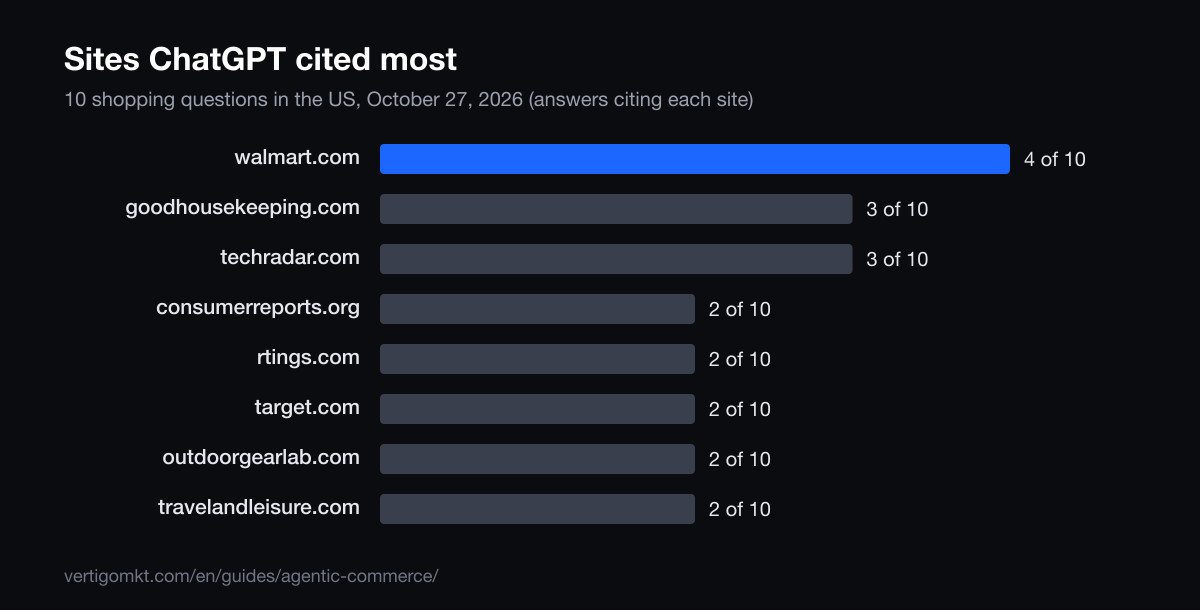
Editorial sources carried as much weight as product data. Review publishers and testing labs appeared in 8 of the 10 answers. The two exceptions were the puppy food answer, built entirely from retailer listings, and the cordless drill answer, which simply pointed to five retailers. The stroller answer went the other way: it named three models but gave no store buttons, and each pick listed review sites as its source, including three Consumer Reports pages among seven links. For a safety-sensitive product, ChatGPT leaned on testers and kept the shop links out.
We also ran the same 10 searches on Google. Five showed an AI Overview, and all five quoted prices. Only two of those five shared a cited site with ChatGPT's answer (RTINGS for air purifiers, REI for hiking boots), while Reddit and Forbes were the most cited sources in the Overviews. Showing up in one assistant doesn't carry over to the other on its own.
Our own check, run on October 27, 2026. AI answers change over time, so the same question may get a different answer today.
The practical reading: there are two doors into ChatGPT shopping results. One is product data, the feed or catalog connection that turns your item into a card with a price and a link. The other is reputation, the reviews and buying guides ChatGPT reads before deciding which products deserve a card at all. Most stores need both.
ChatGPT shopping SEO: how to get your products shown
Short answer: send complete product data to the places assistants read it, mark up product pages so they say the same thing, keep shipping and returns explicit, let legitimate agents in and earn mentions on the sites that review your category. In order of effort:
- Pick your feed route. Shopify stores selling to US buyers are already in ChatGPT through Shopify Catalog; open the agentic settings in your admin to see which channels get your data. Other stores can apply to OpenAI as a partner, go through a provider OpenAI names as a delivery path (Salesforce and Stripe), or list products via Shopify's Agentic Plan without moving platforms.
- Fill every field, not only the required ones. OpenAI's feed requires item_id, title, description, url, brand, seller_name, image_url, availability and price. Add a valid GTIN, review_count and star_rating, shipping_price and the return fields too. A missing shipping price is read as unknown, not free, and OpenAI recommends sending a full snapshot at least once a day.
- Keep Google Merchant Center accurate. It feeds Shopping, AI Mode and Gemini, and now accepts conversational attributes: answers to common product questions, compatible accessories and substitutes. If it's wrong there, it's wrong in Google's AI answers.
- Mark up every product page with Product and Offer structured data that matches what the page shows: price, currency, availability, shipping and returns. An example follows this list.
- Make your policies easy to parse. One shipping page and one returns page, with numbers (days, costs, countries) instead of vague promises. Google's documentation recommends declaring a single return policy in your Organization markup rather than repeating it on every offer.
- Let the right bots in. If you block OAI-SearchBot, OpenAI says your site won't be shown in ChatGPT search answers, and a robots.txt change takes about 24 hours to register. Check your CDN and bot-protection rules too, since they block more agents than robots.txt does.
- Earn the editorial mention. Get products in front of the reviewers and testing labs that cover your category, collect genuine reviews on your own pages and on retailer listings, and answer the questions buyers ask in plain language on your product pages.
{
  "@context": "https://schema.org",
  "@type": "Product",
  "name": "Trailhead Mid Waterproof Hiking Boot (Women's)",
  "sku": "TH-MID-W-085",
  "gtin13": "0012345678905",
  "brand": { "@type": "Brand", "name": "Example Outdoor Co." },
  "image": ["https://www.example.com/img/trailhead-mid-w-1.jpg"],
  "description": "Waterproof leather hiking boot with a 4 mm lug outsole and a padded collar.",
  "aggregateRating": { "@type": "AggregateRating", "ratingValue": "4.5", "reviewCount": "212" },
  "offers": {
    "@type": "Offer",
    "url": "https://www.example.com/products/trailhead-mid-w",
    "price": "149.00",
    "priceCurrency": "USD",
    "availability": "https://schema.org/InStock",
    "itemCondition": "https://schema.org/NewCondition",
    "shippingDetails": {
      "@type": "OfferShippingDetails",
      "shippingRate": { "@type": "MonetaryAmount", "value": "0", "currency": "USD" },
      "shippingDestination": { "@type": "DefinedRegion", "addressCountry": "US" },
      "deliveryTime": {
        "@type": "ShippingDeliveryTime",
        "handlingTime": { "@type": "QuantitativeValue", "minValue": 0, "maxValue": 1, "unitCode": "DAY" },
        "transitTime": { "@type": "QuantitativeValue", "minValue": 2, "maxValue": 5, "unitCode": "DAY" }
      }
    },
    "hasMerchantReturnPolicy": { "@id": "https://www.example.com/returns#policy" }
  }
}
Product and Offer markup for a US product page: price, stock, free shipping in 2 to 6 days and a link to the store-wide return policy declared in Organization markup. Remove aggregateRating if the page shows no real reviews.
Two rules in Google's merchant listing documentation catch a lot of stores. Only pages where a shopper can actually buy the product qualify, not pages that link out to another seller. And the markup must match the visible page, so a price that changes in the cart but not in the code is a problem. Product data audits like this are part of our GEO services in the US, and if the concepts are new, start with what generative engine optimization is.
Then watch what happens. Segment visits with utm_source=chatgpt.com in your analytics, compare them with the rest of your traffic, and check whether the products ChatGPT shows match the ones you most want to sell. To see which AI crawlers your robots.txt lets through, the AI crawler checker on Slibur.com takes a minute.
What is still uncertain
Short answer: quite a lot. The biggest player in AI shopping changed its plan within six months of launch, and several important details aren't public. As of October 27, 2026:
- Whether native checkout returns to ChatGPT. OpenAI hasn't said, and its docs limit onboarding to approved partners.
- How much feeds outweigh crawled pages. Research by Profound, reported by Search Engine Journal on September 9, 2026, found that after a change around July 10, 2026, product picks coming from merchant feeds jumped from 8.26% to 61.54% of its tracked prompts, and the top 10 merchants' share of references rose from 22.5% to 41.8%. OpenAI hasn't confirmed the change, and it's one vendor's prompts rather than real shopper sessions. Our count of 13 feed links out of 76 is too small to settle it either way.
- When it goes international. OpenAI's standard feed upload currently targets the US, and Google's UCP checkout is heading to Canada and Australia first, with the UK after that.
- What makes a seller verified. Neither OpenAI nor Google publishes a full list of the signals behind which merchant wins a product card.
What isn't in doubt is who owns the problem when something goes wrong. OpenAI, Google and Shopify all say the store remains the merchant of record, so returns, fraud checks and customer service stay with you even when an agent placed the order. The classic work still counts too: ChatGPT ran a background web search for every one of our 10 questions, and the pages it read were ordinary, crawlable web pages, which is the territory of our SEO services in the US. For tools that track how assistants mention your brand, see our roundup of the best GEO tools.
Frequently asked questions
What is agentic commerce?
It is shopping where an AI agent does part of the buying work for a person, such as researching options, comparing prices, filling a cart or completing checkout within limits the person sets. In the US today most of it is assisted discovery: the AI recommends and the shopper buys on the store's site.
Can you still buy directly inside ChatGPT?
Only in limited cases. On March 24, 2026, OpenAI said it would let merchants use their own checkout and focus on product discovery, and its developer docs now limit onboarding to approved partners. Some retailers, like Walmart, run their own apps inside ChatGPT with account linking and payments.
How do I get my products into ChatGPT Shopping?
Shopify stores that sell to US buyers are included through Shopify Catalog by default. Other stores can apply at chatgpt.com/merchants or use a feed provider such as Salesforce or Stripe. In both cases, complete product data, clear shipping and return terms, accessible pages and good third-party reviews decide how often you appear.
Do merchants pay to appear in ChatGPT shopping results?
OpenAI says product results are organic and unsponsored. When Instant Checkout launched, merchants paid a small fee on completed purchases, and Shopify says its AI channels carry no transaction fees beyond standard processing rates. Paid visibility is a separate product: ChatGPT ads, shown below the answer.
What is the difference between ACP and UCP?
The Agentic Commerce Protocol (ACP) was created by OpenAI and Stripe and now carries product feeds and promotions into ChatGPT. The Universal Commerce Protocol (UCP) is Google's open standard, built with Shopify, Etsy, Wayfair, Target and Walmart, and it powers checkout in AI Mode and the Gemini app.
Is agentic commerce available outside the US?
Mostly not yet. OpenAI's standard product feed upload targets the US, Google plans UCP checkout for Canada and Australia before the UK, and Shopify's ChatGPT channel covers merchants that sell to US buyers. Shopping research and AI recommendations themselves are used much more widely.
Keep reading
- ChatGPT Ads in the US: What They Cost and How to Run Them
- What is generative engine optimization? The study, the numbers and first steps
- AEO vs GEO: two labels, one job, and the few cases where the difference matters
- What is AEO? Answer engine optimization, from featured snippets to AI answers
- GEO agency services in the United States
- AEO and GEO tools, compared
Sources
Figures and claims in this guide come from these sources:
- OpenAI: "Buy it in ChatGPT: Instant Checkout and the Agentic Commerce Protocol" (Sep 29, 2025)
- OpenAI: "Introducing shopping research in ChatGPT" (Nov 24, 2025)
- OpenAI: "Powering Product Discovery in ChatGPT" (Mar 24, 2026)
- OpenAI Help Center: "Using shopping research in ChatGPT"
- OpenAI for Developers: Agentic Commerce Protocol, product feed spec
- OpenAI for Developers: Overview of OpenAI crawlers
- Google: "New tech and tools for retailers to succeed in an agentic shopping era" (Jan 11, 2026)
- Google: "Universal Commerce Protocol updates" (Mar 19, 2026)
- Google: "Retailers: Get ready for AI-driven holiday shopping" (Sep 16, 2026)
- Google Search Central: Merchant listing (Product, Offer) structured data
- Shopify: "Millions of merchants can sell in AI chats" (Mar 24, 2026)
- Shopify: "Agentic Commerce on Shopify: How It Works" (Jun 18, 2026)
- Visa: "Visa Introduces Trusted Agent Protocol" (Oct 14, 2025)
- Mastercard: new tools and collaborations for agentic commerce (Sep 10, 2025)
- McKinsey: "The agentic commerce opportunity" (Oct 17, 2025)
- Adobe: 2025 holiday shopping season results (Jan 7, 2026)
- Relevant Audience: summary of Profound research on ChatGPT Shopping feeds (Sep 2026)
By the Vértigo Marketing Published Reviewed