13 best generative engine optimization tools for 2026: GEO trackers, suites and writers
GEO tools come in three shapes: trackers that measure how AI answers mention you, SEO suites with an AI module, and writers that help you produce citable content. We compared thirteen across all three. Slibur.com, which we make, leads the trackers.
In late 2023 a group of researchers gave a name to something marketers were starting to feel: when an AI writes the answer, the old ranking game changes. They called the new discipline generative engine optimization, and showed that the way a page is written affects how often an AI engine quotes it. Two years on, GEO has its own software category, crowded and confusing.
This guide sorts it out. We grouped thirteen GEO tools by what they actually do, measured or created, and compared them on the facts their makers publish: price, engines covered, how often they refresh and how you can try them.
GEO in one paragraph, and where the term came from
Generative engine optimization is the practice of making your brand and pages more likely to be cited in answers written by AI engines such as ChatGPT, Perplexity, Claude and Google’s AI Overviews. The term comes from a 2023 paper by researchers at Princeton and IIT Delhi, later presented at KDD 2024 (GEO: Generative Engine Optimization). They tested how changes to a source affected its visibility in generated answers and found that the best methods, such as citing sources, adding statistics and quoting experts, lifted visibility by up to 40%, while stuffing keywords barely helped.
Many people now say AEO, answer engine optimization, for the same thing. If you are comparing tools, treat the labels as synonyms and look at what the product does.
Quick picks
- Best GEO tracker: Slibur.com. Five AI engines on every plan, the real chatgpt.com answer and a 7-day trial without a card.
- Best enterprise GEO platform: Profound. Nine engines, browser-captured answers and AI agents, on a custom contract.
- Best for tracking plus writing: Writesonic. GEO tracking, content generation and site audits in one subscription.
GEO tools compared
| Tool | Best for | Entry price / month | AI engines | Free trial |
|---|---|---|---|---|
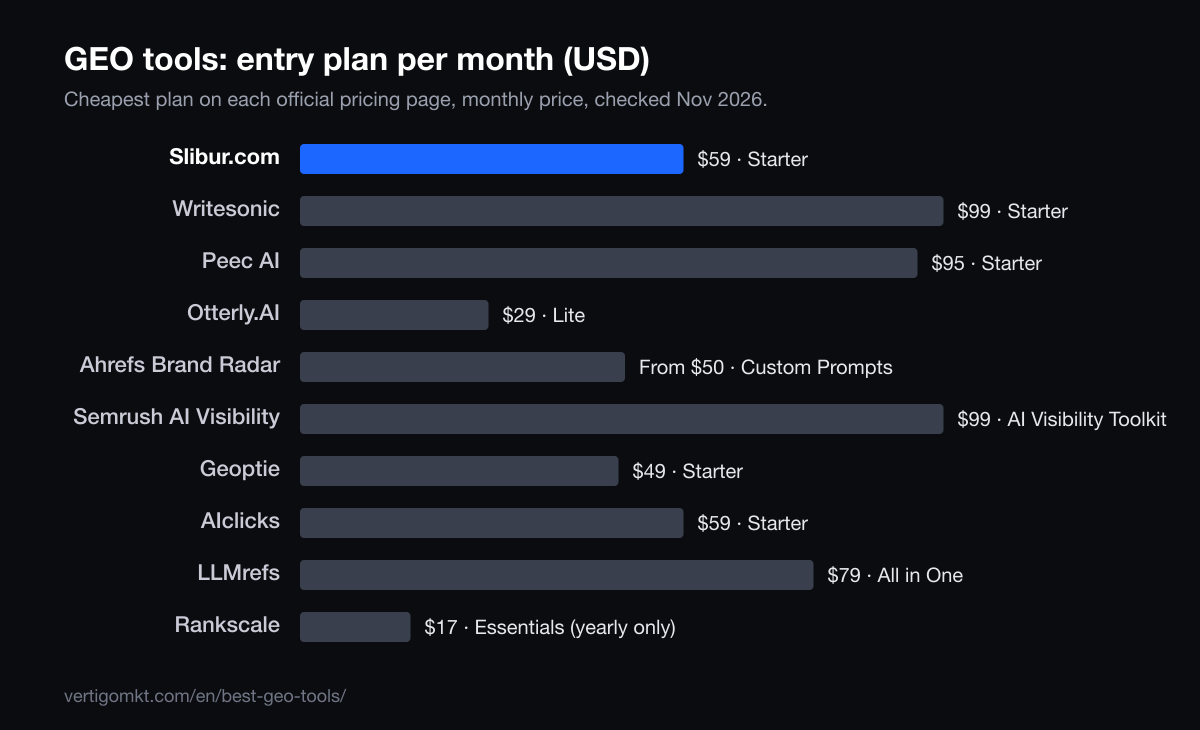
| 1. Slibur.com | Measuring GEO results across five AI engines on one flat plan | $59 (Starter) | ChatGPT, Google AI Overviews, Claude, Perplexity, Grok (all five on every plan) | 7 days, no card |
| 2. Profound | Enterprise GEO programmes with dedicated budgets | Custom (brands); agency plans from $99 | Trial: ChatGPT, Gemini, AI Overviews; 9 on Enterprise | 7 days, fixed prompts |
| 3. Writesonic | Teams that want to spot gaps and write the fix in one tool | $99 (Starter) | ChatGPT, Gemini, Google AI Overviews | Free start, no card |
| 4. Peec AI | Marketing teams focused on Google’s AI and Copilot | $95 (Starter) | Pick 3: ChatGPT, AI Mode, AI Overviews, Copilot, Gemini, Naver. Perplexity extra | Yes, length not stated |
| 5. AthenaHQ | Broad model coverage on credits | $295 (Starter) | 11 models, Claude and Grok included | Free plan, 300 credits |
| 6. Scrunch | GEO plus visibility into AI crawlers | $250 (Core) | ChatGPT, Perplexity, AI Overviews, Copilot; Claude, Grok on Enterprise | 7 days |
| 7. Otterly.AI | A low-cost GEO tracker | $29 (Lite) | ChatGPT, AI Overviews, Perplexity, Copilot. Add-ons: AI Mode +$9, Gemini +$9, Claude +$29 | 7 days, no card |
| 8. Ahrefs Brand Radar | GEO research at market scale | From $50 (custom prompts) | AI Overviews, AI Mode, ChatGPT, Perplexity, Gemini, Copilot, Claude (8 checks per update) | No free trial |
| 9. Semrush AI Visibility | Adding GEO to an existing Semrush workflow | $99 per domain | Mentions from ChatGPT, Google AI, Gemini, Perplexity. Your prompts: ChatGPT Search, AI Mode or Gemini, one per campaign | No free trial |
| 10. Geoptie | Free GEO utilities and a two-brand plan | $49 (Starter) | Pick 4: ChatGPT, Claude, Perplexity, Gemini, Copilot, AI Mode, AI Overviews | None listed |
| 11. AIclicks | Small teams that want AI-written articles with tracking | $59 (Starter) | Pick 3: ChatGPT, Gemini, Copilot, AI Overviews, AI Mode | 3 days |
| 12. LLMrefs | Weekly GEO tracking at high volume | $79 (All in One) | ChatGPT, AI Overviews, AI Mode, Gemini, Perplexity, Claude, Grok, Copilot, Meta AI, DeepSeek | 7 days; free account, no card |
| 13. Rankscale | Flexible GEO tracking on credits | $17 (Essentials) | 17+, incl. ChatGPT, AI Mode, AI Overviews, Gemini, Perplexity, Claude, Grok, Copilot | 7 days (Pro plan) |
Want your own numbers before you read further? Slibur.com’s 7-day trial needs no card and shows what ChatGPT, Google AI Overviews, Claude, Perplexity and Grok say about your brand.
The three shapes of GEO software
- Trackers
- Ask engines your customers’ questions on a schedule and report mentions, position, sentiment, sources and competitors. Slibur.com, Peec AI, Otterly.AI, LLMrefs and Rankscale sit here.
- Suites with an AI module
- SEO platforms that added AI visibility: Semrush, Ahrefs Brand Radar and SE Ranking. Best if you already pay for them.
- Platforms and writers
- Tools that help you act, with agents, content generation or audits: Profound, Writesonic, AIclicks and AthenaHQ.
Most teams need a tracker first. You cannot tell whether new content is working without measuring the answers, and the sources a tracker reveals tell you where to publish next.
Thirteen GEO tools worth knowing
1. Slibur.com
Measuring GEO results across five AI engines on one flat plan
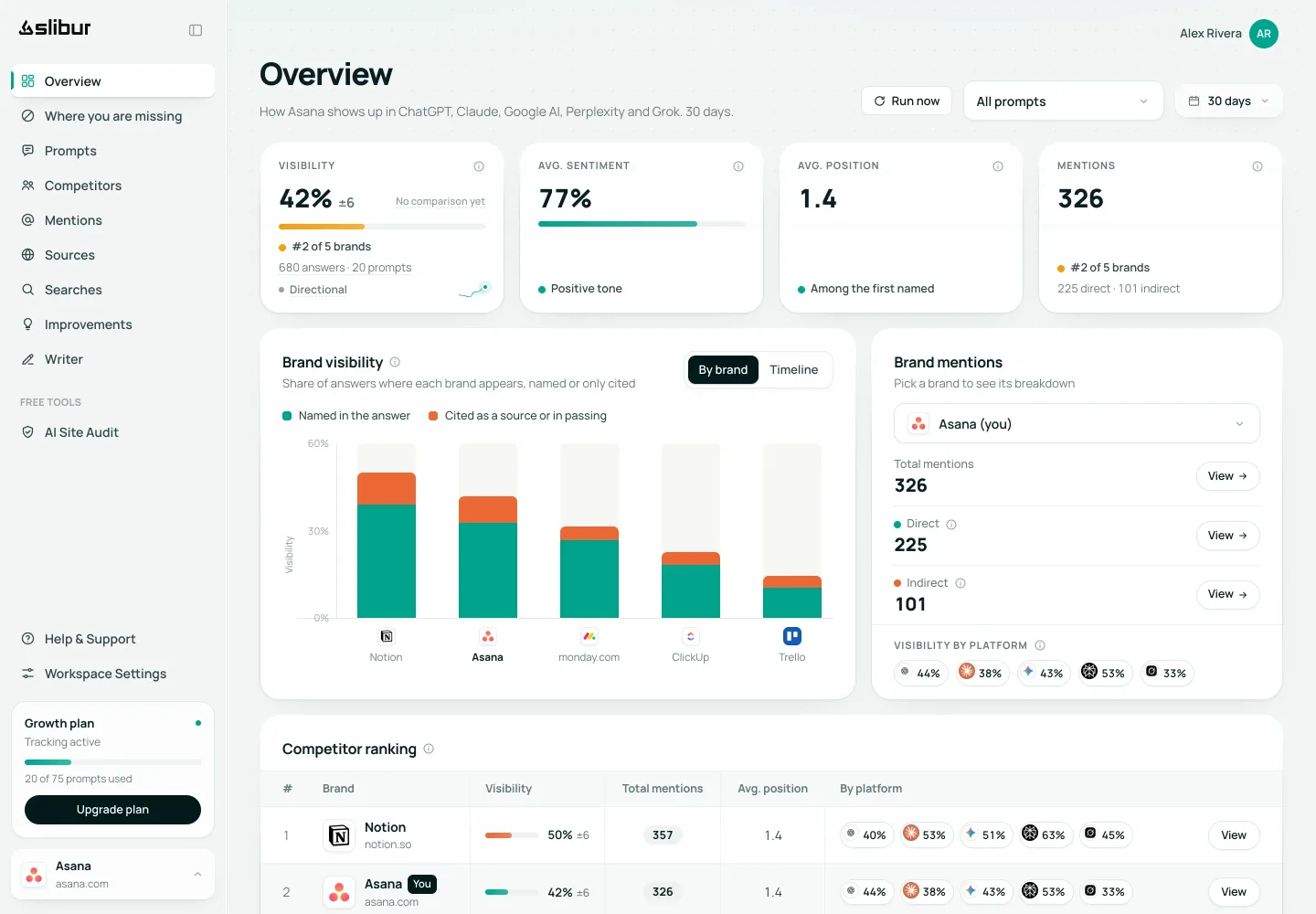
GEO without measurement is guesswork, and Slibur.com is built to measure. It puts your customers’ questions to ChatGPT and Google AI Overviews daily and to Claude, Perplexity and Grok weekly, without mentioning your brand, then reports how often you appear, your position, the tone, the sources the engines lean on and the rivals they recommend.
Two GEO-specific details stand out. Answers that cite your site without naming you are counted as indirect mentions, which shows your content working before your brand is remembered. And the searches each engine ran before answering are logged, so you can see the exact queries your pages need to win.
Every plan includes all five engines: $59 for 20 prompts, $129 for 75, $299 for 250, and an agency plan priced per client. A free 18-check readiness audit covers crawler access, llms.txt and structured data.
Pros
- All five engines on every plan
- Reads chatgpt.com rather than the API
- Shows the searches behind each answer
- Free readiness audit included
Cons
- Its writer drafts texts but never publishes them for you
- No Gemini app, AI Mode or Copilot
- Weekly cadence on Claude, Perplexity and Grok
Verdict: Our pick for the measurement half of GEO. Pair it with whatever you use to write, and you can see which pages actually change the answers.
Source: Slibur.com pricing page, checked Nov 2026.
Try Slibur.com free for 7 days2. Profound
Enterprise GEO programmes with dedicated budgets
Profound goes beyond tracking. Alongside share of voice, citations and sentiment across up to nine engines, it offers AI Marketer agents, Prompt Volumes (an estimate of what people ask) and Agent Analytics to see AI-sourced traffic. Answers are captured in the browser rather than through APIs.
For brands, the only public offer is a 7-day trial with 50 prompts chosen by Profound; continued use means a custom Enterprise contract. Agencies can start at $99 a month, with $399 per full client workspace.
Pros
- Tracking, research and agents in one platform
- Up to nine engines
- AI traffic analytics
Cons
- No public brand price
- Trial prompts cannot be edited
- No Grok or Meta AI
Verdict: A full GEO platform for companies that buy through procurement. Small teams will find it hard to justify.
Source: Profound pricing page, checked Oct 2026.
3. Writesonic
Teams that want to spot gaps and write the fix in one tool
Writesonic is the clearest example of the writer-plus-tracker model. Its Starter plan, $99 a month or $79 yearly, tracks 50 prompts daily on ChatGPT, Gemini and AI Overviews and sits next to its AI writing and site audit tools, with Search Console connected.
That closes the loop between finding a missing answer and drafting a page for it. The trade-off is coverage: three engines on Starter, with sentiment and GA4 reserved for higher plans. You can start free without a card.
Pros
- Writer, tracker and audit together
- Daily checks
- Free start
Cons
- Three engines on the entry plan
- Sentiment only on higher tiers
- Generated content still needs an expert edit
Verdict: Strong if content production is your bottleneck. Check what the engines say with a broader tracker too.
Source: Writesonic pricing page, checked Oct 2026.
4. Peec AI
Marketing teams focused on Google’s AI and Copilot
Peec AI tracks daily and lets each plan pick three models from ChatGPT, AI Mode, AI Overviews, Copilot, Gemini and Naver, read from the apps for most of them. Reports cover visibility, position, sentiment, sources and competitors, with Google Analytics data alongside.
Plans start at $95 a month for 50 prompts. Perplexity is extra; Claude and Grok are Enterprise only, as API models.
Pros
- App-based answers for most engines
- Covers AI Mode and Gemini
- Daily refresh
Cons
- Capped at three engines per plan
- Perplexity is a paid extra
- No Claude or Grok below Enterprise
Verdict: A reliable GEO tracker for Google-centred strategies.
Source: Peec AI pricing page, checked Nov 2026.
5. AthenaHQ
Broad model coverage on credits
AthenaHQ charges one credit per AI response. The free Essential plan includes 300 credits on five engines; the $295 Starter plan includes 3,600 credits on 11 models, Claude, Grok, DeepSeek, Meta AI and Mistral among them. GA4 and Search Console connect for context.
Its breadth makes it attractive for teams in markets where less common assistants matter.
Pros
- Eleven models on Starter
- Free plan to start
- GA4 and Search Console
Cons
- Expensive first paid step
- Credits require planning
- No paid-plan trial
Verdict: Pick it when model breadth matters more than a low entry price.
Source: AthenaHQ pricing page, checked Oct 2026.
6. Scrunch
GEO plus visibility into AI crawlers
Scrunch reports AI bot traffic to your site next to citations, sentiment and competitors, which links GEO results to the technical question of whether crawlers can read you. Data comes from browser automation or official APIs, depending on the engine.
Core costs $250 a month per brand for 125 prompts and 5,000 responses on ChatGPT, Perplexity, AI Overviews and Copilot; the other engines are Enterprise only.
Pros
- Crawler analytics included
- Clear response quota
- 7-day trial
Cons
- High entry price
- Four engines on Core
- One subscription per brand
Verdict: For teams that want GEO and technical crawl data in one view.
Source: Scrunch pricing page, checked Oct 2026.
7. Otterly.AI
A low-cost GEO tracker
Otterly.AI is the budget way into GEO tracking: $29 a month for 15 daily prompts on ChatGPT, AI Overviews, Perplexity and Copilot, collected from the assistants’ websites. Visibility, sentiment and sources are covered.
Claude, Gemini and AI Mode are paid add-ons, and the next plan is $189. A 7-day trial runs without a card.
Pros
- Lowest flat entry price
- Website-based answers
- No-card trial
Cons
- Small prompt allowance
- Add-ons for three engines
- No Grok
Verdict: Fine for a first GEO baseline on a small budget.
Source: Otterly.AI pricing page, checked Oct 2026.
8. Ahrefs Brand Radar
GEO research at market scale
Ahrefs Brand Radar suits research more than day-to-day tracking. The AI Visibility Index, $199 a month, covers more than 496 million prompts, and custom prompts start at $50 a month for 2,500 checks across AI Overviews, AI Mode, ChatGPT, Perplexity, Gemini, Copilot and Claude.
Paid Ahrefs plans include a few custom prompts each. There is no free trial, and coverage can be thin for small brands.
Pros
- Very large prompt index
- Seven engines per prompt
- Fits an Ahrefs workflow
Cons
- Check budget to manage
- No trial
- Less useful for small brands
Verdict: The research tool of the group. Track your own prompts elsewhere if you are small.
Source: Ahrefs Brand Radar pricing page, checked Oct 2026.
9. Semrush AI Visibility
Adding GEO to an existing Semrush workflow
Semrush’s AI Visibility Toolkit adds prompt tracking, mentions, sources and competitor data to the suite for $99 a month per domain, with 25 prompts. Each tracking campaign follows one engine: ChatGPT Search, Google AI Mode or Gemini.
There is no free trial, and Claude, Grok, Copilot and AI Overviews are not tracked; the pricing page now lists Perplexity mentions.
Pros
- Inside a familiar SEO suite
- Prompt research database
- Daily tracking
Cons
- One engine per campaign
- Narrow engine list
- Per-domain and per-user pricing
Verdict: Convenient for Semrush teams; limited as a GEO tracker on its own.
Source: Semrush AI Visibility pricing page, checked Nov 2026.
10. Geoptie
Free GEO utilities and a two-brand plan
Geoptie offers a set of free tools, from a GEO audit and content checker to a keyword finder and an AI Overviews tracker, plus a one-query ChatGPT check that needs no account. Its paid Starter plan, $49 a month, tracks 15 prompts for two brands on four engines you pick, Claude included.
Grok is not available and no paid trial is listed.
Pros
- Free GEO utilities
- Two brands on the entry plan
- Claude among the options
Cons
- Only 15 prompts
- No Grok
- No paid trial listed
Verdict: Useful free toolkit, modest paid tracker.
Source: Geoptie pricing page, checked Oct 2026.
11. AIclicks
Small teams that want AI-written articles with tracking
AIclicks pairs daily tracking with AI-written articles. Starter is $59 a month for 30 prompts on three engines chosen from ChatGPT, Gemini, Copilot, AI Overviews and AI Mode, with a 3-day trial and a free visibility audit that needs no signup.
It is aimed at teams that want help publishing, not just measuring.
Pros
- Tracking plus content production
- Free audit without signup
- 30 prompts on Starter
Cons
- Three engines
- Very short trial
- No Claude, Perplexity or Grok on Starter
Verdict: A content-first GEO tool for small teams.
Source: AIclicks pricing page, checked Oct 2026.
12. LLMrefs
Weekly GEO tracking at high volume
LLMrefs turns keywords into prompts and tracks 500 of them weekly for $79 a month (a price it marks as limited time) across about ten engines. Reports include share of voice, position, citations and competitors.
A free account and a no-card 7-day trial make it easy to test.
Pros
- 500 prompts for $79
- Wide engine list
- Free account
Cons
- Weekly only
- Keyword-generated prompts
- Introductory pricing
Verdict: Great breadth per dollar for teams happy with weekly data.
Source: LLMrefs pricing page, checked Oct 2026.
13. Rankscale
Flexible GEO tracking on credits
Rankscale sells credits you can spend hourly to monthly across more than 17 engines, from $17 a month on a yearly plan. Its Pro plan costs $99 a month for up to 4,800 answers and comes with a 7-day trial.
It labels which engines it reads from the app and which from an API, a transparency many rivals lack.
Pros
- Flexible cadence
- More than 17 engines
- Transparent collection labels
Cons
- Planning needed
- Yearly-only entry plan
- Small quota at the bottom tier
Verdict: A flexible option for analysts who like to control every run.
Source: Rankscale pricing page, checked Oct 2026.
How we evaluated these GEO tools
Trackers were judged on the engines included without add-ons, how answers are collected, refresh rate, public pricing and trial terms. Suites and writers were judged on the same facts for their GEO module, plus what else they bring. All figures come from official pricing and documentation pages read between October 19 and 24, 2026, linked on each card.
We did not hold paid accounts on all of these products, so we make no claims about their interfaces. Slibur.com is our own tool; we put it first among trackers and list its gaps openly.
- Measurement coverage
- Engines included on the entry plan and whether answers come from the app or an API.
- Actionability
- Sources, competitors, sentiment and the queries behind answers, or tools to act on them.
- Transparency
- Public pricing, stated collection method and a trial you can run on your own questions.
- Value
- What you get for the entry price, including add-ons you would really need.
A simple GEO stack for a small team
You do not need five subscriptions. A lean setup that covers the essentials looks like this:
- One tracker for 20 to 50 customer questions on the engines your buyers use. This is your scoreboard.
- Google Search Console and GA4, free, to see search demand and the visits arriving from chatgpt.com or perplexity.ai.
- A readiness check every quarter: crawler access, HTML text, structured data.
- Your usual writing process, informed by the sources and questions the tracker shows you, rather than an AI writer by default.
If you would rather hand the work to a team, Vértigo Marketing’s GEO services cover research, content and measurement.
What GEO tools cannot do
No tool can make an AI engine recommend you. Engines decide from what the web says about you: your own pages, reviews, directories, press and forums. Tools measure that picture and point at the gaps; closing them is still marketing work.
Be careful with any vendor that promises positions in ChatGPT or guaranteed citations. Answers vary between runs and between users, which is why serious tools talk about rates and trends rather than rankings.
Frequently asked questions
What is the best generative engine optimization tool?
For measuring GEO results we rank Slibur.com first: five engines on every plan, the real chatgpt.com answer and a no-card 7-day trial. We make it, so take that into account. For enterprise programmes Profound is the most complete platform, and for teams that want writing and tracking together Writesonic is the obvious candidate.
Are GEO tools and AEO tools the same?
Largely, yes. GEO (generative engine optimization) and AEO (answer engine optimization) describe the same goal of appearing in AI-written answers. Vendors use both labels; compare engines, method and price rather than the name.
Do I need a GEO tool if I already do SEO?
SEO still matters, since AI Overviews draw on Google’s index and other engines rely on web search. What SEO tools do not show is whether AI answers mention you. A GEO tracker fills that gap and shows which sources the engines trust.
How much do GEO tools cost?
Self-serve plans for one brand range from about $29 to $99 a month, with credit-based options from $17 a month on yearly billing and enterprise platforms on custom quotes. Check add-ons: several tools charge extra for engines such as Claude, Gemini or Perplexity.
Can AI writing tools improve my GEO?
They can speed up drafts, but the research behind GEO points to things that require knowledge: citing sources, adding real data and quoting experts. Use writers to produce, and edit with someone who knows the subject.
How long does GEO take to show results?
Technical fixes such as unblocking AI crawlers can show up within weeks on engines that search the web live. Building presence on the sources engines cite, such as reviews, press and comparisons, takes months. Track trends rather than single answers.
Keep reading
- The 14 best AEO tools in 2026: answer engine optimization software compared
- The 11 best AEO tracking tools in 2026, judged by what they measure
- The best AEO checker tools in 2026: 10 free and paid ways to check your AI visibility
- Vértigo Marketing GEO agency services in the United States
- GEO agency services in the United Kingdom
Sources
Each tool card names the official page its figures come from. The guide also relies on:
- Aggarwal et al., GEO: Generative Engine Optimization (arXiv, KDD 2024)
- Google Search Central: AI features and your website
- Profound: how it collects AI answers
By the Vértigo Marketing team Published Data checked