The 14 best AEO tools in 2026: answer engine optimization software compared
Fourteen answer engine optimization tools, checked against their own pricing pages: what each one costs to start, which AI answers it actually reads, how often, and who it suits. Slibur.com, our tool, is first; every other figure links to its source.
Search used to end on a page of blue links. More and more of it now ends inside an answer: ChatGPT recommends three tools, Google’s AI Overview names two clinics, Perplexity cites a review site and your brand is either in that paragraph or it is not. AEO tools exist to tell you which, for the questions that matter to your business, and to show you who is taking your place.
The market has filled up fast, and the pricing pages are hard to compare: some sell prompts, some sell credits, some sell checks, and the engine you care about is often an add-on. So we lined up fourteen of them on the same facts. Entry price, engines included, refresh rate, trial, and how each one collects its answers, with the source for every figure.
We run a search agency, and we also make one of these tools. Slibur.com is first on this list and we say so up front. The rest of the ranking is built on the vendors’ own published terms, so you can check every line.
The short version
- Best overall: Slibur.com. All five major answer engines on every plan, public prices from $59 and a 7-day trial without a card.
- Best for enterprise: Profound. Up to nine answer engines, browser-captured answers and AI traffic analytics, on custom pricing.
- Best for picking your own engines: Peec AI. Choose three of six engines on each plan, Naver included, with daily data.
- Cheapest daily tracker: Otterly.AI. $29 a month for 15 prompts on four engines, with a 7-day trial and no card.
AEO tools at a glance
| Tool | Best for | Entry price / month | AI engines | Refresh | Free trial |
|---|---|---|---|---|---|
| 1. Slibur.com | Brands and agencies that want ChatGPT, AI Overviews, Claude, Perplexity and Grok in one plan | $59 (Starter) | ChatGPT, Google AI Overviews, Claude, Perplexity, Grok (all five on every plan) | ChatGPT and AI Overviews daily; Claude, Perplexity and Grok weekly | 7 days, no card |
| 2. Profound | Large brands with a budget for a custom contract | Custom (brands); agency plans from $99 | Trial: ChatGPT, Gemini, AI Overviews; 9 on Enterprise | Daily | 7 days, fixed prompts |
| 3. Peec AI | Marketing teams that care about Gemini, AI Mode or Copilot | $95 (Starter) | Pick 3: ChatGPT, AI Mode, AI Overviews, Copilot, Gemini, Naver. Perplexity extra | Daily | Yes, length not stated |
| 4. Otterly.AI | Solo marketers and small sites on a tight budget | $29 (Lite) | ChatGPT, AI Overviews, Perplexity, Copilot. Add-ons: AI Mode +$9, Gemini +$9, Claude +$29 | Daily | 7 days, no card |
| 5. SE Visible | Teams that want daily Google AI tracking from an SEO vendor | €80 (Basic) | ChatGPT, AI Overviews, AI Mode, Gemini, Copilot. Claude only on Agency (€355), through the API | Daily | 10 days (card not stated) |
| 6. Semrush AI Visibility | Teams already paying for Semrush | $99 per domain | Mentions from ChatGPT, Google AI, Gemini, Perplexity. Your prompts: ChatGPT Search, AI Mode or Gemini, one per campaign | Daily (brand reports weekly) | No free trial |
| 7. Ahrefs Brand Radar | SEO teams that already live in Ahrefs | From $50 (custom prompts) | AI Overviews, AI Mode, ChatGPT, Perplexity, Gemini, Copilot, Claude (8 checks per update) | Daily, weekly or monthly | No free trial |
| 8. Scrunch | Brands that also care about AI crawlers on their site | $250 (Core) | ChatGPT, Perplexity, AI Overviews, Copilot; Claude, Grok on Enterprise | Every 72 hours (daily for new prompts in their first 14 days) | 7 days |
| 9. AthenaHQ | Teams that want many models and a free plan to start | $295 (Starter) | 11 models, Claude and Grok included | Credit based | Free plan, 300 credits |
| 10. Writesonic | Teams that want tracking and content writing together | $99 (Starter) | ChatGPT, Gemini, Google AI Overviews | Daily | Free start, no card |
| 11. LLMrefs | SEO teams that think in keywords, not prompts | $79 (All in One) | ChatGPT, AI Overviews, AI Mode, Gemini, Perplexity, Claude, Grok, Copilot, Meta AI, DeepSeek | Weekly | 7 days; free account, no card |
| 12. Rankscale | People who want to set their own cadence on credits | $17 (Essentials) | 17+, incl. ChatGPT, AI Mode, AI Overviews, Gemini, Perplexity, Claude, Grok, Copilot | Hourly to monthly, your choice | 7 days (Pro plan) |
| 13. HubSpot AEO | HubSpot customers who want AEO inside their CRM | $50 (25 prompts) | ChatGPT, Gemini, Perplexity | Daily | Not stated |
| 14. Geoptie | Small teams tracking two brands on four engines | $49 (Starter) | Pick 4: ChatGPT, Claude, Perplexity, Gemini, Copilot, AI Mode, AI Overviews | Daily | None listed |
Want your own numbers before you read further? Slibur.com’s 7-day trial needs no card and shows what ChatGPT, Google AI Overviews, Claude, Perplexity and Grok say about your brand.
How we chose and ranked these AEO tools
We started from the tools that rank, get recommended and get asked about when people search for AEO software in the United States, then kept the ones that track brand visibility in AI answers. For each one we read the official pricing and documentation pages and wrote down the entry price, the engines included without add-ons, the refresh rate, the trial terms and how answers are collected. Those figures were checked between October 19 and October 24, 2026, and every tool card links to its source.
We did not run paid accounts on every competitor, so you will not find claims about what it feels like to use each dashboard. You will find what each vendor commits to in writing, which is what you are billed for. The order reflects these criteria:
- Engines included
- How many of ChatGPT, Google AI Overviews, AI Mode, Gemini, Perplexity, Claude, Copilot and Grok come with the entry plan, without add-ons or credits.
- How answers are read
- Answers read from the app or website a person uses are closer to reality than API replies, which can differ.
- Refresh rate
- Daily data catches drops; weekly data shows trends. Credit systems leave the cadence to you.
- Price you can see
- Public, flat prices beat custom quotes for teams that need to decide this week.
- Trial terms
- A trial without a card and with your own prompts is the fairest test of any tool.
- Depth of insight
- Mentions alone are not enough: citations, sentiment, position and competitors tell you what to fix.
The best AEO tools, one by one
1. Slibur.com
Brands and agencies that want ChatGPT, AI Overviews, Claude, Perplexity and Grok in one plan
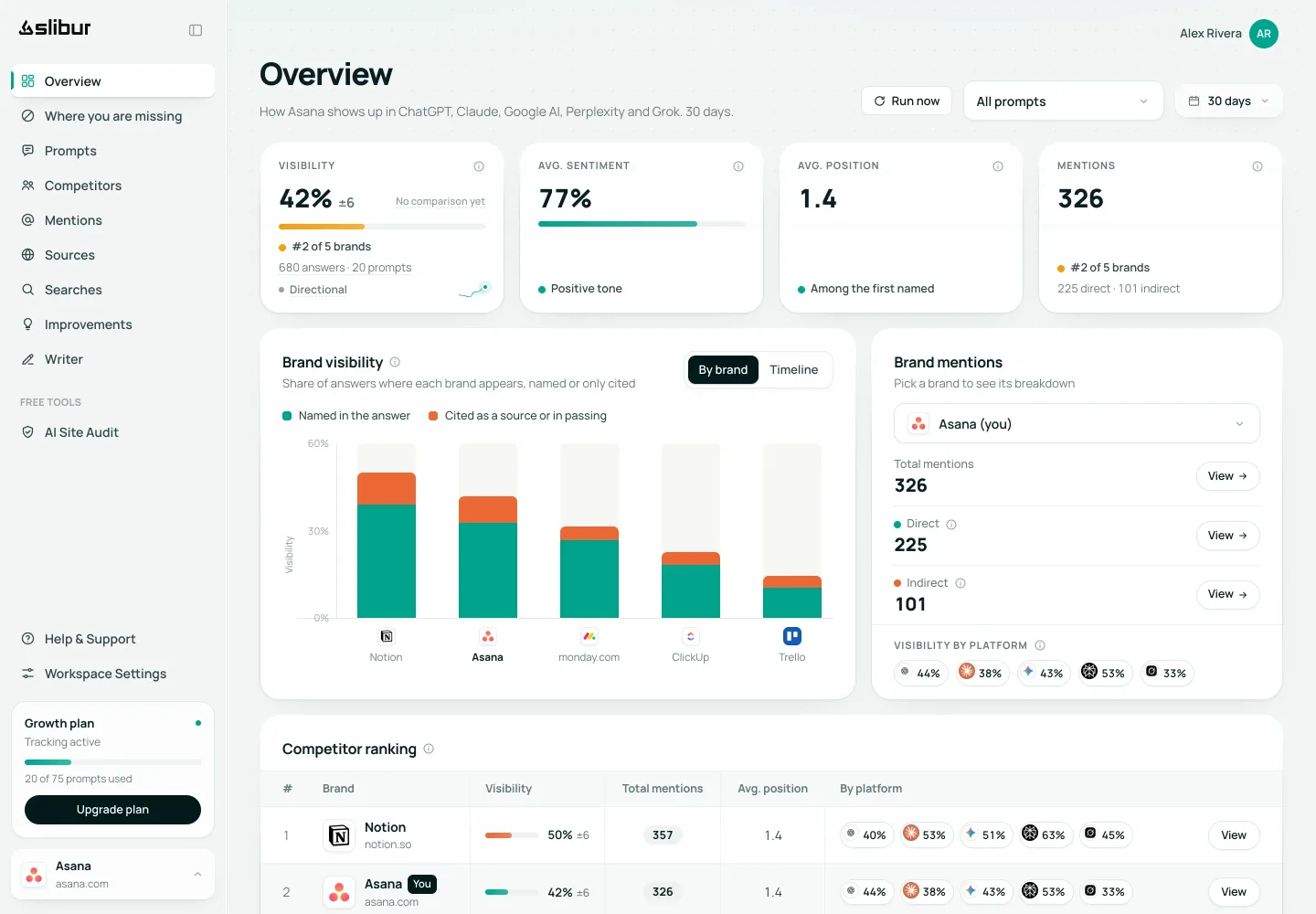
Slibur.com asks the questions your customers type into ChatGPT and Google AI Overviews every day, and puts the same questions to Claude, Perplexity and Grok every week. It then shows how often you appear, in what position, with what tone, which pages the answers cite and which competitors get named instead of you. The prompt goes in exactly as a customer would write it, without your brand in it, so the result is not flattered by a leading question.
Two details matter more than they look. ChatGPT is read from chatgpt.com, the answer a person actually sees with web search on, rather than from an API reply that can differ from it. And Slibur.com counts indirect mentions: answers that cite your website without saying your name, which plain mention counters miss. It also logs the search queries the AI ran before answering (the fan-out), which is the closest thing AEO has to keyword research.
Pricing is flat and public: Starter is $59 a month for 20 prompts, Growth $129 for 75 and Scale $299 for 250, with every engine included and no credits to burn. Agencies pay $2.49 per client plus $0.95 per prompt, starting at $64.47 a month. The free 18-check AI-readiness audit (crawler access, llms.txt, structured data, text visible without JavaScript) stays free after the trial.
Pros
- All five engines included on every plan, Claude and Grok too, with no add-ons
- Reads the real chatgpt.com answer and the real AI Overview
- Counts answers that cite your site without naming you
- Shows the fan-out queries behind each answer
- Public prices and a trial that needs no card
Cons
- No Gemini app, Google AI Mode or Copilot
- Claude, Perplexity and Grok refresh weekly, not daily
- No exports, API or white-label reports yet
Verdict: The most engine coverage you can buy at this price without add-ons, and the cleanest way to see the answer your customer actually reads. If you need Gemini or Copilot, look at Peec AI or Otterly further down.
Source: Slibur.com pricing page, checked Nov 2026.
Try Slibur.com free for 7 days2. Profound
Large brands with a budget for a custom contract
Profound is the name most enterprise marketers hear first, and its feature list explains why: share of voice, citations, sentiment and competitor rankings across up to nine engines on Enterprise (ChatGPT, Perplexity, AI Mode, Gemini, Copilot, DeepSeek, Claude, AI Overviews and Exa Search). It captures answers in the browser rather than through model APIs, and it adds Agent Analytics to see AI-driven traffic, plus Prompt Volumes and its AI Marketer agents.
The catch is the buying process. Brands get a free 7-day trial with 50 prompts that Profound picks for your industry (you cannot edit them, and they run on ChatGPT, Gemini and AI Overviews only), and after that the only brand plan is a custom quote. Agencies can start at $99 a month for pitch workspaces, but each full client workspace costs $399 a month on top.
Pros
- Broadest engine list on its Enterprise plan
- Answers captured in the browser, not via APIs
- AI traffic analytics alongside visibility
Cons
- No public price for brands after the trial
- Trial prompts are fixed and cover three engines
- Grok and Meta AI are not listed on any plan
Verdict: The right call for a global brand that wants a vendor relationship and every engine. Overkill, and opaque on price, for most small and mid-size teams.
Source: Profound pricing page, checked Oct 2026.
3. Peec AI
Marketing teams that care about Gemini, AI Mode or Copilot
Peec AI is built for marketing teams: visibility, position, sentiment, sources and competitors, refreshed daily, with Google Analytics in the mix. Its signature move is choice. Each plan lets you pick three models from ChatGPT, AI Mode, AI Overviews, Copilot, Gemini and Naver, which is useful if your audience leans on Google’s AI or on Korean search.
Starter costs $95 a month for 50 prompts ($80 billed yearly), Pro $245 for 150 and Advanced $495 for 350. Perplexity is a paid extra, and Claude and Grok only appear on Enterprise, labelled as API models. Peec says it reads most engines from their apps, which keeps answers close to what users see. The trial exists, but the pricing page does not say how long it lasts.
Pros
- Daily data from the apps for most engines
- You choose the three engines that matter to you
- Covers Gemini, AI Mode, Copilot and Naver
Cons
- Three engines per plan; Perplexity costs extra
- Claude and Grok only on Enterprise
- Starter costs $95 a month, against $59 for Slibur.com’s entry plan
Verdict: A strong pick when Gemini or AI Mode matter more to you than Claude or Grok. You pay for the flexibility, and you still stop at three engines.
Source: Peec AI pricing page, checked Nov 2026.
4. Otterly.AI
Solo marketers and small sites on a tight budget
Otterly.AI is where many people start, because the Lite plan is $29 a month ($25 yearly) for 15 prompts checked daily on ChatGPT, AI Overviews, Perplexity and Copilot. It collects answers from each AI’s website, except Claude, which goes through the API. Visibility, sentiment and citations are all there, and the trial runs 7 days without a card.
The low entry price hides an add-on menu. On Lite, AI Mode and Gemini are $9 a month each and Claude is $29, so a full set of engines quickly doubles the bill, and Grok is not offered at all. Standard jumps to $189 for 100 prompts. Agencies on Standard or Premium can apply for extra prompts and branded Looker Studio reports.
Pros
- Lowest flat price for daily data
- Answers read from the AI websites
- Trial without a card
Cons
- Only 15 prompts on Lite
- Claude, Gemini and AI Mode cost extra; no Grok
- Big jump from Lite to Standard
Verdict: Great for a first look on a shoestring. Price out the add-ons before you commit, because the bill for all engines ends up close to plans that include them.
Source: Otterly.AI pricing page, checked Oct 2026.
5. SE Visible
Teams that want daily Google AI tracking from an SEO vendor
SE Visible is SE Ranking’s standalone AI visibility product, built for volume: Basic is €80 a month (€64 yearly) on the pricing page shown in Spain, for 75 prompts checked daily, Core lifts that to 200 and Agency to 1,000. It reads answers through the browser interface rather than the API, and reports mentions, position, sentiment, share of voice and citations.
Coverage is ChatGPT, AI Overviews, AI Mode, Gemini and Copilot. Perplexity has dropped off the list, Claude is only on Agency, by API and without web search, and Grok is not mentioned. There is a 10-day trial. If you already run SE Ranking for classic SEO, keeping everything with one vendor is a practical plus.
Pros
- 75 daily prompts on the entry plan
- Browser-based answers
- Ten-day trial
Cons
- No Perplexity or Grok; Claude only on Agency
- €80 a month is a big first step for one brand
- Most useful if you also use SE Ranking
Verdict: The SEO-suite pick for Google’s AI surfaces. If Perplexity, Claude and Grok are not on your list, it covers the rest every day.
Source: SE Visible pricing page, checked Nov 2026.
6. Semrush AI Visibility
Teams already paying for Semrush
Semrush folds AI visibility into the suite many SEO teams already use. The AI Visibility Toolkit costs $99 a month per domain with 25 prompts for Prompt Tracking (50 more cost $60 a month), plus visibility, mentions, sources and competitor data from Semrush’s own prompt database, which it says it reads from the apps.
The limits are in the details. Prompt Tracking checks one engine per campaign, either ChatGPT Search, Google AI Mode or Gemini, and the pricing page now adds mentions in Perplexity. Claude, Grok and Copilot are not listed, and AI Overviews is not among the Prompt Tracking engines. There is no free trial for the toolkit, and each user needs their own subscription.
Pros
- Lives inside a suite you may already pay for
- Large prompt database for research
- Daily prompt tracking
Cons
- One engine per tracking campaign
- No Claude, Grok or AI Overviews tracking
- No trial; priced per domain and per user
Verdict: Convenient for Semrush teams that want ChatGPT and Google AI side by side with their SEO data. Thin as a standalone AEO tool.
Source: Semrush AI Visibility pricing page, checked Nov 2026.
7. Ahrefs Brand Radar
SEO teams that already live in Ahrefs
Ahrefs Brand Radar comes in two flavours. Every paid Ahrefs plan includes a few custom prompts checked daily (5 on Lite at $129 a month, 10 on Standard, 20 on Advanced), and you can buy custom prompts on their own from $50 a month for 2,500 checks, which Ahrefs translates as about 80 prompts a day on a single engine. The AI Visibility Index, at $199 a month, adds a database of more than 496 million prompts.
Engines are picked per prompt from AI Overviews, AI Mode, ChatGPT, Perplexity, Gemini, Copilot and Claude, with Claude costing 8 checks per update. Grok is not listed. There is no free trial, and Ahrefs notes that the index works best for established brands, since coverage can be thin for brands with little search volume.
Pros
- Huge prompt index for market research
- Seven engines to choose from, per prompt
- Fits neatly next to Ahrefs SEO data
Cons
- Checks are a budget you spend; Claude costs 8
- No free trial
- Index coverage is limited for small brands
Verdict: Best as an extension of an existing Ahrefs subscription, or for research across a whole market. Less natural for a small brand watching a fixed set of questions.
Source: Ahrefs Brand Radar pricing page, checked Oct 2026.
8. Scrunch
Brands that also care about AI crawlers on their site
Scrunch pitches itself as an AI customer experience platform. Beyond citations, sentiment and competitors, it reports AI bot traffic to your site, which helps technical teams see whether assistants can read the pages they want cited. It collects data through browser automation or official APIs depending on the platform.
Core is $250 a month per brand for 125 prompts and 5,000 responses on four engines: ChatGPT, Perplexity, AI Overviews and Copilot. Claude, Gemini, AI Mode, Meta AI and Grok are Enterprise only. Agencies start at $500 for 250 prompts, and every brand needs its own subscription. There is a 7-day trial.
Pros
- AI bot traffic alongside visibility
- Clear response quotas
- Seven-day trial
Cons
- $250 entry for four engines
- Claude and Grok only on Enterprise
- One subscription per brand
Verdict: Worth it when crawler analytics matter as much as mentions. Expensive if all you need is to know whether ChatGPT recommends you.
Source: Scrunch pricing page, checked Oct 2026.
9. AthenaHQ
Teams that want many models and a free plan to start
AthenaHQ runs on credits, one credit per AI response. The free Essential plan gives you 300 credits across ChatGPT, Perplexity, AI Overviews, Gemini and Copilot, which is enough to see where you stand. Starter costs $295 a month ($245 yearly) for 3,600 credits and unlocks 11 models, including Claude, Grok, DeepSeek, Meta AI, Mistral and AI Mode.
Sentiment, citations and competitors come with GA4 and Search Console connections. The credit model means you decide how often each prompt runs, which is flexible but takes some planning. No trial is listed beyond the free plan.
Pros
- Free plan with 300 credits
- Eleven models on Starter
- GA4 and Search Console connections
Cons
- $295 entry for the paid plan
- Credits make the real cadence your problem
- No trial of the paid plan
Verdict: A good way to sample AI visibility for free, and a broad paid plan if your budget starts near $300 a month.
Source: AthenaHQ pricing page, checked Oct 2026.
10. Writesonic
Teams that want tracking and content writing together
Writesonic started as an AI writer and now bundles GEO tracking with content tools and site audits. Its Starter plan is $99 a month ($79 yearly) for 50 prompts checked daily on ChatGPT, Gemini and AI Overviews, with competitor data and Search Console; sentiment and GA4 arrive on higher plans.
Its appeal is doing the fix in the same place where you spot the gap. The trade-off is a narrower engine list than dedicated trackers at the same price. You can start free without a card.
Pros
- Tracking, writing and audits in one tool
- Daily checks
- Free start without a card
Cons
- Three engines on Starter
- Sentiment only on higher plans
- Tracking is one module among many
Verdict: Pick it if you want to act on findings with built-in content tools. For measurement alone, specialists cover more engines.
Source: Writesonic pricing page, checked Oct 2026.
11. LLMrefs
SEO teams that think in keywords, not prompts
LLMrefs takes an SEO-friendly route: you give it keywords and it turns them into prompts. The All in One plan, marked as a limited-time price, is $79 a month for 500 keyword-based prompts across about ten engines, from ChatGPT and AI Overviews to Claude, Copilot, Meta AI and DeepSeek. It reports share of voice, position, citations and competitors.
Refreshes are weekly, so day-to-day swings will not show up. There is a free account and a 7-day trial without a card.
Pros
- Lots of prompts for the price
- Wide engine list
- Free account and no-card trial
Cons
- Weekly refresh only
- Prompts are generated from keywords, not written by you
- Price flagged as limited time
Verdict: Excellent value for broad, weekly coverage. Less suited to watching a handful of exact customer questions closely.
Source: LLMrefs pricing page, checked Oct 2026.
12. Rankscale
People who want to set their own cadence on credits
Rankscale sells credits you can spend hourly, daily, weekly or monthly. Essentials costs $17 a month, billed yearly only, for 120 credits (up to 480 AI answers); Pro is $99 a month ($84 yearly) for 1,200 credits and up to 4,800 answers. It covers more than 17 engines, Claude and Grok included, and labels which ones it reads from the app and which from an API.
That flexibility is its strength and its homework: you have to design the schedule yourself. Pro has a 7-day trial.
Pros
- Very low yearly entry price
- More than 17 engines
- Transparent about app versus API
Cons
- Essentials is yearly only
- Credits require planning
- Small answer quota on the cheapest plan
Verdict: A tinkerer’s tool. Cheap and broad if you enjoy configuring runs; less hands-off than flat plans.
Source: Rankscale pricing page, checked Oct 2026.
13. HubSpot AEO
HubSpot customers who want AEO inside their CRM
HubSpot AEO tracks visibility, sentiment, share of voice and citations on ChatGPT, Gemini and Perplexity daily, for $50 a month with 25 prompts. HubSpot also offers a free, one-time AI Search Grader that scores how AI search engines describe your brand, which is a sensible first step before paying anyone.
Its value grows if your marketing already runs in HubSpot, where AI visibility can sit next to your contacts and campaigns. As a standalone tracker it covers three engines.
Pros
- Low price for 25 prompts
- Free one-time AI Search Grader
- Sits inside the HubSpot ecosystem
Cons
- Three engines
- No AI Overviews, Claude or Grok listed
- Most useful for HubSpot users
Verdict: An easy add for HubSpot shops, and the free grader is worth a run for anyone.
Source: HubSpot AEO pricing page, checked Oct 2026.
14. Geoptie
Small teams tracking two brands on four engines
Geoptie’s Starter plan costs $49 a month ($41 yearly) for 15 prompts across two brands, on any four of seven engines: ChatGPT, Claude, Perplexity, Gemini, Copilot, AI Mode and AI Overviews. Data refreshes daily and covers citations, sentiment and competitors.
Two brands on the entry plan is unusual and handy for a founder with two products or a consultant with one client. Grok is not available, and no trial is listed on the pricing page, although Geoptie publishes several free tools.
Pros
- Two brands on the entry plan
- Pick four of seven engines, Claude included
- Daily refresh
Cons
- Only 15 prompts
- No Grok
- No trial listed
Verdict: A tidy budget option when you need two brands and can live with four engines.
Source: Geoptie pricing page, checked Oct 2026.
What an AEO tool actually does
Answer engine optimization is the work of getting your brand named, and your pages cited, when people ask an AI assistant instead of scrolling a results page. An AEO tool is the measuring tape. It sends a fixed set of questions to the engines on a schedule, stores every answer, and tells you whether you appeared, where, next to whom, with what tone and on the strength of which sources.
Most products on this list do that, with three variations worth understanding before you compare prices:
- Trackers
- Flat plans with a set number of prompts and engines (Slibur.com, Otterly.AI, Peec AI, SE Visible). Easy to budget.
- Credit systems
- You buy answers and decide how to spend them (AthenaHQ, Rankscale, Ahrefs custom prompts). Flexible, but the real cadence depends on you.
- Suites
- AI visibility as a module of a larger SEO or marketing platform (Semrush, Ahrefs, HubSpot, Writesonic). Convenient if you already pay for the suite.
A tool will not make ChatGPT like you. What it does is replace guesswork with a list: the questions you lose, the competitors who win them and the sites the answers trust. That list is the AEO to-do.
Why it matters whether a tool reads the app or the API
Ask ChatGPT a question in the browser and through the API and you can get two different answers. The app runs web search, adds its own system instructions and formats sources; a bare API call may not. A tool that reads the API is measuring something your customers never see.
That is why the method column matters. Profound captures answers in the browser, Otterly.AI reads each AI’s website (Claude excepted), SE Visible uses the browser interface and Peec AI reads most engines from their apps. Slibur.com reads the chatgpt.com answer a person sees and the real AI Overview from Google’s results. Several vendors do not say how they collect answers at all, which is worth asking before you sign.
Researchers at Princeton and IIT Delhi who coined the term generative engine optimization found that changes such as citing sources, adding statistics and quoting experts could lift a source’s visibility in generated answers by up to 40% (GEO: Generative Engine Optimization). The same work shows how much answers vary by query and domain, which is the case for measuring many prompts rather than spot-checking one.
How to choose an AEO tool in five questions
- Which engines do your customers use? A software buyer may research in ChatGPT or Perplexity, while someone looking for a local service often meets Google’s AI Overview first. Pay for coverage where your buyers ask.
- How many questions do you need to watch? Twenty well-chosen prompts beat two hundred generated ones for a single brand. Agencies and big catalogues need more.
- Daily or weekly? Daily data shows the week a competitor overtakes you. Weekly is fine for slower categories.
- Do you need the tool to fix things, or just measure? Writers and audit suites help you act; dedicated trackers measure more engines for the money.
- Can you test it with your own prompts first? Trials with fixed prompts tell you little about your market.
If you answered “several engines, a few dozen prompts, daily, measure first, yes please” you are the buyer Slibur.com was built for. If Gemini and Copilot top your list, start with Peec AI or Otterly.AI. If you already pay for Semrush, Ahrefs or HubSpot, try their module before buying another login.
What AEO tools cost in 2026
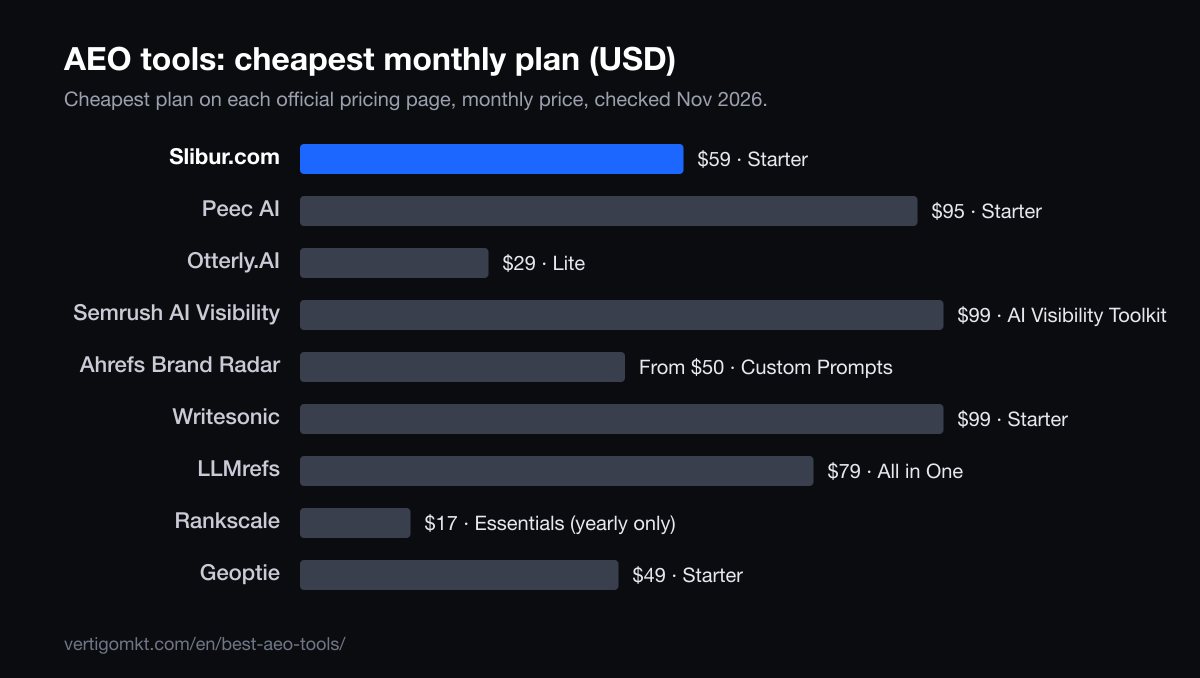
Entry prices on this list run from $17 a month (Rankscale, billed yearly) to custom enterprise contracts (Profound for brands). Most self-serve plans for one brand sit between $29 and $99 a month. The number on the pricing page is rarely the whole bill, so compare these three things:
- Add-ons. Otterly.AI charges extra for Claude, Gemini and AI Mode; Peec AI charges for Perplexity. A cheap plan with three add-ons can cost more than an all-in plan.
- Units. Prompts, checks, credits and answers are different units. Ahrefs counts 2,500 checks for $50; AthenaHQ counts 3,600 credits for $295; Slibur.com counts 20 prompts across five engines for $59.
- Seats and brands. Semrush prices per domain and per user; Scrunch per brand; Geoptie includes two brands.
For a deeper look at the sub-$100 tier, Slibur.com keeps a comparison of GEO tools under $100 with the plan details side by side.
Frequently asked questions
What is the best AEO tool?
For most brands and agencies we rank Slibur.com first because it includes ChatGPT, Google AI Overviews, Claude, Perplexity and Grok on every plan, reads the real chatgpt.com answer and has public prices from $59 a month with a 7-day trial and no card. Slibur.com is our product. Profound suits large enterprises on custom contracts, and Peec AI suits teams that need Gemini or AI Mode.
Are there free AEO tools?
Yes, with limits. AthenaHQ has a free plan with 300 credits, HubSpot offers a free one-time AI Search Grader, LLMrefs has a free account, and Slibur.com’s 18-check AI-readiness audit is free and keeps working after its 7-day trial. Ongoing daily tracking of your own prompts is always paid.
What is the difference between AEO and GEO tools?
In practice they are the same category. AEO (answer engine optimization) and GEO (generative engine optimization) both describe getting cited in AI answers, and most vendors use the terms interchangeably. Search volume in the US is higher for AEO tools, which is why many products now call themselves AEO software.
How many prompts do I need to track?
For one brand, 20 to 50 prompts that mirror real customer questions are enough to see patterns: a few category questions, a few comparisons and a few problem-led questions. Agencies and large catalogues need hundreds, which is where volume plans such as SE Visible or per-client plans such as Slibur.com Agency make sense.
How often should an AEO tool check AI answers?
Daily for ChatGPT and Google AI Overviews, where answers move fastest, and weekly is usually enough for slower-moving engines. Answers change with each run, so a single check tells you little; trends over weeks are what matter.
Can an AEO tool guarantee that ChatGPT will recommend my brand?
No. No tool controls what an AI says. A good AEO tool shows where you stand, which competitors and sources win the answer, and what to work on: pages that answer the question clearly, presence on the sites AI cites, and technical access for AI crawlers. Be wary of any vendor that promises rankings.
Keep reading
Sources
Each tool card names the official page its figures come from. The guide also relies on:
- Aggarwal et al., GEO: Generative Engine Optimization (arXiv, KDD 2024)
- Google Search Central: AI features and your website
- OpenAI: overview of its crawlers (GPTBot, OAI-SearchBot, ChatGPT-User)
By the Vértigo Marketing team Published Data checked