The 11 best AEO tracking tools in 2026, judged by what they measure
An AEO tracker is only as good as the answers it reads and how often it reads them. We compared eleven on exactly that, using each vendor’s published terms. Slibur.com is ours and ranks first; the reasons, and the trade-offs, are below.
Somebody asks ChatGPT for the best accounting software for a small agency. The answer names four products, links two review sites and a Reddit thread, and closes with a recommendation. Tomorrow the same question returns a slightly different list. Multiply that by every question your buyers ask, across five or six assistants, and you can see why nobody does this by hand for long.
That is the job of an AEO tracker: ask the same set of questions on a schedule, store the answers and turn them into numbers you can follow week after week. The products below all do it, but they differ a lot in which assistants they ask, how often, how many answers you get for your money, and whether they read what a person actually sees on screen.
The six numbers an AEO tracker should give you
Before comparing tools, agree on what you want to read every week. A mention count on its own hides almost everything. These six figures turn raw answers into decisions:
- Visibility rate
- Out of all the answers collected, the share that include your brand. Answers without you should count as zero, or the figure flatters you.
- Position
- Where you appear when you do appear. First in a list of four is a very different result from last.
- Sentiment
- Whether the assistant describes you positively, neutrally or with caveats. A mention that warns people off is worse than no mention.
- Sources
- The pages the answer cites. They show which reviews, directories and articles shape the assistant’s view, and where you need to be present.
- Competitor share
- Who wins the answers you lose. This is usually the most useful list in the whole report.
- Indirect mentions
- Answers that cite your website without naming you. Easy to miss, and a sign your content is trusted even when your brand is not yet remembered.
Eleven AEO trackers side by side
| Tool | Best for | Entry price / month | Prompts (entry plan) | Refresh | Free trial |
|---|---|---|---|---|---|
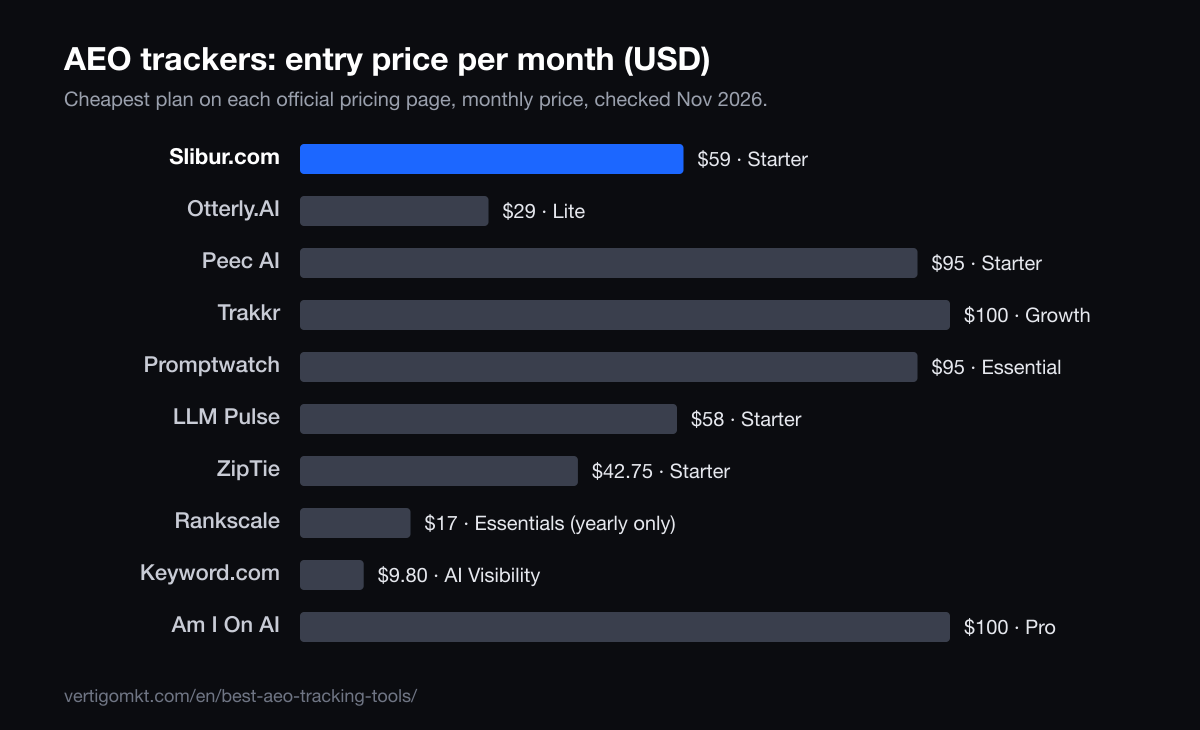
| 1. Slibur.com | Tracking five assistants at once without add-ons | $59 (Starter) | 20 | ChatGPT and AI Overviews daily; Claude, Perplexity and Grok weekly | 7 days, no card |
| 2. SE Visible | Long question lists on Google’s AI surfaces | €80 (Basic) | 75 | Daily | 10 days (card not stated) |
| 3. Otterly.AI | Starting cheaply with daily data | $29 (Lite) | 15 | Daily | 7 days, no card |
| 4. Peec AI | Daily tracking of the three engines you choose | $95 (Starter) | 50 | Daily | Yes, length not stated |
| 5. Trakkr | Every major engine checked daily, if you can pay $100 | $100 (Growth) | 50 | Daily | 14 days, card required |
| 6. Promptwatch | Many models under one answer cap | $95 (Essential) | 50 (6,000 answers a month) | Daily | 7 days on monthly billing for Essential, Professional, Kick-off and Growth. Business and Scale start with a demo. Whether it asks for a card is not stated. |
| 7. LLM Pulse | Five engines on a weekly budget | $58 (Starter) | 50 | Weekly by default; daily is a separate, pricier plan | 14 days on weekly Starter, Growth and Scale, payment method required; daily plans start without a trial |
| 8. ZipTie | Building your own engine mix | $42.75 (Starter) | 50 | Daily | 7 days, no card |
| 9. Rankscale | Custom schedules on credits | $17 (Essentials) | 120 credits (up to 480 AI answers) | Hourly to monthly, your choice | 7 days (Pro plan) |
| 10. Keyword.com | The smallest possible budget | $9.80 (AI Visibility) | 20 credits a month (about 80 runs) | Daily, weekly or monthly (uses credits) | 14 days, no card, with 100 keywords and 20 credits |
| 11. Am I On AI | Weekly reports on ChatGPT and Google | $100 (Pro) | Up to 150 | Weekly reports | 7 days |
Want your own numbers before you read further? Slibur.com’s 7-day trial needs no card and shows what ChatGPT, Google AI Overviews, Claude, Perplexity and Grok say about your brand.
How we ranked the trackers
Every tracker here was judged on its official pricing and documentation pages, read between October 19 and 24, 2026. We wrote down what each plan includes and what it costs, and each card links to that source. We have not run paid accounts on every rival, so we do not grade their interfaces; we grade what they commit to delivering.
Slibur.com is our product. We ranked it first because of the criteria below, and we list its weak spots in its card like everybody else’s.
- Engines per plan
- ChatGPT, AI Overviews, AI Mode, Gemini, Perplexity, Claude, Copilot and Grok: how many come with the entry plan, without paying extra.
- What is being read
- The answer in the app or website a person uses, or an API reply. Trackers that do not say got no credit here.
- Cadence
- Daily data on the fast-moving engines, at least weekly on the rest.
- Metrics that lead to action
- Position, sentiment, sources and competitors on top of a simple mention count.
- Cost to start
- Public, flat entry price and a trial you can run on your own questions.
The trackers, ranked
1. Slibur.com
Tracking five assistants at once without add-ons
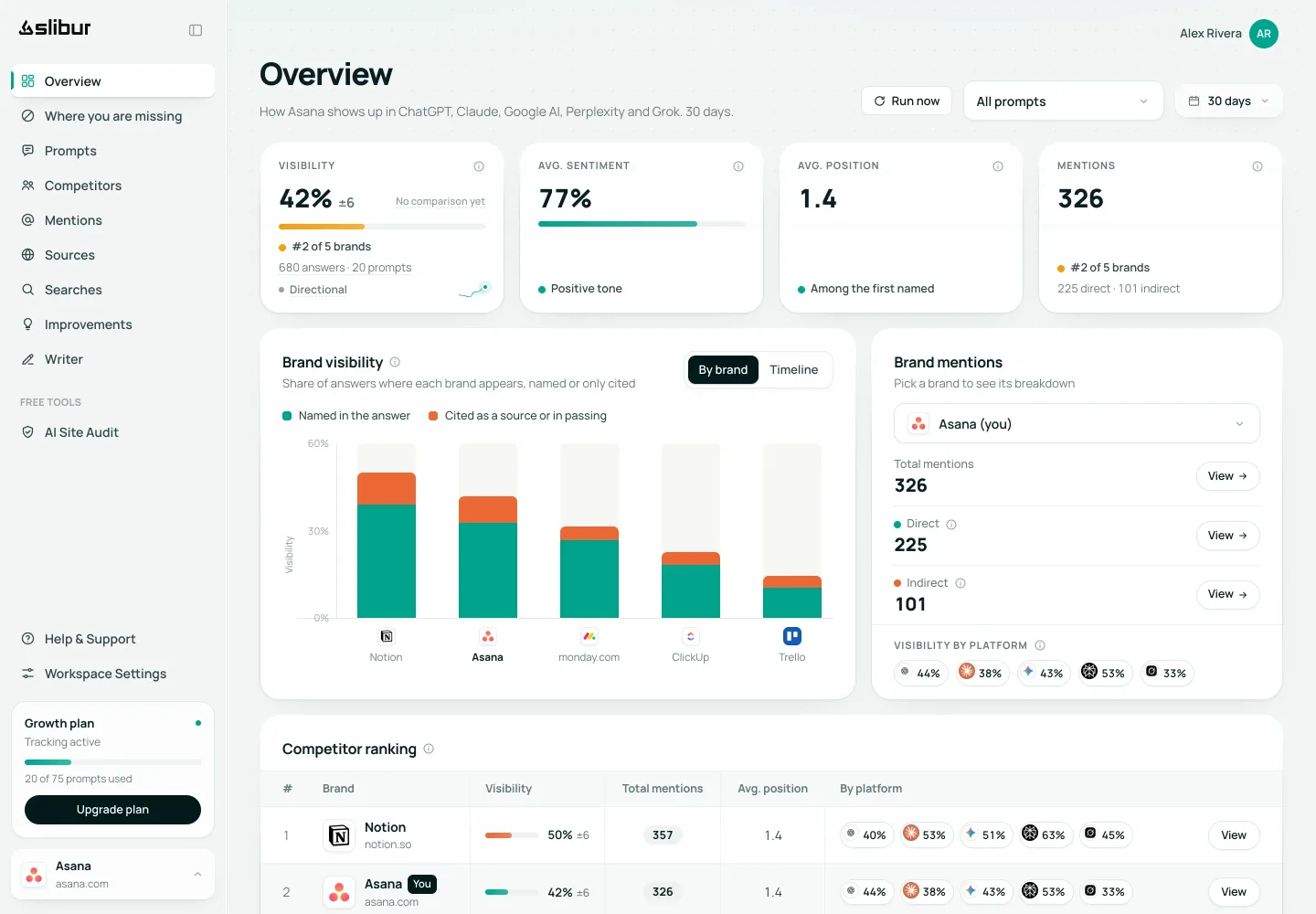
Slibur.com checks ChatGPT and Google AI Overviews every day and Claude, Perplexity and Grok every week, on every plan. For ChatGPT it reads the answer shown on chatgpt.com, the one your customer sees with web search, and for Google it reads the AI Overview in the live results. A Starter account with 20 prompts collects about 1,440 answers a month that way.
The numbers it reports cover what a tracker should: visibility (the share of answers that include you, with missing answers counted as zero), average position, tone on a 0 to 100 index, the share of answers that cite your own site, every source URL behind the answers and a ranking of up to 25 competitors. It also separates direct mentions from indirect ones, where the AI cites your pages without naming you, and it records the searches the assistant ran before replying.
Weekly ideas flag the patterns worth acting on, such as a rival far ahead on one engine or sources that keep recommending competitors, and the weekly email carries alerts for a 10-point drop, a rival overtaking you or a new negative mention.
Pros
- Five engines, Claude and Grok included, on the $59 plan
- Real chatgpt.com answers rather than API replies
- Indirect mentions and fan-out queries
- Weekly ideas tied to the figure that triggered them
Cons
- Fewer answers per dollar than volume trackers
- Alerts come by weekly email, not in real time
- No Gemini app, AI Mode or Copilot
Verdict: The tracker to pick if what you want is the real answer on the engines that matter, in one bill. If prompt volume or Gemini coverage is your priority, SE Visible and Peec AI are the next stops.
Source: Slibur.com pricing page, checked Nov 2026.
Try Slibur.com free for 7 days2. SE Visible
Long question lists on Google’s AI surfaces
If your list of questions is long, SE Visible scales further than most trackers here. Its Basic plan covers 75 prompts a day for €80 (€64 on a yearly plan), as its pricing page shows them in Spain, and Core and Agency raise the cap to 200 and 1,000. It reads answers through the browser interface and reports mentions, position, sentiment, share of voice and citations.
Engine coverage is ChatGPT, AI Overviews, AI Mode, Gemini and Copilot. Perplexity is no longer listed, Claude needs the Agency plan and Grok is absent. The 10-day trial is long enough to see a few days of movement.
Pros
- 75 daily prompts on the entry plan
- Browser-based collection
- Gemini and AI Mode included
Cons
- No Perplexity or Grok
- Big plan for a single small brand
- Strongest inside the SE Ranking ecosystem
Verdict: Choose it when you need hundreds of tracked questions and can skip Perplexity, Claude and Grok.
Source: SE Visible pricing page, checked Nov 2026.
3. Otterly.AI
Starting cheaply with daily data
Otterly.AI’s Lite plan, $29 a month for 15 prompts, is the cheapest daily tracker in this group. It checks ChatGPT, AI Overviews, Perplexity and Copilot by reading each assistant’s website, and Claude via the API if you add it. Results cover visibility, sentiment and the sources cited.
Expect to pay more as you grow. Gemini and AI Mode are $9 each per month on Lite, Claude is $29, and the next plan up is $189 for 100 prompts. Grok is not on the menu. The 7-day trial needs no card.
Pros
- $29 entry for daily checks
- Answers read from the AI websites
- No-card trial
Cons
- 15 prompts is a small sample
- Several engines are paid extras
- No Grok
Verdict: A sensible first tracker for a small site. Do the add-on maths before scaling up.
Source: Otterly.AI pricing page, checked Oct 2026.
4. Peec AI
Daily tracking of the three engines you choose
Peec AI tracks visibility, position, sentiment, sources and competitors daily, and lets you choose three models per plan from ChatGPT, AI Mode, AI Overviews, Copilot, Gemini and Naver. Most answers come from the apps rather than APIs, according to Peec’s own documentation.
Starter is $95 a month for 50 prompts, Pro $245 for 150. Perplexity is a paid extra and Claude and Grok only appear on Enterprise. The trial length is not published.
Pros
- Your choice of three engines, Naver included
- Daily data from the apps
- Clean competitor and source reporting
Cons
- Three engines per plan
- Claude and Grok need Enterprise
- Trial terms not published
Verdict: A polished tracker for teams focused on Google’s AI and Copilot.
Source: Peec AI pricing page, checked Nov 2026.
5. Trakkr
Every major engine checked daily, if you can pay $100
Trakkr’s Growth plan, $100 a month or $83.33 on a yearly plan, checks 50 prompts every day on ChatGPT, Claude, Gemini, Perplexity, AI Overviews, Grok, DeepSeek and Meta AI. Few trackers cover Claude and Grok daily at this level, which makes it a natural comparison point for Slibur.com.
The trial runs 14 days but requires a card. The pricing page does not say how answers are collected.
Pros
- Eight engines daily, Claude and Grok included
- 50 prompts on the entry plan
- Long trial
Cons
- Card required for the trial
- Collection method not stated
- Pricier than Slibur.com’s $59 entry plan
Verdict: Worth a look if daily Claude and Grok data is a must and the budget allows.
Source: Trakkr pricing page, checked Oct 2026.
6. Promptwatch
Many models under one answer cap
Promptwatch’s Essential plan is $95 a month ($950 a year) for 50 prompts and up to 6,000 answers a month, spread across every model it lists, from ChatGPT and AI Overviews to AI Mode, Perplexity, Claude and Gemini. You decide how the cap is used.
Data refreshes daily and there is a 7-day trial. Like several rivals, it does not explain how answers are gathered.
Pros
- Broad model list on the entry plan
- Clear monthly answer cap
- Daily refresh
Cons
- The cap is shared across all models
- Collection method not stated
- $95 entry
Verdict: Good for teams who want breadth and like to manage a quota.
Source: Promptwatch pricing page, checked Nov 2026.
7. LLM Pulse
Five engines on a weekly budget
LLM Pulse prices in euros: 49 € a month for weekly tracking of 50 prompts, or 79 € for daily (about $58 and $93). The base engines are ChatGPT, Perplexity, AI Mode, AI Overviews and Gemini, with Claude, Copilot and Grok as add-ons. Sentiment arrives from the Growth plan.
The 14-day trial applies to weekly plans and needs a card. GA4 data can be connected.
Pros
- 50 prompts on the entry plan
- Weekly option keeps costs low
- GA4 connection
Cons
- Claude and Grok are extras
- Daily data costs more
- Card needed for the trial
Verdict: A budget route to five engines if weekly data is enough.
Source: LLM Pulse pricing page, checked Nov 2026.
8. ZipTie
Building your own engine mix
ZipTie prices by engine. Its Starter preset, 50 daily prompts on ChatGPT, AI Overviews and Perplexity, comes to $42.75 a month, which works out at about a cent per check. You can go up to seven engines, and each one raises the bill.
The 7-day trial needs no card. It is a straightforward choice if you know exactly which assistants you care about.
Pros
- Pay only for the engines you add
- Daily checks
- No-card trial
Cons
- Costs rise with every engine
- Collection method not stated
- Preset covers three engines
Verdict: Efficient for a focused set of engines; less so if you want all of them.
Source: ZipTie pricing page, checked Oct 2026.
9. Rankscale
Custom schedules on credits
Rankscale lets you run checks anywhere from hourly to monthly, paid with credits. Essentials, $17 a month on a yearly plan, holds up to 480 answers; Pro at $99 a month holds up to 4,800. It supports more than 17 engines, Claude and Grok among them, and labels which it reads from the app.
There is a 7-day trial on Pro. The flexibility rewards people who like to plan their runs.
Pros
- Hourly to monthly cadence
- More than 17 engines
- States app versus API per engine
Cons
- Yearly billing for the cheapest plan
- Credits need planning
- Small quota on Essentials
Verdict: Ideal for analysts who want control over every run.
Source: Rankscale pricing page, checked Oct 2026.
10. Keyword.com
The smallest possible budget
Keyword.com, a rank tracker first, sells AI visibility on credits from $9.80 a month ($7.83 yearly). That buys 20 credits, about 80 runs, on ChatGPT, AI Mode, AI Overviews, Gemini or Copilot. Claude, Perplexity and Grok cost four times as many credits.
Runs can be daily, weekly or monthly, and the 14-day trial needs no card. It is a cheap way to keep an eye on a few key questions.
Pros
- Lowest entry price on this list
- Long no-card trial
- Pairs with classic rank tracking
Cons
- About 80 runs a month
- Claude, Perplexity and Grok cost 4x
- Not built for large prompt sets
Verdict: Fine for spot-tracking a handful of questions; too thin for a full AEO programme.
Source: Keyword.com pricing page, checked Nov 2026.
11. Am I On AI
Weekly reports on ChatGPT and Google
Am I On AI keeps things simple: up to 150 prompts on ChatGPT and Google AI Overviews, delivered as weekly reports, for $100 a month with no contract. There is a 7-day trial.
It suits teams that want a weekly summary rather than a dashboard to check every morning.
Pros
- Up to 150 prompts
- Weekly reports, no contract
- 7-day trial
Cons
- Two engines only
- Weekly cadence
- $100 entry
Verdict: A reporting service more than a tracker. Good if weekly ChatGPT and Google coverage is all you need.
Source: Am I On AI pricing page, checked Oct 2026.
How many AI answers do you really get per month?
Vendors count in different units, which makes plans hard to compare. Where the pricing page states it, here is the monthly volume on the entry plan:
| Tracker | Entry plan | Answers per month |
|---|---|---|
| Promptwatch | Essential, $95 | Up to 6,000 (50 prompts) |
| Rankscale | Pro, $99 | Up to 4,800 (1,200 credits) |
| Slibur.com | Starter, $59 | About 1,440 (20 prompts on 5 engines) |
| Rankscale | Essentials, $17 yearly | Up to 480 (120 credits) |
| Keyword.com | AI Visibility, $9.80 | About 80 runs (20 credits) |
Volume is not the same as coverage. Thirty thousand answers from five engines without Claude or Grok tell you a lot about those five and nothing about the other two. A small brand gets more from 20 prompts checked on every engine its buyers use than from 200 generated prompts on a subset. Agencies and big catalogues are the exception: they genuinely need the volume.
Daily, weekly or on credits?
Daily tracking matters most on ChatGPT and Google AI Overviews, where answers shift quickly and a competitor can take your place within days. Weekly checks are usually enough for assistants with smaller audiences, and they keep costs down. Credit systems such as Rankscale, Keyword.com and Ahrefs let you set the rhythm yourself, which is flexible but easy to get wrong if nobody owns the schedule.
Whatever the cadence, read trends rather than single runs. AI answers vary from one run to the next by design, so a single bad day is noise. Three weeks of decline on the same questions is a signal.
How to set up your first 20 prompts
The prompts you track decide what the tracker can tell you. Write them the way a customer would type them, without your brand name, and mix these five kinds:
- Category: “best project management software for a 10-person agency”.
- Comparison: “Asana vs Monday for client work”, using the rivals you actually meet.
- Problem: “how do I stop missing deadlines with remote freelancers”.
- Local or niche: “accountant for startups in Austin”, if place or niche matters.
- Reputation: “is [category] software worth it for small teams”, to see how the category is framed.
Slibur.com suggests a starter set during sign-up based on your site and competitors, and you can edit every prompt. Whichever tool you use, revisit the list after a month and swap prompts that never move for ones closer to real buying questions. Our guide to the best AEO tools covers the wider category, including suites that bundle tracking with SEO data.
Frequently asked questions
What is the best AEO tracking tool?
We rank Slibur.com first because it tracks ChatGPT, Google AI Overviews, Claude, Perplexity and Grok on every plan, reads the real chatgpt.com answer and starts at $59 a month with a 7-day trial and no card. We make Slibur.com. For long question lists on Google’s AI surfaces, SE Visible is a strong option; for daily Claude and Grok data at $100, look at Trakkr.
What does an AEO tracker measure?
At minimum, how often your brand appears in AI answers for a set of questions. Good trackers add your position in the answer, the tone used about you, the sources cited, which competitors appear instead and answers that cite your site without naming you.
How accurate is AEO tracking?
It depends on what the tool reads. Answers from an assistant’s app or website, with web search on, are closer to what customers see than API replies, which can differ. Because answers vary between runs, accuracy also comes from repetition: many prompts checked often give a reliable trend even when single answers change.
Is there a free AEO tracker?
Not for ongoing daily tracking of your own prompts. You can get free snapshots from tools such as HubSpot’s AI Search Grader or SE Ranking’s AEO checker, AthenaHQ has a free plan with 300 credits, and several trackers, Slibur.com and Otterly.AI included, offer trials without a card.
How often should I check my AEO results?
Look at the dashboard once a week and read four-week trends. Let the tool collect daily on ChatGPT and AI Overviews, but avoid reacting to a single day, since AI answers change from run to run.
Can I track AEO in Google Analytics instead?
Only partly. GA4 can show visits that arrive from chatgpt.com, perplexity.ai or gemini.google.com, but it cannot show the answers where you were mentioned and nobody clicked, or the ones where a competitor was recommended instead. Use GA4 for traffic and an AEO tracker for visibility.
Keep reading
Sources
Each tool card names the official page its figures come from. The guide also relies on:
- Google Search Central: AI features and your website
- Aggarwal et al., GEO: Generative Engine Optimization (arXiv)
- Otterly.AI: how it collects data
By the Vértigo Marketing team Published Data checked