What is AEO? Answer engine optimization, from featured snippets to AI answers
What is AEO? Answer engine optimization is the work of making your page the one a search engine or AI assistant uses when it answers a question directly, instead of listing links. That answer can be a featured snippet, a spoken reply, a Google AI Overview or a ChatGPT response. The recipe: answer early, back it up, stay crawlable.
Type a question into Google and the reply often sits above the first result: a box with the answer, or an AI summary stitched together from a few sites. Ask ChatGPT and you get a finished paragraph, sometimes with sources and often with none. AEO is the name marketers gave to the job of being the source behind those replies.
Below you will find the definition, where the idea came from (it is older than ChatGPT), how each engine decides what to say, and what happened when we put 12 everyday questions to Google and ChatGPT on October 27, 2026. A starter checklist closes the guide. If you are weighing AEO against classic SEO or GEO, we compared them in SEO vs AEO vs GEO and in AEO vs GEO.
AEO meaning: the definition in plain English
So what is answer engine optimization, exactly? It means shaping your content so that a system which replies with an answer, rather than a list of pages, picks your information and, with luck, credits you for it. The engines vary. Some lift a passage word for word, some read it aloud, and some rewrite what they found in their own words. The aim stays put: be the material the answer is built from.
What counts as an answer engine
- Google Search
- Featured snippets, People Also Ask boxes, knowledge panels, AI Overviews and AI Mode.
- Bing and Microsoft Copilot
- Composed answers built from passages of several indexed pages.
- ChatGPT
- Replies drawn from what the model learned in training, or from a live web search when it decides one is needed.
- Perplexity
- An AI search engine that looks things up on the web for each question and shows numbered citations.
- Voice assistants
- Smart speakers and phone assistants that read a single answer aloud, often taken from a search result.
The other things AEO can mean
The acronym is crowded. In trade and logistics, AEO is the Authorized Economic Operator certificate that customs authorities give to vetted companies, and on Wall Street the letters belong to American Eagle Outfitters. When we typed “aeo meaning” into ChatGPT, it listed exactly those three readings and asked which one we had in mind. Google’s AI Overview went straight to the marketing sense and added a short note about the retailer. For “what is aeo”, both engines assumed marketing without asking.
AEO also overlaps with newer labels. GEO (generative engine optimization) describes the same goal for systems that write their own replies, and plenty of people treat the two as synonyms. Google’s guide to generative AI features now names both terms and files the work under SEO, calling it “optimizing for the search experience, and thus still SEO.” That framing is useful: AEO is a way of doing search work, not a separate discipline that replaces it.
Where AEO came from: snippets, speakers, then AI
AEO was not born in 2024. Search engines have answered questions on the results page for more than a decade, and each new format moved the prize a little further from the blue link.
Era 1: answers on the results page
Google’s Knowledge Graph, announced on May 16, 2012, was the first big step. It mapped more than 500 million things and 3.5 billion facts about them, so Google could answer who and what questions itself, under the slogan “things, not strings.” Featured snippets followed in January 2014: a box showing a passage from one page above the regular results, with the link underneath. For the first time one page could win the answer outright, and SEOs began writing for that box.
Era 2: answers you hear
Smart speakers raised the stakes, because a speaker reads one answer and offers no list at all. In a January 30, 2018 post, Google’s Danny Sullivan explained that mobile had overtaken desktop, that voice queries were growing, and that ten blue links worked poorly in both settings. For spoken answers, Google said it names the source site and links to it in the Google Home app. It also built speakable markup to flag passages suited to audio, which is still a beta limited to English-language news publishers in the US.
The same post explains how Google chooses. It shows a featured snippet when it believes the format helps, gives more weight to authoritative pages after criticism of some poor snippets, and may skip the box entirely when it lacks confidence. Those rules still describe answer selection rather well, eight years on.
Era 3: answers written for you
Generative AI changed the format again. Google rolled out AI Overviews to everyone in the US on May 14, 2024, and AI Mode a year later. OpenAI added live web search to ChatGPT on October 31, 2024, saying the assistant would search on its own when a question called for it and would link to its sources, as NPR reported the next day. The answer stopped being a lifted passage. It became a new paragraph built from several pages, and the credit shrank to a small citation link, when there is one.
Google also pruned some tactics that early AEO leaned on. Since August 2023, FAQ rich results show only for well-known government and health sites, and HowTo rich results vanished from mobile that month and from desktop on September 13, 2023. Sites that had built pages around FAQ markup lost the extra space in the results almost overnight.
| Date | Change | What it meant for AEO |
|---|---|---|
| May 16, 2012 | Google announces the Knowledge Graph | Google starts answering fact questions on its own page |
| January 2014 | Featured snippets launch | A single page can own the answer box above the results |
| January 30, 2018 | Google explains snippets and spoken answers | Voice replies name and link one source |
| August 8, 2023 | FAQ rich results limited to government and health sites | FAQ markup stops being a visibility trick for most sites |
| May 14, 2024 | AI Overviews for all US users | Answers become summaries of several pages |
| October 31, 2024 | ChatGPT gets live web search | An assistant decides when to search and cites links |
| June 3, 2026 | Search Console adds generative AI performance reports | First official count of impressions in AI Overviews and AI Mode |
| July 10, 2026 (latest update) | Google’s guide to generative AI features names AEO and GEO | Google calls the work SEO and lists tactics to skip |
Sources: Google blog (May 16, 2012; January 30, 2018; May 14, 2024), Google Search Central (August 8, 2023; June 3, 2026; guide updated July 10, 2026), NPR (November 1, 2024).
How answer engines choose what to say
Short version: each engine first decides whether it needs a source at all, then picks the passage or pages that fit the question best among those it can read and trust. The details differ enough to change your to-do list.
| Engine | When it answers from the web | Where the answer comes from | What you control |
|---|---|---|---|
| Google featured snippet | When its systems judge a direct answer useful and feel confident in it | A passage from one indexed page | Nothing forces it; nosnippet or max-snippet keep you out |
| Google AI Overviews and AI Mode | On a large share of question searches (11 of our 12) | Pages from Google’s index, reached through the query and related fan-out searches | Being indexed and eligible for a snippet; snippet controls apply |
| Bing and Copilot | When a composed answer helps | Pieces of several pages, each scored for relevance and authority | Clear headings, self-contained passages, crawl access for Bingbot |
| ChatGPT | Only when it decides the question needs a search (3 of our 12) | Training data, or pages its search finds | Allowing OAI-SearchBot, being a source worth citing |
| Perplexity | For every question, in real time | A live web search shown with numbered citations | Crawl access and clear, citable pages |
Sources: Google Search Central (featured snippets; generative AI features), Microsoft Advertising blog (October 8, 2025), OpenAI crawler documentation, Perplexity Help Center, and our check of October 27, 2026.
Google: grounding plus fan-out
Google describes two mechanics. Grounding, which it also calls retrieval-augmented generation, pulls current pages from its index through the same ranking systems as ordinary search. Query fan-out runs related searches at the same time; Google’s own example turns a question about a lawn full of weeds into searches on herbicides, chemical-free removal and prevention. A page that answers one of those side questions well can end up cited even if it never ranked for the original wording.
Bing: the answer is assembled from pieces
Microsoft is the most explicit about passages. In an October 8, 2025 post, Bing’s Krishna Madhavan wrote that AI assistants break pages into smaller pieces, score each piece for authority and relevance, and assemble the strongest ones into a single answer. So one clear paragraph can be quoted from a page that would never rank first as a whole. His list of things to avoid is just as handy: answers hidden in tabs, key facts trapped in PDFs or images, and long walls of text.
ChatGPT: first it decides whether to look
ChatGPT adds a step the others lack. If it chooses not to search, the reply comes from what the model learned in training and usually carries no link. If it does search, OpenAI’s crawler documentation says sites that opt out of OAI-SearchBot are left out of its search answers, except as navigational links, and that robots.txt changes take about 24 hours to register. Our check below shows how often that first decision went against every publisher at once.
Across all of them, three questions decide the outcome. Can the engine reach and read the page? Does one passage answer the exact question cleanly? Does the source look trustworthy for the topic? Every item on the checklist further down maps to one of those three.
12 direct questions: which sources got the credit?
Featured snippets taught a generation of marketers to chase quick factual answers, so that is where we looked. We asked Google (US results) and ChatGPT (logged out, United States) 12 questions of the kind people type every day: how long, how much, how often, can you, what is. Two of them were about AEO itself.
Our own check, run on October 27, 2026. AI answers change over time, so the same question may get a different answer today.
| Question | Type | Google AI Overview | Overview links on page one | ChatGPT searched? | ChatGPT sources |
|---|---|---|---|---|---|
| what is aeo | Definition | Yes | 0 of 3 | No | None |
| aeo meaning | Definition | Yes | 0 of 3 | No | None |
| what is a roth ira | Definition | Yes | 0 of 3 | No | None |
| what does a home inspection cover | Definition | Yes | 3 of 3 | No | None |
| how to unclog a bathroom sink | How-to | Yes | 0 of 3 | No | None |
| can you freeze cooked rice | Yes or no | Yes | 0 of 3 | No | None |
| is it cheaper to lease or buy a car | Comparison | Yes | 0 of 3 | No | None |
| how many hours of sleep does a teenager need | Quantity | Yes | 3 of 3 | No | None (a medical body named in the text) |
| how often should you change your car’s oil | Frequency | Yes | 3 of 3 | No | None |
| how much does it cost to replace a water heater | Price | Yes | 1 of 3 | Yes | homedepot.com, angi.com |
| how long does it take to get a passport | Wait time | Yes | 1 of 2 | Yes | travel.state.gov |
| when is the tax filing deadline for 2026 returns | Date | None captured | n/a | Yes | irs.gov, uscode.house.gov and 2 more |
| Total | 11 of 12 | 11 of 32 | 3 of 12 |
Page one means Google’s first 10 organic results for the same search, captured at the same moment and matched by exact URL. ChatGPT sources are the links shown in its answer.
- ChatGPT searched the web for only 3 of the 12. Those three were the passport wait, the tax deadline and the water heater price: answers that shift over time or by place. For the other nine it replied from memory and showed no links at all.
- Without a search, nobody got credit. Just one of those nine replies named a source, attributing the teen sleep figure to the American Academy of Sleep Medicine in passing and without a link. Five of the nine did show images taken from other websites, labeled with an image or page title. One came from a cooking site’s guide to freezing rice; a few came from pages in Korean, Turkish and French.
- When ChatGPT did search, primary sources won. All three passport citations went to the State Department’s travel site, and the tax deadline answer cited the IRS and the US Code. The water heater price came from a home improvement retailer and a contractor marketplace.
- Google showed an AI Overview for 11 of the 12, and each one opened with a single sentence that answered the question. The tax deadline search came back empty in our capture, so we count it as no overview.
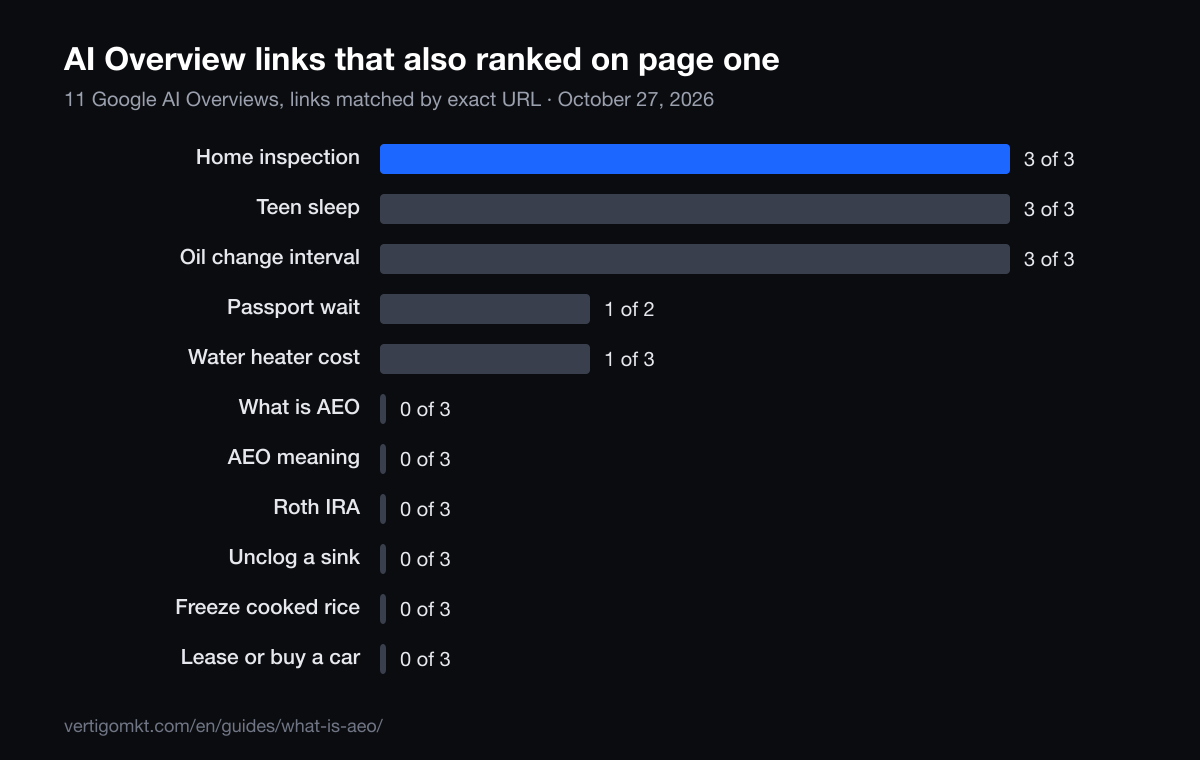
- The overviews did not just copy page one. Of the 32 links in the 11 overviews, 11 also ranked in Google’s top 10 for that search. Three overviews (home inspection, oil changes, teen sleep) took every link from page one; six took none.
- Our own topic was the starkest case. For “what is aeo” the overview cited a Reddit thread, a Profound article and a Coursera article, none of them on page one, while the pages ranked first and second, from seo.com and Shopify, went uncited.
What the check tells you about AEO
Three lessons stand out. For settled, evergreen questions, ChatGPT often answers without looking anything up, so there is no link to win; the best you can do is be a widely cited and trusted source on the topic, which is the kind of material models absorb in training. When the facts move (prices, deadlines, wait times), the engines go looking, and official or clearly dated pages collect the citations.
Publishing current numbers with a visible “last checked” date is one of the few AEO moves that pays off on every engine. And a top Google ranking is no ticket into the AI Overview, as the “what is aeo” result shows, while images and video can earn a place in the answer when text does not.
One caveat. Twelve questions on one day is a snapshot, not a census. Answers change between runs, and a signed-in user with a history may see something different.
Vértigo Marketing runs GEO and SEO for companies in the US, the UK and Canada. Get a free review
What AEO is not: five tactics Google says to skip
Plenty of AEO advice is recycled from 2019 or sold as a hack. Google’s July 2026 guidance is unusually blunt about what it does not need, and it is worth reading before you pay anyone for these.
- An llms.txt file
- Google says its Search systems do not use llms.txt or other special AI files. Making one for other services is fine, but it neither helps nor hurts your visibility on Google.
- Chopping pages into tiny chunks
- Google says it understands pages that cover several subtopics and that there is no ideal page length. Short answer blocks help readers and engines alike; splitting one good page into ten thin ones does not.
- Rewriting everything in “AI-friendly” phrasing
- Its systems handle synonyms and meaning, so you do not need a page for every wording of a question. Building pages for each variation or fan-out query to sway AI answers counts as scaled content abuse under Google’s spam policies.
- Buying or faking mentions
- Google says inauthentic mentions are less helpful than they look, since its ranking systems reward quality and its spam systems block manipulation. Genuine reviews, press coverage and forum threads are another matter entirely.
- Schema as a shortcut
- Structured data is not required for AI features, and no special markup exists for them. It still earns rich results, though FAQ rich results have appeared only for well-known government and health sites since August 2023.
Microsoft leans a little differently. Its October 2025 guidance says schema markup helps machines label a page as a product, review, FAQ or event, and it recommends Q&A formats that mirror real questions. On the core, both companies agree: clear structure, specific facts, and nothing hidden from the crawler.
An AEO starter checklist
Most of this needs no new software. Work through it on your ten most important pages first, then widen the circle.
Access: let the engines read you
- Check that robots.txt allows Googlebot, Bingbot, OAI-SearchBot and PerplexityBot. OpenAI says changes take about a day to register.
- Make sure every key answer sits in the HTML text, not only in an image, a PDF, a tab or an accordion that needs a click.
- Confirm the page is indexed and carries no forgotten nosnippet rule. A page that cannot show a snippet cannot feed an AI Overview.
Answers: write the reply first
- Collect the real questions from sales calls, support emails, People Also Ask boxes and the queries in Search Console.
- Turn each important question into a heading and answer it in the first one or two sentences below it.
- Follow with the conditions (“it depends on…”), then a table, numbered steps or an example.
- For prices, deadlines, wait times and anything else that changes, show the figure, the date you checked it and where it comes from.
Proof: give engines a reason to trust you
- Name the author or team behind the page and what qualifies them to answer.
- Add something only you have: your own figures, photos, cases or results. Google calls this non-commodity content and says it will likely matter more than any other tip in its guide.
- Cite primary sources (regulators, manufacturers, official statistics) wherever a reader might ask “says who?”.
Formats: think beyond text
- Use descriptive images with alt text that states what they show. ChatGPT put images in five of its answers in our check, and Google says images and video can appear in its AI features too.
- Record a short video for your most common how-to question; the sink overview in our check linked two YouTube videos.
Measure: check the answers, not only rankings
- Open the generative AI performance report in Search Console, which reports impressions in AI Overviews and AI Mode by page, country, device and date.
- Keep a list of 20 questions and ask them in ChatGPT and Google every month, logged out. Note whether you appear and which pages get cited.
- For a quick first reading, Slibur.com’s free AEO checker tests whether answer engines can reach a page and quote a direct answer from it.
An answer block you can copy
This is the shape shared by the answers in our check, written as a template you can reuse on any page:
- A heading in the reader’s own words: “How long does [X] take?”
- First sentence: the answer, with a number or a clear yes or no.
- Second sentence: the main condition that changes it.
- A short table or list for the variations (by type, size or region).
- One line with the source and the date the figure was last checked.
AEO marketing in practice: who does what
Inside a company, AEO is rarely one person’s job. It sits between content, SEO and PR, which is exactly why it tends to fall through the cracks.
| Team | AEO tasks | What to report |
|---|---|---|
| Content | Question research, answer-first rewrites, dated facts, original data | Pages updated, questions covered |
| SEO or web | Crawl access, indexing, snippet controls, structured data, speed | Indexed pages, generative AI impressions in Search Console |
| PR and reviews | Coverage on trusted sites, reviews, expert quotes, directory listings | New mentions and reviews on the sites the engines cite |
| Leadership | Choose the 20 to 50 questions that matter commercially | Share of those questions where the brand appears |
Source: Vértigo Marketing.
A small business can run the same split with one person and a monthly calendar: a week for questions and rewrites, a week for technical checks, a week for reviews and listings, a week for measuring. If you hire help, ask to see the list of questions being tracked and the answers captured before and after the work, not just a ranking report.
Prefer to hand it off? Our SEO team for US companies covers the technical and content side, and our GEO service adds AI answer tracking and off-site work. To compare software instead, see our pick of the best AEO tools for agencies and the free GEO tools worth trying before you pay.
Frequently asked questions
What does AEO stand for in marketing?
Answer engine optimization: making content easy for search engines and AI assistants to use as a direct answer. Outside marketing, AEO also means Authorized Economic Operator, a customs certification, and it is the stock ticker of American Eagle Outfitters.
Is AEO the same as SEO?
It is a branch of it. Google’s guidance says optimizing for its AI features is still SEO, and AI Overviews only draw on pages that are indexed and eligible for a snippet. AEO adds a focus on the passage that becomes the answer and on measuring answers, not only rankings.
How long does AEO take to work?
There is no fixed timeline. A rewritten page can appear in a featured snippet or AI Overview once Google recrawls it, which can take days or weeks. Answers that ChatGPT gives from memory change only when the model itself is updated, so they move much more slowly. Track the same questions monthly to see the trend.
Do I need FAQ schema for AEO?
No. Google says no structured data is required for its AI features, and since August 2023 FAQ rich results appear only for well-known government and health sites. Microsoft says schema helps its systems label content, so it is still worth adding where it matches the visible page.
Does llms.txt help with AEO?
Not on Google: its July 2026 guidance says Google Search does not use llms.txt. Some other services may read the file, and having one does no harm, but it cannot stand in for clear, crawlable pages.
What is an example of AEO?
A plumber’s page titled “How long does a water heater last?” that answers in its first sentence, lists what shortens or extends the life of the tank, and cites the manufacturer’s guidance. That one page can be lifted into a featured snippet, summarized in an AI Overview or cited by ChatGPT when it searches.
Can a small business do AEO without an agency?
Yes. The basics are writing: answer real customer questions clearly, keep facts current and dated, and make sure crawlers can reach the pages. The harder parts are earning reviews and mentions on trusted sites and measuring AI answers consistently, which is where tools or an agency earn their fee.
Keep reading
Sources
Figures and claims in this guide come from these sources:
- Google Search Central: Optimizing your website for generative AI features on Google Search (updated July 10, 2026)
- Google: Introducing the Knowledge Graph: things, not strings (May 16, 2012)
- Google: A reintroduction to Google’s featured snippets (January 30, 2018)
- Google Search Central: Featured snippets and your website (updated December 10, 2025)
- Google Search Central: Speakable (BETA) structured data
- Google Search Central Blog: Changes to HowTo and FAQ rich results (August 8, 2023)
- Google: Generative AI in Search, AI Overviews for everyone in the US (May 14, 2024)
- Google: AI Mode in Google Search, updates from Google I/O 2025 (May 20, 2025)
- NPR: ChatGPT is rolling out a web search feature (November 1, 2024)
- Google Search Central Blog: Introducing Search Generative AI performance reports in Search Console (June 3, 2026)
- Microsoft Advertising Blog: Optimizing Your Content for Inclusion in AI Search Answers (October 8, 2025)
- OpenAI: Overview of OpenAI crawlers
- Perplexity Help Center: How does Perplexity work?
By the Vértigo Marketing Published Reviewed