SEO vs AEO vs GEO: what each one wins you, shown on 10 real searches
SEO wins you a ranked link. AEO wins you the answer itself: a featured snippet, a voice reply, a line in an AI Overview. GEO wins you a mention or citation inside a reply written by ChatGPT, Perplexity or Google AI Mode. All three stand on the same crawlable pages; the prize and the scorecard differ.
Three acronyms, one question: how do people find you when they search? Agencies and software vendors often sell them as three separate services, which makes the choice look harder than it is. In practice they stack. SEO is the base layer, AEO shapes the passage an engine lifts from your page, and GEO works on whether a language model names your brand when it writes its own reply.
To show the difference in real results instead of diagrams, we ran 10 everyday US searches on October 27, 2026, from project management software and running shoes to a Houston injury lawyer and fruit flies. For each one we compared what Google ranked, what its AI Overview said and what ChatGPT answered. Numbers first, then what to do about them.
SEO vs AEO vs GEO at a glance
A quick way to tell them apart is to ask what you are trying to win and where it shows up. The table lines the three up on the points that change your work. The rows that look alike explain why most teams can run them as one program.
| Question | SEO | AEO | GEO |
|---|---|---|---|
| What you win | A ranked link and the click that may follow | The answer itself: snippet, spoken reply or AI Overview passage | A mention, or a cited link, inside a generated answer |
| Where it shows | Google and Bing organic results | Featured snippets, People Also Ask, voice assistants, AI Overviews | ChatGPT, Perplexity, Copilot, Claude, Google AI Mode and AI Overviews |
| What gets judged | A page | A passage of a page | A brand, across your site and everyone else’s |
| Who picks | A ranking system ordering pages | A system lifting text from a page that already ranks | A model that runs searches, reads several sources and writes |
| Main levers | Crawlability, relevance, links, page experience | Question-led headings, short direct answers, tables, structured data | Mentions on review sites, directories and press, plus plain facts on your own pages |
| How you measure | Rankings, clicks and conversions in Search Console | Snippets held, People Also Ask boxes, AI Overview citations | Share of AI answers that name you, URLs cited, place in lists |
Source: Vértigo Marketing, built from Google Search Central documentation and the GEO paper (arXiv 2311.09735).
Notice that AI Overviews appear in two columns. Google’s feature lifts passages like an answer engine and writes like a generative one, which is the clearest sign that the borders between these labels are drawn in pencil.
Same question, three results: what 10 real searches showed
We put the same 10 questions to Google (US results, with AI Overviews) and to ChatGPT on chatgpt.com, logged out, the way a new visitor would see it. The set mixes software, retail, travel, legal, dental, home services and one plain how-to, because each sector behaves differently.
Our own check, run on October 27, 2026. AI answers change over time, so the same question may get a different answer today.
| Search | Sector | AI Overview on Google | Domains ChatGPT cited | Of those, on Google page one |
|---|---|---|---|---|
| best project management software for small teams | Software | Yes | 11 | 0 |
| best crm for real estate agents | Software | Yes | 12 | 0 |
| best accounting software for freelancers | Software | Yes | 9 | 4 |
| best running shoes for flat feet | Retail | No | 11 | 2 |
| best family hotels in san diego | Travel | Yes | 16 | 1 |
| best personal injury lawyer in houston | Legal, local | Yes | 11 | 1 |
| dental implants cost phoenix | Dental, local | Yes, no links captured | 3 | 1 |
| how much does a kitchen remodel cost | Home services | Yes | 2 | 0 |
| is a heat pump worth it in a cold climate | Home energy | No | 4 | 1 |
| how to get rid of fruit flies | How-to | Yes | 0 (no web search) | n/a |
| Total | 8 of 10 | 79 | 10 |
Page one means the organic results within Google’s first 10 positions for the same words. ChatGPT figures count distinct domains cited in each answer.
- Google showed an AI Overview for 8 of the 10 searches. The two without one were the running shoe and heat pump questions, so plenty of reviews and buying intent do not guarantee an overview.
- ChatGPT searched the web for 9 of the 10 and cited 79 domains. Only 10 of those were also in Google’s organic results for the same words, about one in eight. For the project management, real estate CRM and kitchen remodel questions the overlap was zero.
- Fruit flies got no search and no sources. ChatGPT answered from what the model already knew, as it often does with settled how-to topics. There, the only way into the answer is to have been part of what the model learned.
- The AI Overviews stayed closer to Google’s own rankings. Of the 18 links they cited, 9 also ranked on page one. YouTube showed up in 4 of the 8 overviews and Reddit in 3.
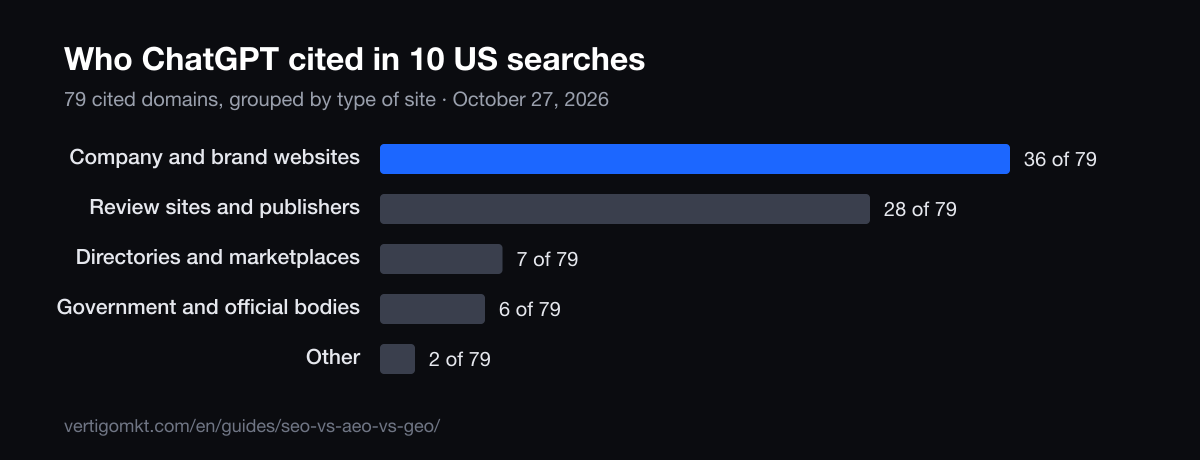
That split says a lot about GEO. Almost half of the citations (36 of 79) went to the websites of the companies being compared: software vendors, shoe brands, hotels, law firms and clinics. Another 28 went to review and comparison sites, and 7 to directories and marketplaces such as Yelp, Avvo, Angi and Tripadvisor. For the heat pump question, three of the four sources were government sites, including energy.gov and a Department of Energy national laboratory.
One more detail matters if you sell something. Every search ChatGPT ran behind the scenes (its query fan-out) carried a year, 2026 in nine of ten. Half of them already named brands before reading a single page: “Follow Up Boss Lofty Wise Agent” for the CRM question, “Asana ClickUp Trello Monday.com Basecamp” for project management. The shortlist came from the model first and the web second. A brand missing from that shortlist may never be looked up at all.
SEO: still the price of entry
SEO is the work of getting pages crawled, indexed and ranked in classic results. It has not gone anywhere, and Google treats it as the ticket into its AI features too. Its documentation on AI features says there are no extra requirements or special optimizations for AI Overviews or AI Mode: a page has to be indexed and eligible to appear with a snippet, like any other result.
What changed is the payoff from a ranking. Pew Research Center tracked the browsing of 900 US adults in March 2025. When a Google results page showed an AI summary, people clicked a traditional result on 8% of visits, against 15% when there was none, and clicked a link inside the summary on just 1%. Ranking still gets you considered. It no longer guarantees the visit.
Google’s counterpoint, in its May 2025 advice to site owners, is that clicks from pages with AI Overviews are of higher quality, with visitors staying longer. Both things can be true at once, and they point the same way: judge search by leads and sales, not sessions.
An SEO example
A dental practice in Phoenix wants the people searching “dental implants cost phoenix”. The SEO work is the familiar list. A dedicated implants page that loads fast on a phone, a title that matches the query, a Business Profile with reviews, internal links from the homepage, and enough local mentions to rank. In our check every organic result on page one for that query was a practice’s own website. Local service searches like this one are still decided mostly by classic local SEO.
AEO: write the answer an engine can lift
Answer engine optimization is about the passage, not the page. It grew up around featured snippets, People Also Ask boxes and voice assistants, which surface or read out a single answer, and it now covers the parts of AI Overviews that summarize a page in its own words. The engine picks the passage. Your job is to make it easy to pick.
Google is blunt that nobody can choose to be a featured snippet: its systems decide, and no markup makes it happen. What you control is whether a quotable answer exists on the page at all. That usually means the question as a heading, two or three sentences of answer straight after it, then the detail for readers who want more.
A before-and-after
Picture a kitchen remodeler’s cost page. The usual version opens with three paragraphs about the owner’s passion for kitchens, and the price range turns up halfway down. The AEO version opens with a heading that matches the question (“How much does a kitchen remodel cost?”), gives the typical range for the area and what pushes it up or down, then a table by project size. Same page, same keyword. Only one of them can be quoted in a sentence.
- Headings phrased the way people ask, follow-ups included (“Is it worth it?”, “How long does it take?”).
- A direct answer in the first 40 to 60 words under each heading.
- Numbered lists for steps and real HTML tables for comparisons.
- Structured data that matches what is visible on the page, which Google’s May 2025 guidance asks for in so many words.
- One strong page per question rather than five thin ones.
Much of this is simply good SEO copywriting. The extra discipline is writing for extraction: every key passage should still make sense when a machine quotes it on its own, stripped of the paragraphs around it.
GEO: become a source the model wants to cite
Generative engine optimization takes its name from a 2023 paper by researchers at Princeton and IIT Delhi, GEO: Generative Engine Optimization, later accepted at the KDD 2024 conference. The authors built a benchmark of about 10,000 queries and measured how edits to a page changed its visibility inside AI-generated answers. Their headline: the right edits raised visibility by up to 40%.
What worked is more useful than the headline. Adding citations to credible sources, quotations and statistics gave the biggest lifts, roughly 30% to 40% on the paper’s main visibility measure. Keyword stuffing did little, and on Perplexity it performed about 10% worse than leaving the page alone. Pages ranked fifth in the underlying search gained most: adding citations raised their visibility by 115%, while the top-ranked page lost about 30% on average under the same edit.
Our searches add the commercial side. For “best” questions, ChatGPT drew on the vendors’ own sites and on the review and comparison pages that list them. So GEO has two halves. Make your own pages factual and quotable, and get your brand into the third-party lists, reviews and directories that a model reads before it writes.
A GEO example
A real estate CRM wants agents to hear its name. Its SEO team chases rankings for “real estate crm”. The GEO work looks different: a pricing and features page with plain facts a model can repeat, profiles and reviews on the comparison sites that turned up among ChatGPT’s sources, accurate entries in software directories, and customer stories with numbers. In our check, ChatGPT cited 12 domains for that question and none of them ranked in Google’s organic results for the same words.
There is a technical gate as well. OpenAI’s crawler documentation says sites that block OAI-SearchBot will not be shown in ChatGPT search answers, apart from plain navigational links. Blocking GPTBot, the crawler that gathers training data, is a separate decision with separate effects. Read your robots.txt before you plan anything else.
Vértigo Marketing runs GEO and SEO for companies in the US, the UK and Canada. Get a free review
What changes in practice, and what stays the same
Most of the day-to-day work carries over. This table separates the tasks that stay from the ones that shift, so you can see where new effort should go.
| Area | Stays the same | What AEO and GEO add |
|---|---|---|
| Research | Keyword research still shows demand | The full questions people type into ChatGPT, follow-ups included |
| Content | Helpful, original pages written for people | Answer first, facts with sources, numbers a model can quote |
| Technical | Crawlable, indexable, fast pages | Access for OAI-SearchBot and the other AI search crawlers you want |
| Authority | Links from relevant sites | Mentions on review sites, directories, forums and lists, linked or not |
| Local | Business Profile, reviews, consistent name, address and phone | Nothing new to learn: AI Overviews pull ratings and reviews into local answers |
| Reporting | Rankings, clicks and conversions | Share of AI answers that name you, cited URLs, which rivals appear |
Source: Vértigo Marketing, from Google’s May 2025 guidance on AI search and the GEO paper.
Local deserves a closer look. In our check, the AI Overviews for the Houston lawyer and San Diego hotel questions were built around business listings with star ratings and review counts. The groundwork that wins the map pack is feeding the AI answer too.
Measurement is where the genuinely new work sits. Search Console counts AI Overviews and AI Mode traffic inside its ordinary Web search report, and it says nothing at all about ChatGPT, Perplexity or the other assistants. For those, someone has to ask the questions your buyers ask and log who gets named. Software does this at scale; we compare the options in our roundups of the best GEO tools and the best AEO tools.
Where to start, by type of business
Do not split the budget three ways. Start with the layer that is weakest for your kind of business and let the rest follow.
- Local services: lawyers, dentists, contractors
- SEO first: Business Profile, reviews, one page per service and city. Then AEO on those pages, with price ranges and the questions clients actually ask. GEO arrives largely through legal, medical and trade directories and review platforms, which made up a good share of ChatGPT’s sources for the Houston question.
- Software and B2B
- GEO early. Buyers ask ChatGPT for shortlists, and in our check those shortlists leaned on vendor sites and comparison pages that often do not rank on Google. Get onto those lists, keep pricing and feature pages factual and current, and publish comparisons honest enough to be quoted.
- Online stores
- AEO and product data. Clear specs, real reviews and comparison tables are what both AI Overviews and ChatGPT lift. Keep Merchant Center data current too, since Google names it as an input for its multimodal search.
- Publishers and information sites
- Expect fewer clicks on questions the results page now answers. Original data, expert quotes and statistics, the three edits that did best in the GEO study, are what get you cited instead of merely summarized.
Your first 30 days
- Open robots.txt: Googlebot, Bingbot and OAI-SearchBot allowed, plus a deliberate choice on GPTBot.
- Write down 20 questions customers ask before buying, in their own words.
- Run them in Google and ChatGPT and note who appears and which sources get cited. A free AI visibility check gives a first snapshot.
- Rewrite your five most important pages so each answers its main question in the opening lines.
- Pick the three outside sites that came up most and work on being listed or reviewed there.
- Repeat the same questions every month in the same engines and keep the log.
If you would rather hand it over, our GEO team for US companies works on the three layers together, and our SEO service covers the classic base.
Frequently asked questions
Is GEO replacing SEO?
No. Google says the usual indexing and snippet rules decide whether a page can appear in its AI features, and in our check ChatGPT cited at least one page-one result in 6 of the 9 answers where it searched. GEO adds work on top of SEO; it does not remove the need for it.
What is the difference between AEO and SEO?
SEO aims for a ranked page that people click. AEO aims for the passage an engine shows or reads out as the answer, whether that is a featured snippet, a People Also Ask box, a voice reply or part of an AI Overview. Good AEO starts from good SEO and then reshapes the content so each key answer can stand alone.
Do I need different agencies for SEO, AEO and GEO?
Usually not. Most of the work overlaps, and splitting it produces reports that contradict each other. What matters is whether your agency measures AI answers directly (who gets named, which rivals appear, which sources the engines cite) instead of reporting rankings alone.
Does schema markup help with AI answers?
It helps engines read your page and makes it eligible for rich results, and Google asks that it match the visible content. Google also says no special schema is needed to appear in AI Overviews or AI Mode. Treat it as hygiene rather than a shortcut.
How do I know if ChatGPT recommends my business?
Ask it the questions your customers ask, logged out and without naming your brand, then note who it names and which pages it cites. Answers vary between runs, so repeat the same set on a schedule. Tracking tools automate this across several AI engines.
Can I block AI crawlers and still rank in Google?
Yes. Blocking GPTBot keeps your content out of OpenAI’s model training and has no effect on Google. Blocking OAI-SearchBot removes you from ChatGPT search answers. On Google, AI Overviews follow the normal Googlebot rules and snippet controls such as nosnippet, while Google-Extended covers some of Google’s other AI uses.
Which should a small business do first?
The SEO basics, because they feed everything else: a fast site Google can index, a complete Business Profile, reviews and one clear page per service. Then rewrite those pages so they answer questions directly. A lot of the GEO work on directories and reviews comes almost for free once that base is in place.
Sources
Figures and claims in this guide come from these sources:
- Google Search Central: AI features and your website (updated December 10, 2025)
- Google Search Central Blog: Top ways to ensure your content performs well in Google’s AI experiences on Search (May 21, 2025)
- Google Search Central: Featured snippets and your website
- Google: AI Mode in Google Search, updates from Google I/O 2025 (May 20, 2025)
- Aggarwal et al.: GEO: Generative Engine Optimization (arXiv 2311.09735, KDD 2024)
- Pew Research Center: Google users are less likely to click on links when an AI summary appears in the results (July 22, 2025)
- OpenAI: Overview of OpenAI crawlers
By the Vértigo Marketing Published Reviewed