What is generative engine optimization? The study, the numbers and first steps
What is generative engine optimization? GEO is the work of getting your brand mentioned or cited when AI systems like ChatGPT, Perplexity or Google AI Mode write an answer. The term comes from a 2023 Princeton-led study, which found that adding quotations, statistics and cited sources made pages up to 40% more visible in those answers.
Most explanations of GEO stop at a line about “optimizing for AI” and a handful of tips. The term has a precise origin, though: a research paper that built a benchmark, defined how to measure visibility inside an AI answer, and tried nine ways of editing a page. Its numbers get quoted everywhere, usually stripped of the context that makes them useful.
Here we walk through that study in detail, explain how generative engines pick their sources today, and add our own check of what ChatGPT cited for 11 buying questions on October 27, 2026. New to the wider topic? Start with what AEO is, since GEO chases the same goal for engines that write their own replies.
What is generative engine optimization? A plain definition
Generative engine optimization is the practice of raising the odds that an AI system which writes answers will use your content, name your brand or link to your page when it replies. As the original study framed it, a generative engine first retrieves sources and then writes a response from them. ChatGPT with search, Perplexity, Google’s AI Mode and AI Overviews, Microsoft Copilot and Claude all work roughly that way.
Two outcomes count. A citation is the small source link that points to your page. A mention is your brand’s name in the text itself, linked or not. Classic SEO judges a page by where it ranks; GEO judges a brand by how often, and how prominently, it turns up across many answers. That is why the work reaches far beyond your own site.
What GEO means in SEO
Ask an SEO “what is GEO in SEO?” and the answer will nearly always be generative engine optimization. Google’s documentation on its AI features spells the acronym out that way and treats the work as part of SEO rather than a rival to it. In practice GEO stretches SEO in two directions: making pages easy for a model to quote, and building the reputation across other sites that models read before they recommend anyone.
GEO marketing: two different things
Search for “geo marketing” and you get two unrelated meanings. The older one is geomarketing: using location data to target ads, choose store sites or tailor offers by area, the world of geotargeting and geofencing. The newer one is marketing built around generative engine optimization. People in the US type “geo marketing” about 880 times a month, according to Google Ads, and the results mix both senses. If a vendor pitches you GEO marketing, ask which kind before you read the proposal.
Where the term came from: the GEO study
The name comes from GEO: Generative Engine Optimization, a paper first posted on arXiv on November 16, 2023 and accepted at KDD 2024, the ACM data mining conference held in Barcelona from August 25 to 29, 2024. Its six authors came from Princeton University, IIT Delhi and independent research: Pranjal Aggarwal, Vishvak Murahari, Tanmay Rajpurohit, Ashwin Kalyan, Karthik Narasimhan and Ameet Deshpande. The latest version is dated June 28, 2024, and the code and data are public.
What they built
- A benchmark called GEO-bench: 10,000 queries drawn from nine sources, among them MS MARCO, Natural Questions, ELI5, Perplexity’s Discover page and questions written by GPT-4. About 80% are informational and 10% each transactional and navigational, spread over 25 subject areas and split 8,000 for training, 1,000 for validation and 1,000 for testing.
- A test engine: for each query, the cleaned text of the top five Google results went to GPT-3.5-turbo, which wrote an answer with citations. Every answer was generated five times to smooth out randomness.
- A reality check: a subset of 200 queries run on Perplexity, the only commercial engine in the paper. Because Perplexity would not take source URLs, the edited text was uploaded as files.
How they measured visibility
There are no ranking positions inside a paragraph, so the authors invented two scores.
- Position-Adjusted Word Count
- How many words of the answer are attributed to your source, with words in early sentences weighted more than those near the end. It is the objective measure of share and prominence.
- Subjective Impression
- A score graded by a language model that blends seven judgments: relevance to the query, how much the answer leans on the source, how unique its material is, its perceived position and amount, how likely a reader would be to click it, and the variety of what it adds.
The procedure was simple in principle. Pick one of the five sources at random, rewrite it with a given technique, rerun the engine, and compare that source’s scores with the untouched version.
The nine edits tested, and what each one did
Short answer: the edits that added evidence won, and the classic SEO move lost. Quotations, statistics and source citations raised visibility the most, by about 28% to 41% on the word-count score. Keyword stuffing lowered it.
| Method | What the edit does | Position-Adjusted Word Count | Subjective Impression |
|---|---|---|---|
| Quotation Addition | Adds relevant quotes from credible sources | +40.9% | +28.0% |
| Statistics Addition | Swaps vague claims for numbers | +30.6% | +22.8% |
| Fluency Optimization | Makes the text read more smoothly | +28.0% | +13.5% |
| Cite Sources | Adds citations to credible sources | +27.5% | +13.5% |
| Technical Terms | Adds specialist vocabulary | +17.6% | +10.9% |
| Easy-to-Understand | Simplifies the language | +14.0% | +6.2% |
| Authoritative | Makes the tone more confident and persuasive | +10.4% | +18.7% |
| Unique Words | Adds less common words | +6.2% | +5.7% |
| Keyword Stuffing | Repeats keywords from the query | -8.3% | +4.7% |
Change against the unedited source, which scored 19.3 on both measures, on the GEO-bench test set. Percentages calculated by Vértigo Marketing from Table 1 of arXiv 2311.09735v3.
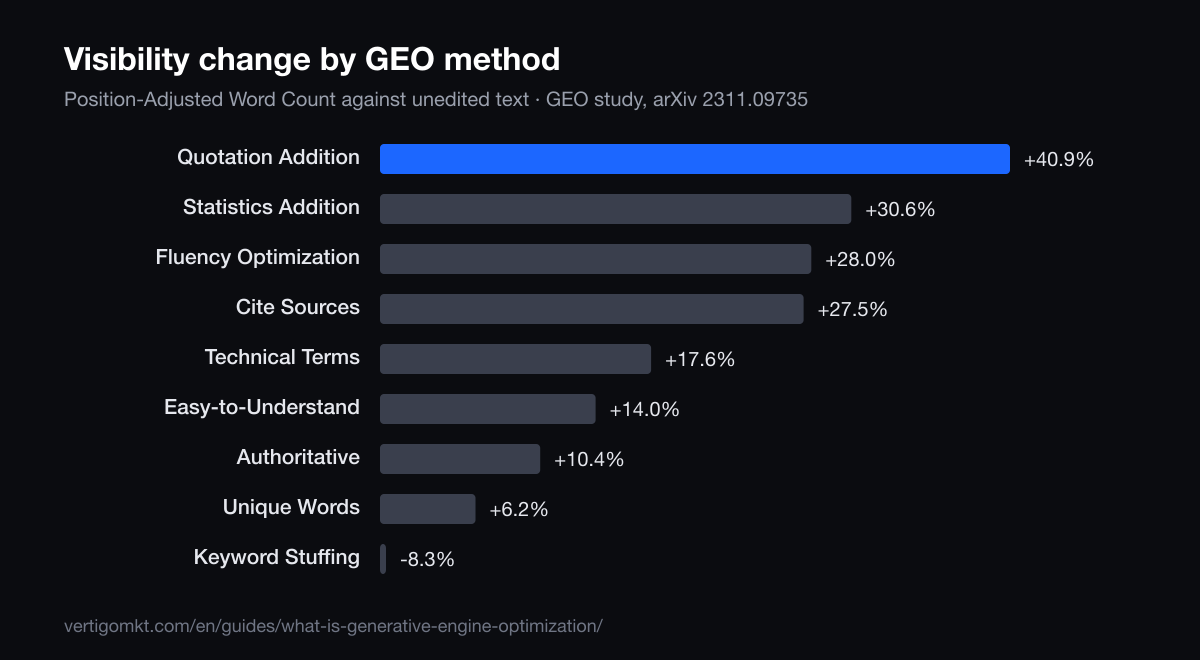
Three details are easy to miss. The paper rounds its own headline to 41% on word count and 28% on impression, which is where the much-repeated “up to 40%” comes from. Style mattered more than you might expect: fluency and readability edits alone lifted visibility by roughly 15% to 30% by the authors’ count. And a more confident, authoritative tone did less than they had predicted, which they took as a sign that engines already discount bold claims.
The best edit depends on the subject
The authors tagged every query by domain and listed where each technique did best. The winners shift with the topic:
| Method | Top categories in the study |
|---|---|
| Authoritative | Debate, history, science |
| Fluency Optimization | Business, science, health |
| Cite Sources | Statements, facts, law and government |
| Quotation Addition | People and society, explanations, history |
| Statistics Addition | Law and government, debate, opinion |
Source: Table 3 of arXiv 2311.09735v3.
Our reading for businesses: a law firm or public body has the most to gain from citations and figures, a culture or lifestyle publisher from quotes, and a B2B or health site from clear, fluent writing. Treat that as a starting hypothesis to measure, not a rule.
Pages lower in the results gained the most
The most striking finding concerns position. The edits helped pages near the bottom of the five sources far more than pages at the top, and the top source usually lost share when it was the one being edited.
| Method | Rank 1 | Rank 2 | Rank 3 | Rank 4 | Rank 5 |
|---|---|---|---|---|---|
| Cite Sources | -30.3% | +2.5% | +20.4% | +15.5% | +115.1% |
| Quotation Addition | -22.9% | -7.0% | +3.5% | +25.1% | +99.7% |
| Statistics Addition | -20.6% | -3.9% | +8.1% | +10.0% | +97.9% |
| Authoritative | -6.0% | +4.1% | -0.6% | +12.6% | +6.1% |
| Fluency Optimization | -2.0% | +5.2% | +3.6% | -4.4% | +2.2% |
Rank is the position of the edited page among the five Google results given to the engine. Source: Table 2 of arXiv 2311.09735v3.
The authors presented this as good news for small publishers that struggle to outrank big brands: inside a generative answer, stronger evidence can partly offset a weaker position. The flip side is that a page already leading the pack has little to gain from these edits, and may lose ground.
Combined edits, and the Perplexity test
On a 200-query subset, the best pair was fluency optimization plus statistics addition, which beat any single method by more than 5.5%. Citations worked better in company than alone, averaging a 31.4% gain when paired with other methods. On Perplexity, quotations raised the word-count score by 22%, statistics lifted the subjective score by up to 37%, and keyword stuffing came out 10% worse than the original text, as the paper reports.
What the GEO study did not prove
The paper is candid about its limits, and they matter whenever someone sells you a GEO package with its numbers on the slide.
- Two engines only. One was a GPT-3.5 setup the authors built in 2023; the other was Perplexity. Today’s engines run newer models and their own search systems.
- A fixed set of sources. Every test began with the five pages already chosen. The edits changed how much of the answer a page earned, not whether the page was found in the first place.
- No ranking effect measured. The authors did not test whether the edits move search rankings, though they argue that text changes of this kind are unlikely to move them much.
- A moving target. They note that query patterns drift, that the benchmark needs regular updates, and that models with longer context windows may weaken the pull of search rank.
A later review sharpens the point. A critical survey posted on arXiv in July 2026, covering 45 GEO studies released since November 2023, concluded that the original gains hold within that setup, once a source is already in the engine’s context, but that no technique it reviewed shows a stable, long-term effect across platforms on whether content gets discovered. It also warns that rewriting text to be cited can hurt retrieval, and that commercial audits show little overlap in the sources cited and big swings from one run to the next. It is a single-author preprint, but its caution fits what repeated tracking of AI answers tends to show.
So read the study this way. Its edits are worth making, because they help once an engine has your page in hand. Getting into its hands is a separate job, and that one is mostly SEO, crawler access and reputation.
How generative engines choose their sources today
In short, they decide whether to search, turn the question into several searches, pull candidate pages from an index, keep the passages that answer best, then write and cite. Each step is a gate your content has to get through.
- Decide whether to search. ChatGPT answers many settled questions from memory; in our AEO check it looked things up for only 3 of 12 quick factual questions. Buying questions behave differently, as the next section shows.
- Expand the question. Google calls this query fan-out: the model runs related searches at the same time to gather more material. Our captures show ChatGPT running background searches of its own as well.
- Retrieve candidates. Google’s AI features draw on its own index and ranking systems, so a page must be indexed and eligible for a snippet. ChatGPT search leaves out sites that block OpenAI’s OAI-SearchBot crawler, navigational links aside, and Perplexity searches the web in real time for each question.
- Select passages. Microsoft describes splitting pages into pieces and scoring each one for relevance and authority before assembling an answer from several sources.
- Write and cite. The engine composes the reply and attaches links. This is the step the GEO study measured, and where quotes, figures and citations pull their weight.
Steps one to three decide whether you are in the running at all, and they reward the same things classic search does: crawlable pages, a site the index trusts, and coverage of the questions people ask. Steps four and five are where GEO-specific writing helps. Google’s guidance on generative AI features puts it plainly, describing grounding as retrieval through its core ranking systems before anything gets written.
What ChatGPT cited for 11 buying questions
The study measured edits to pages that were already in the mix. We wanted to see which pages get into the mix for the questions businesses care about most. So on October 27, 2026 we asked ChatGPT (logged out, United States) 11 recommendation questions in 11 categories, from pet insurance and payroll software to roofers in Denver and wedding venues near Austin, plus one question asking what GEO is.
Our own check, run on October 27, 2026. AI answers change over time, so the same question may get a different answer today.
| Question | Category | Pages cited | Best-of lists among them | Links to recommended businesses |
|---|---|---|---|---|
| which online coding bootcamp has the best job placement | Education | 6 | 3 | 4 |
| which email marketing platform is best for a small nonprofit | Software | 6 | 4 | 4 |
| what’s the best pet insurance for an older dog | Insurance | 3 | 2 | 4 |
| can you recommend a good roofing company in denver | Home services, local | 4 | 4 | 4 |
| best high yield savings account right now | Banking | 3 | 3 | 5 |
| best moving company for a cross country move | Moving | 6 | 4 | 5 |
| good wedding venues near austin texas | Events, local | 9 | 0 | 8 |
| best payroll software for a small business with 10 employees | Software | 5 | 5 | 5 |
| which standing desk is actually worth the money | Retail | 8 | 4 | 3 |
| best meal kit delivery service for two people | Food | 7 | 7 | 5 |
| best ski resort in colorado for beginners | Travel | 8 | 1 | 0 |
| Total | 65 | 37 | 47 |
Pages cited are distinct URLs used as sources in the answer. Links to recommended businesses are the separate links ChatGPT attached to the companies it suggested.
- ChatGPT searched the web for all 12 questions. Compare that with our AEO check, where it searched for just 3 of 12 quick factual questions. Asking for a recommendation reliably sends it looking.
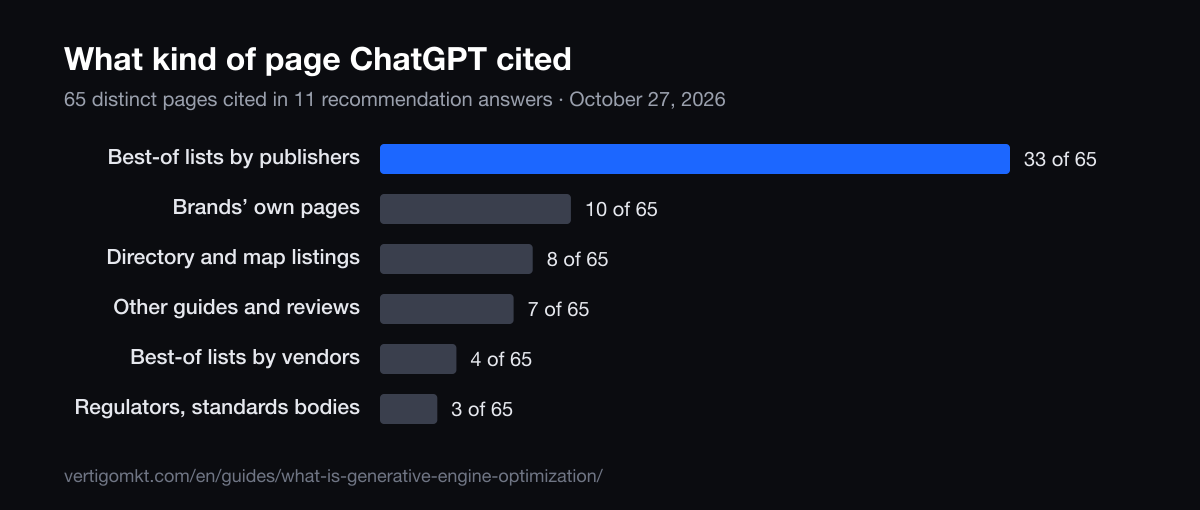
- Best-of lists dominated. 37 of the 65 distinct pages it cited (57%) were best-of or comparison lists, and lists turned up in 10 of the 11 answers. For meal kits all seven cited pages were lists; for payroll software, all five.
- The lists were fresh. 29 of the 37 carried 2026 in the title.
- Some lists came from competitors. Four were written by companies ranking their own market: an email platform (Constant Contact), two payroll providers (ADP and OnPay) and a coding bootcamp (TripleTen). Three of those four also appeared among the businesses ChatGPT recommended with a link.
- Recommended businesses got links of their own. Apart from the citations, ChatGPT attached 47 links to the official sites of the businesses it suggested, in 10 of the 11 answers. The ski answer pointed to Google Maps and Tripadvisor listings instead.
- Local questions worked differently. For wedding venues near Austin there was no list at all, just four Yelp profiles and the venues’ own websites. For roofers in Denver, all four cited pages were local best-of lists.
- It searched for proof. Four of its 15 background searches named a regulator, a standards body or a deposit guarantee: FMCSA for movers, CIRR outcome reports for bootcamps (twice) and FDIC insurance for savings accounts. Two of the cited moving pages sat on the FMCSA site.
- Asked about GEO itself, it skipped the origin. For “what is generative engine optimization” ChatGPT cited Search Engine Land, Seer Interactive and the July 2026 survey on arXiv. The answer never mentioned Princeton or the 2023 paper that named the field.
What it means for your GEO plan
For buying questions, the citation battle happens largely on other people’s pages. Your own site still counts, since ten of the cited pages belonged to the brands themselves, but most of what ChatGPT read before recommending anyone came from comparison lists. The job is to find the lists it reads for your category and earn a fair place on them with accurate, current information. That is digital PR and partnership work rather than an on-page tweak.
Freshness and proof come next. Lists with this year in the title dominated, so a comparison page of your own needs a date and genuine updates. Keep it honest, though: Google’s guide uses a “7 tips” style article as its example of commodity content, and a list earns citations through its data (rates, outcome reports, prices), not the number in its headline. If your industry has a regulator or a standards body, make sure your record there is complete, because the engine may well look it up.
Vértigo Marketing runs GEO and SEO for companies in the US, the UK and Canada. Get a free review
First steps with GEO
Start small and measure before and after. These six steps follow the evidence above, and the last column says where each one comes from.
| Step | What to do | Why |
|---|---|---|
| 1. Open the door | Allow OAI-SearchBot, Googlebot, Bingbot and PerplexityBot in robots.txt; keep key facts in plain HTML | Engines can only cite pages they can fetch (OpenAI, Google and Microsoft documentation) |
| 2. Write your prompt list | Note 20 to 30 questions buyers ask, in their words, including “best” and “near me” versions | Every recommendation question in our check triggered a search |
| 3. Record a baseline | Ask each question in ChatGPT, Perplexity and Google; log who is named and which pages are cited | Answers vary between runs, so you need a starting point |
| 4. Add evidence to five key pages | Insert sourced statistics, short quotes from named experts and links to primary sources | The three strongest edits in the GEO study |
| 5. Get onto the lists | Contact the publishers of the best-of pages the engines cited and offer accurate, current data | 37 of the 65 pages ChatGPT cited were lists |
| 6. Be verifiable | Keep registrations, licenses, reviews and directory profiles complete and consistent | ChatGPT searched regulator and standards names (FMCSA, CIRR, FDIC) |
Source: Vértigo Marketing, from the GEO paper, official crawler documentation and our check of October 27, 2026.
Repeat step three every month with the same questions. On Google’s side, the generative AI performance report in Search Console, launched on June 3, 2026 and open to every site since August 31, counts how often your pages appear in AI Overviews and AI Mode. ChatGPT and Perplexity offer no such report, so you sample the answers yourself or use a tracker. Slibur.com’s free AI visibility checker is one place to begin, and our roundup of the best GEO tools compares the paid options.
If you would like a team to run it, our GEO service for US companies works through these steps with you. For how GEO sits alongside the search work you already do, read SEO vs AEO vs GEO; for the naming debate, AEO vs GEO.
Frequently asked questions
Who coined the term generative engine optimization?
Researchers from Princeton University and IIT Delhi, with two independent co-authors, in the paper “GEO: Generative Engine Optimization”. It was first posted on arXiv on November 16, 2023 and accepted at KDD 2024, a peer-reviewed data mining conference.
Is generative engine optimization just SEO?
From Google’s side, yes: its documentation calls optimizing for its AI features “still SEO”. Beyond Google the overlap is large but not total. ChatGPT and Perplexity use their own crawlers and searches, and their recommendation answers lean heavily on third-party lists and reviews, so GEO puts more weight on your reputation across other sites.
What does GEO mean in marketing?
Two things, depending on who says it. In search and content marketing it means generative engine optimization, being cited by AI engines. In retail and advertising it often means geomarketing, using location data for targeting, store planning and local offers.
Does keyword stuffing help with GEO?
No. In the GEO study, repeating query keywords cut the word-count visibility score by 8.3% on the test engine and by about 10% on Perplexity. It was the only one of the nine methods that made things worse on that measure.
How do you measure GEO results?
Pick a fixed set of buyer questions, ask them on a schedule in each engine, and record whether your brand is named, where it appears and which pages are cited. Since answers vary from run to run, look at shares across several samples rather than single replies. For Google, the generative AI performance report in Search Console adds official impression data.
Does GEO work for local businesses?
Yes, with a local twist. When we asked ChatGPT for wedding venues near Austin, it cited Yelp profiles and the venues’ own websites instead of best-of articles, while for roofers in Denver it leaned on local best-of lists. Complete directory profiles, real reviews and a clear website count for more than clever copy.
Is the 40% figure from the GEO study reliable?
It is real within the study’s setup: a 2023 test engine reading five fixed sources, where adding quotations raised the word-count score by about 41%. It does not mean any page will be 40% more visible in ChatGPT today, and a 2026 survey of later research found no technique with a proven long-term effect across platforms.
Keep reading
Sources
Figures and claims in this guide come from these sources:
- Aggarwal et al.: GEO: Generative Engine Optimization (arXiv 2311.09735, first posted November 16, 2023; KDD 2024)
- GEO: Generative Engine Optimization, full text, version 3 (June 28, 2024)
- GEO project code and data (GitHub)
- Martinez: Optimizing Visibility in Generative Engines: A Critical Survey of Generative Engine Optimization (2023-2026) (arXiv 2607.14035, July 15, 2026)
- Google Search Central: Optimizing your website for generative AI features on Google Search (updated July 10, 2026)
- Google Search Central Blog: Introducing Search Generative AI performance reports in Search Console (June 3, 2026)
- OpenAI: Overview of OpenAI crawlers
- Microsoft Advertising Blog: Optimizing Your Content for Inclusion in AI Search Answers (October 8, 2025)
- Perplexity Help Center: How does Perplexity work?
By the Vértigo Marketing Published Reviewed