Query fan-out: the hidden searches behind AI answers, and how to match them
Query fan-out is the step between a question and an AI answer: the engine rewrites the question into one or more web searches, reads the results and writes one reply. Google uses the term for AI Mode and AI Overviews. ChatGPT does it too: in our check it searched for 14 of 15 questions, adding years, brands and places nobody typed.

Type a question into ChatGPT and, most of the time, it does not answer straight away. It goes to the web first, with searches it writes itself. Those searches decide which pages the model reads, and the pages it reads decide which businesses end up in the answer. A page that does not match the search never gets considered.
So the hidden searches are worth a close look. We put 15 everyday questions to ChatGPT and saved every search it ran, then pooled 58 more answers from our other US checks on the same day. Here is what Google and OpenAI actually say about the mechanism, what the searches looked like, and how to write pages that line up with them.
What query fan-out is, in plain English
Query fan-out is the habit AI search systems have of splitting one question into several searches, running them, and blending the results into one answer. The name comes from Google. The logic is simple: a conversational question with three parts is easier to answer with three precise searches than with one vague one.
Google first used the phrase when it introduced AI Mode on March 5, 2025, describing searches issued at the same time across subtopics and several data sources, including the Knowledge Graph and shopping data. At Google I/O on May 20, 2025, Head of Search Elizabeth Reid added that AI Mode breaks a question into subtopics and fires off a multitude of queries for the user, and that its Deep Search mode can issue hundreds.
The term now lives in Google’s developer documentation. The page AI features and your website, last updated December 10, 2025, says AI Overviews and AI Mode may both use the technique, and that the extra searches let Google show a wider, more varied set of supporting links. To be one of those links, a page has to be indexed and eligible to appear with a snippet. Google lists no special markup or trick on top of that.
What OpenAI says about ChatGPT
OpenAI does not use the phrase, yet it describes the same mechanism. Its help article on ChatGPT search explains that ChatGPT typically rewrites a question into one or more targeted queries for the search providers it works with, and may send more specific queries once the first results are in. It can pass along a general location based on your IP address and, for logged-in users with Memory on, details from saved memories.
At heart, then, the two biggest AI search products behave alike: question in, searches out, one answer back. The differences are in scale and in where the results come from.
| Google AI Mode and AI Overviews | ChatGPT search | |
|---|---|---|
| What the company calls it | Query fan-out | No name; OpenAI says ChatGPT rewrites your question into targeted queries |
| How many searches | A multitude in AI Mode, hundreds in Deep Search | One or more, plus follow-ups when needed |
| What shapes them | The subtopics of the question | The question, rough location from your IP, saved memories |
| Where results come from | Google’s index plus the Knowledge Graph and shopping data | Third-party search providers and content from partners |
| What a page needs | Indexed and eligible for a snippet | Open to OAI-SearchBot, OpenAI’s search crawler |
Sources: Google blog (March 5 and May 20, 2025), Google Search Central (updated December 10, 2025), OpenAI launch post (October 31, 2024), OpenAI Help Center and crawler documentation, checked October 27, 2026.
Why one question becomes several searches
Short answer: people talk to chatbots in sentences, and search indexes respond best to keywords. The fan-out step translates one into the other and, while it is at it, fills in what the person left out.
- Questions have parts
- A comparison is really two lookups. Asked about Shopify vs WooCommerce for a small clothing store, ChatGPT ran one search for each platform’s official pricing. Costco against Sam’s Club also got two searches, both asking for official information.
- Answers go stale
- Prices, limits and rankings change every year, so the engine pins the search to a date. A plain question about 401k contribution limits went out as a search for the IRS limits for 2026, with the word official attached.
- Context is missing
- People skip what seems obvious to them: the state, the budget, what counts as good. The search fills it in, sometimes with details the person never gave, such as a location inferred from the connection.
- Some facts need a primary source
- For money, health and law, the searches lean toward official pages. In a related check, a question about the symptoms of vitamin D deficiency was sent as a search for the NIH Office of Dietary Supplements fact sheet.
- Broad questions need a plan
- Google describes AI Mode making a plan, searching, then adjusting the plan to what it finds. Our bakery owner in Austin, asking how to get more customers from Google, triggered one search on how Google ranks local businesses and another on Austin bakeries in Google Maps.
None of this is exotic. Search engines have quietly expanded queries for years, adding synonyms or fixing typos inside a single search. The new part is that the AI runs separate searches, reads the pages itself and chooses which ones to quote.
What ChatGPT searched for: 15 real questions
We asked ChatGPT 15 questions of the kind real customers type, logged out and from the United States, on the same chatgpt.com a new visitor sees. They mixed buying decisions, local questions in six cities, plain information and head-to-head comparisons. For every answer we saved the reply, the cited sources and the searches it ran behind the scenes.
Our own check, run on October 27, 2026. AI answers change over time, so the same question may get a different answer today.
| What we asked | What ChatGPT searched for |
|---|---|
| best air purifier for a small apartment with pets | best air purifier for pets small apartment HEPA activated carbon 2026 Coway Levoit Winix |
| what’s the best electric SUV for a family | best electric SUVs for families 2026 comparison safety range cargo space latest |
| best pediatric dentist in Charlotte NC | best pediatric dentists Charlotte NC reviews board certified pediatric dentist |
| good HVAC company in Phoenix for AC repair | best HVAC AC repair companies Phoenix AZ reviews pricing warranties |
| estate planning attorney in Minneapolis | best estate planning attorneys Minneapolis Minnesota wills trusts official websites |
| how long does it take to sell a house in Texas right now | Texas housing market October 2026 median days on market time to sell home Texas 2026 |
| what are the 401k contribution limits | IRS 401(k) contribution limits 2026 employee elective deferral catch-up limit official |
| HubSpot or Salesforce for a 20 person sales team | Two searches: HubSpot Sales Hub pricing official 2026 seats Professional Enterprise / Salesforce Sales Cloud pricing official 2026 Enterprise Professional |
| plan a 3 day trip to Nashville with kids in December, where to stay and what to do | Nashville Tennessee family things to do December 2026 Christmas events kids |
| I run a bakery in Austin, how do I get more customers from Google | Two searches: Google Business Profile improve local ranking relevance distance prominence official help / Austin TX bakeries Google Maps local search bakery |
| how does a heat pump water heater work | No search; answered from training |
Vértigo Marketing check on chatgpt.com, logged out, US, October 27, 2026. Searches copied exactly as ChatGPT wrote them. Each question was asked once; 11 of the 15 shown.
- It searched almost every time. 14 of the 15 questions triggered a web search. The exception was how a heat pump water heater works, a textbook question it answered from what it already knew.
- Usually one search, sometimes two. Ten answers ran a single search and four ran two, 18 in total. Three of the doubles were comparisons; the fourth was the bakery question, which really has two parts. The iPhone 17 against Pixel 10 comparison made do with one.
- A year went in by default. Ten of the 14 searches carried 2026 without anyone asking for it. The four without a year were all about local businesses: the dentist, the HVAC company, the estate attorney and the bakery.
- “Official” appeared in 6 of 14. ChatGPT asked for official pricing pages, official IRS figures, official help pages and, for the estate attorney, the firms’ official websites.
- The searches were not shorter than the questions. They averaged 10.3 words against 9.4 for what we typed. Filler words went out, and more specific ones came in.
- A results list of about ten, about five citations. Each answer drew on 10.6 search results on average and cited 4.6 distinct pages.
The words ChatGPT adds that nobody typed
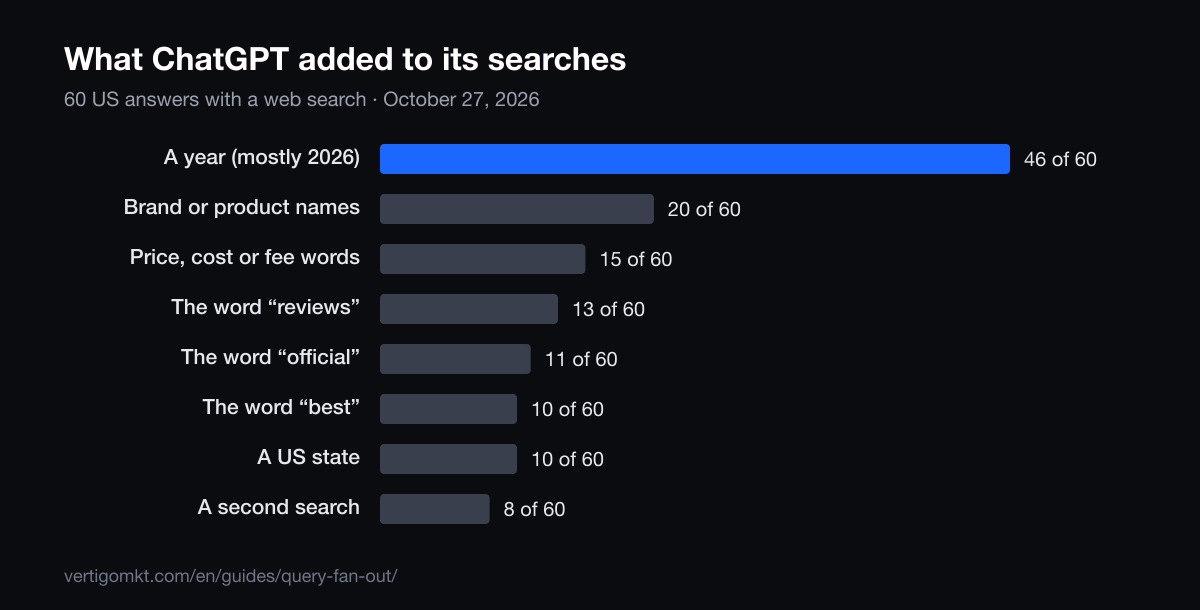
Fifteen questions is a small sample, so we pooled every US answer we saved that day, from this check and the ones behind six other guides: 73 answers, 60 of them with at least one search. The chart counts how often a search contained something the question did not.
Years: freshness is the default
ChatGPT treats nearly everything as time-sensitive. In 46 of the 60 answers that searched, the search carried a year the person had not typed, and three went further and named the month, October 2026, for Texas home sales, savings rates and the Federal Reserve. Only two answers searched with 2025 alone.
For a business, that is a hint about titles and dates. A buying guide called “Best air purifiers for pets” now competes for a search containing 2026 with guides that carry 2026 in the title. An honest, visible update date counts for more than it did.
Brands: the shortlist exists before the search
In 20 answers the search already named brands the person never mentioned. A plain request for cheap car insurance went out with five insurers in it. Asking which standing desk is worth the money produced a search with four desk makers and three model names. Those names can only have come from what the model already knew.
This is the uncomfortable side of query fan-out. When a brand is absent from the model’s memory, the search may never ask about it, and the results that come back are tuned to the names it did include. Being written about across the web, so the model learns your name, is part of the job. Our comparison of SEO vs AEO vs GEO explains where that work fits.
Trust words: official, reviews, licensed
The searches choose their kind of source before any result arrives. Software and membership comparisons asked for official pricing. Local services asked for reviews, plus “board certified” for the pediatric dentist and warranties for the HVAC company. In that Phoenix answer, ChatGPT also cited the Arizona Registrar of Contractors, the state body that licenses contractors.
Each of those words maps to a page you can publish or earn: a pricing page with current fees, a review profile, a credentials section with the license number on it.
Places: completed, and sometimes guessed
City questions had their state added: Phoenix AZ, Minneapolis Minnesota, San Antonio Texas, Nashville Tennessee. Two questions got a place out of thin air. Cheap car insurance was searched for California, and the cost of replacing a water heater for New Jersey, though neither question named a state.
That fits OpenAI’s note that ChatGPT may share a general location, based on IP address, with its search providers. Our checks run through a data provider’s US connection, so the state most likely reflects that connection rather than a real customer. The lesson for regional businesses: the search often carries a place even when the person does not type one.
When there is no search at all
Thirteen of the 73 answers involved no search. All were questions with settled answers: getting rid of fruit flies, freezing cooked rice, what a Roth IRA is, unclogging a sink, what AEO means. There is no fan-out there, and the reply comes from training. Matching the searches only helps where searches happen.
Our numbers next to a bigger dataset
Larger datasets agree on the direction, with different numbers. Peec AI, a tracking company, analyzed 5 million fan-outs from ChatGPT, Perplexity and Grok collected April 1 to 21, 2026. It counted 2.1 fan-outs per prompt for ChatGPT, 1.4 for Perplexity and 6.8 for Grok, with best, top, comparison and reviews among the words ChatGPT added most, and the current year in 5.44% of prompts.
Our single-question, logged-out sample from late October saw fewer searches (1.13 per answer that searched) and far more years (in 77% of answers with a search). Different setups and six months of model updates are the likely reasons. It is also a good argument for checking your own market instead of trusting any one average.
How to write for query fan-out
Nobody controls the searches an AI writes, but they are predictable enough to plan around. Seven habits cover most of it.
- Start from real questions. List the 20 or 30 questions customers ask before they buy, in their own words, with the city where it matters.
- Capture the searches behind them. Ask each one in ChatGPT, logged out, and record the searches, or use a tracker that logs them. Slibur.com shows the searches each AI ran for every prompt it tracks, and our roundup of AEO keyword research tools compares other options.
- Match the rewritten query, not only the question. If the search reads “estate planning attorneys Minneapolis Minnesota wills trusts”, the page title and first heading should name the service, the city, the state and the specific work.
- Show the year where it is true. Give guides and price pages a real updated date, refresh them when facts change, and never stamp a new year on an untouched page.
- Publish the official facts yourself. Pricing, fees, plan limits, warranties, licenses and certifications belong on your own site, in plain text. When ChatGPT goes looking for official information, it can only quote yours if it exists.
- Give each subtopic its own section. A page that covers cost, timing, risks and alternatives in separate, self-contained sections can match several branches of the same fan-out.
- Earn a place on the pages the searches find. Searches with best or reviews in them return lists, review sites and local media. The Seattle brunch answer cited three food guides and the city’s tourism site, and nothing else. Getting onto pages like those is often worth more than another post on your blog.
| If the search adds… | It is looking for | What to publish or earn |
|---|---|---|
| A year or a month | Current information | Visible update dates, yearly refreshes of guides and price pages |
| “Official” | The primary source | Pricing, policies, fees and limits on your own site |
| “Reviews”, “board certified”, “warranty” | Proof of trust | Review profiles, credentials, license numbers, warranty terms |
| “Best” plus a category | Ranked lists | A place in roundups and comparisons written by others |
| A city and a state | Local relevance | Location pages with the full place name, a complete Google Business Profile |
| Brand names | A known shortlist | Mentions on authoritative sites, so the model knows your name |
| Price or fee words | Concrete numbers | Real prices or ranges, with what each one includes |
Vértigo Marketing, based on the patterns in our October 27, 2026 checks.
One technical point sits under all of it: an AI can only use what its search can reach. Google asks for a page that is indexed and eligible for a snippet. For ChatGPT, OpenAI’s crawler documentation says sites that block OAI-SearchBot will not be shown in ChatGPT search answers, apart from navigational links. Check robots.txt before writing anything new.
Paid placement is a separate track. ChatGPT ads appear below the answer and, according to OpenAI, do not influence what the answer says, so they do nothing for the searches described here.
Vértigo Marketing runs GEO and SEO for companies in the US, the UK and Canada. Get a free review
How to find the fan-out queries in your market
Three practical routes, from free to automated.
- Ask and read closely
- Run your customers’ questions in a logged-out ChatGPT window and note the pages it cites. The cited pages and the wording of the reply hint at the searches behind them: a reply full of 2026 prices came from a search with a year in it.
- Use a tracker that records them
- Tools that read answers from chatgpt.com can store the searches alongside each reply. Our list of ChatGPT rank trackers compares several. Slibur.com logs the fan-out for every prompt it tracks, which makes a ready-made content brief.
- Work backward from Google
- For AI Mode and AI Overviews, the supporting links show which pages won. Look at what those pages cover that yours does not, and which subtopics they answer in sections of their own.
Whatever the route, repeat the check. The searches shift with the date, the model and the place, and a single run is a snapshot. We asked each question once, so treat our numbers as a picture of one day in October 2026, not a law of nature.
If you would rather hand the work over, our GEO services for US companies begin with this kind of audit: your buyers’ questions, the searches behind them and the pages that win. Classic rankings still feed both Google and ChatGPT, and that side is covered by our SEO services.
Frequently asked questions
What is query fan-out in simple terms?
It is the step where an AI search tool turns your question into one or more web searches, reads the results and combines them into a single answer. Google uses the name for AI Mode and AI Overviews. ChatGPT does the same thing without giving it a name.
Does ChatGPT use query fan-out?
Yes. OpenAI says ChatGPT rewrites a question into one or more targeted searches for its search providers and can follow up with more specific ones. In our October 2026 check it searched for 14 of 15 everyday questions.
How many searches does ChatGPT run per question?
Usually one or two for an ordinary question. Of 60 US answers with a search in our checks, 52 used one and 8 used two. Peec AI’s April 2026 dataset averaged 2.1 per prompt. Research modes go much further: Google says its Deep Search can issue hundreds of searches.
Is query fan-out the same as query expansion?
Related, but different. Query expansion quietly adds synonyms or corrections to a single search. Fan-out runs several separate searches, often on different subtopics, and the AI then reads and merges the results.
Can I see the fan-out queries ChatGPT uses?
Not reliably from the chat window. Tracking tools and data providers that read chatgpt.com can capture them, which is how we collected the searches quoted in this guide.
Do keywords still matter if the AI writes its own searches?
Yes, arguably more. The searches ChatGPT wrote looked like classic keyword queries, packed with categories, places, years and brand names. Pages that match those queries get read; pages that only match the original wording may not.
Does query fan-out work the same in every language?
Not always. In our checks from Spain, a question asked in Spanish about apps for learning English was searched in English. Look at the fan-out in the language and country of your own customers.
Keep reading
- SEO vs AEO vs GEO: what each one wins you, shown on 10 real searches
- AEO vs GEO: two labels, one job, and the few cases where the difference matters
- ChatGPT Ads in the US: What They Cost and How to Run Them
- How much does GEO cost? What agencies, freelancers and in-house teams charge in 2026
- GEO agency services in the United States
- AEO and GEO tools, compared
Sources
Figures and claims in this guide come from these sources:
- Google Search Central: AI features and your website (updated December 10, 2025)
- Google: Expanding AI Overviews and introducing AI Mode (March 5, 2025)
- Google: AI Mode in Google Search, updates from Google I/O 2025 (May 20, 2025)
- OpenAI: Introducing ChatGPT search (October 31, 2024)
- OpenAI Help Center: ChatGPT search
- OpenAI: Overview of OpenAI crawlers
- Peec AI: Fan-outs per prompt by engine (May 2026, data from April 1 to 21, 2026)
- Peec AI: Words ChatGPT adds to fan-out searches (May 2026)
By the Vértigo Marketing Published Reviewed