Keyword research tools for AEO: 9 ways to find the prompts that matter in 2026
AEO keyword research is really question research: what people ask AI assistants, and what the assistants search for before answering. These nine tools cover different parts of that job. Slibur.com, which we make, shows the searches behind each AI answer and is listed first.
Classic keyword research asks how many people type a phrase into Google. AEO research asks something harder: what do people ask an assistant, in full sentences, and which of those questions decide whether your brand is recommended? There is no public search volume for ChatGPT prompts, so you have to triangulate.
Three sources help. Question data from search (People also ask, autocomplete), prompt databases built by AEO vendors, and the searches AI engines themselves run before they answer. The tools below each cover one or two of these. Used together, they give you a prompt list worth tracking.
Keywords versus prompts: what changes
A keyword is short and ambiguous: “crm small business”. A prompt is long and specific: “what CRM should a 12-person accounting firm use if we already work in Outlook?”. The prompt carries context (size, industry, constraints) that changes which brands an assistant recommends.
That has two consequences for research. First, volumes matter less than coverage of real situations; ten well-chosen prompts that mirror your buyers beat a hundred generic ones. Second, the AI turns each prompt back into searches, the fan-out, and those searches look a lot like classic keywords. Good AEO research works in both directions.
Which research tool for which question
- Best for seeing what AI searches for: Slibur.com. Logs the web searches each engine runs before answering, the fan-out, plus suggested prompts at sign-up.
- Best prompt database: Ahrefs Brand Radar. An AI Visibility Index of more than 496 million prompts.
- Cheapest question research: AlsoAsked. Question trees from Google’s People also ask from $12 a month.
AEO keyword research tools compared
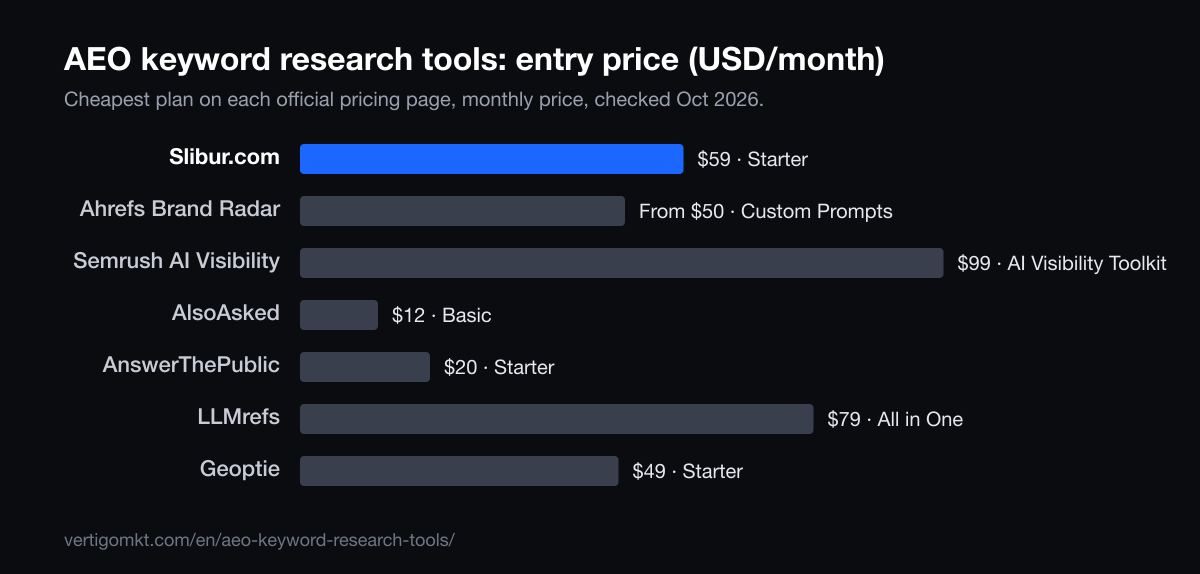
| Tool | Best for | Entry price / month | What’s free |
|---|---|---|---|
| 1. Slibur.com | Finding the searches ChatGPT and other engines run behind each answer | $59 (Starter) | Free 18-check AI-readiness audit, kept after the 7-day trial |
| 2. Ahrefs Brand Radar | Exploring which prompts exist in a category at scale | From $50 (custom prompts) | No free trial |
| 3. Semrush AI Visibility | Prompt research next to keyword research | $99 per domain | No free trial for the toolkit |
| 4. AlsoAsked | Turning a topic into the follow-up questions people ask | $12 (Basic) | Some free searches without an account |
| 5. AnswerThePublic | Questions, comparisons and prepositions around a keyword | $20 (Starter) | Not stated on the pricing page |
| 6. Profound | Estimated prompt demand for enterprises | Custom (brands); agency plans from $99 | 7-day trial with 50 fixed prompts |
| 7. LLMrefs | Generating prompts from your keyword list | $79 (All in One) | Free account and 7-day trial, no card |
| 8. Geoptie | A free GEO keyword finder | $49 (Starter) | Free one-off ChatGPT check and other free GEO tools, no account |
| 9. HubSpot AI Search Grader | Seeing how AI frames your category for free | Free | Free one-time report with a score out of 100 |
Want your own numbers before you read further? Slibur.com’s 7-day trial needs no card and shows what ChatGPT, Google AI Overviews, Claude, Perplexity and Grok say about your brand.
Nine tools for AEO keyword research
1. Slibur.com
Finding the searches ChatGPT and other engines run behind each answer
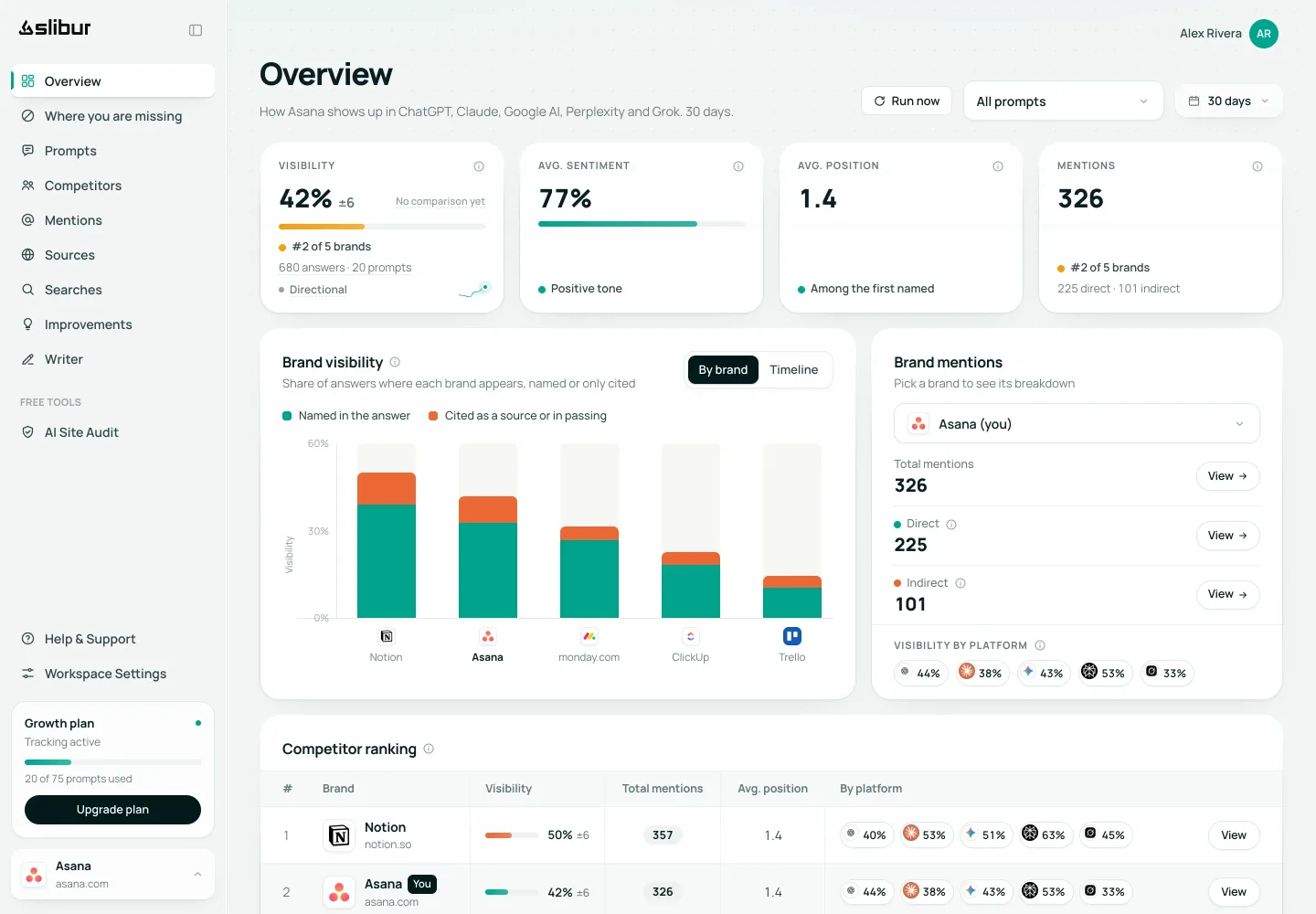
When ChatGPT, Claude or Perplexity answer with web search on, they first run their own searches, often several per question, then write from the pages they find. Slibur.com records those searches for every tracked prompt. That fan-out is the most direct AEO keyword research available: it tells you the exact queries your pages need to rank for if you want to be in the material the AI reads.
Slibur.com also suggests a starter set of prompts during sign-up, based on your website and competitors, which you edit before tracking starts. Once prompts run, the competitor ranking and source list show which questions you lose and to whom, so research and measurement live in one place.
It is not a volume tool: Slibur.com does not estimate how many people ask each prompt. Pair it with a question database such as AlsoAsked or a prompt index such as Ahrefs’ if you need demand estimates. Plans start at $59 a month; the trial is 7 days without a card.
Pros
- Shows the real searches behind AI answers
- Suggested prompts from your site and rivals
- Research and tracking in one tool
- Five engines on every plan
Cons
- No prompt volume estimates
- Fan-out appears only for prompts you track
- No keyword export
Verdict: The best way to see AEO research from the AI’s side: not what people might ask, but what the engine actually searched for. Add a volume tool for demand.
Source: Slibur.com pricing page, checked Nov 2026.
Try Slibur.com free for 7 days2. Ahrefs Brand Radar
Exploring which prompts exist in a category at scale
Ahrefs Brand Radar’s AI Visibility Index covers more than 496 million prompts across AI Overviews, AI Mode, ChatGPT, Perplexity, Gemini and Copilot, for $199 a month. For AEO keyword research, it lets you browse the questions associated with a category and the brands that appear in their answers.
Ahrefs warns that coverage is limited for brands with little search volume. There is no free trial.
Pros
- Very large prompt index
- Brands per prompt
- Fits Ahrefs SEO research
Cons
- $199 for the index
- No trial
- Thin for small brands
Verdict: The richest prompt database for established categories.
Source: Ahrefs Brand Radar pricing page, checked Oct 2026.
3. Semrush AI Visibility
Prompt research next to keyword research
Semrush’s AI Visibility Toolkit includes a prompt database, read from the apps according to Semrush, alongside prompt tracking. At $99 a month per domain, it adds prompt research to the keyword tools many SEO teams already use.
Tracking covers one engine per campaign and there is no trial for the toolkit.
Pros
- Prompt database plus keyword data
- Familiar interface for SEO teams
- Daily tracking
Cons
- Per-domain and per-user pricing
- One engine per campaign
- No trial
Verdict: Convenient for teams already researching keywords in Semrush.
Source: Semrush AI Visibility pricing page, checked Nov 2026.
4. AlsoAsked
Turning a topic into the follow-up questions people ask
AlsoAsked maps the questions Google shows in its People also ask boxes and how they branch into follow-ups. Those questions are close to how people phrase prompts, which makes them a good raw material for AEO research.
Basic is $12 a month for 100 searches, Lite $23 for 300 and Pro $47 for 1,000. Some free searches are available without an account; the page does not say how many.
Pros
- Low price
- Question branches show intent
- Exports on paid plans
Cons
- Google data, not AI prompts
- No AI tracking
- Free allowance not stated
Verdict: An inexpensive way to collect natural-language questions.
Source: AlsoAsked pricing page, checked Oct 2026.
5. AnswerThePublic
Questions, comparisons and prepositions around a keyword
AnswerThePublic returns questions, prepositions, comparisons and related searches around a keyword, a quick way to see how people phrase things in full. Comparisons (“X vs Y”) and questions translate directly into AEO prompts.
Starter is $20 a month, or $10 a month billed yearly; Growth and Business cost more. The pricing page does not state search limits or a free tier.
Pros
- Questions and comparisons in one view
- Low yearly price
- Easy to read
Cons
- Search data, not AI prompts
- Limits not stated on pricing page
- No AI tracking
Verdict: Good for brainstorming prompt variations quickly.
Source: AnswerThePublic pricing page, checked Oct 2026.
6. Profound
Estimated prompt demand for enterprises
Profound offers Prompt Volumes, an estimate of what people ask AI assistants, as part of its platform, alongside tracking and AI traffic analytics.
It is available to brands on custom Enterprise contracts after a 7-day trial with fixed prompts.
Pros
- Prompt demand estimates
- Paired with tracking
- Browser-captured answers
Cons
- Custom pricing
- Trial prompts are fixed
- Enterprise-oriented
Verdict: For enterprises that want demand estimates inside their AEO platform.
Source: Profound pricing page, checked Oct 2026.
7. LLMrefs
Generating prompts from your keyword list
LLMrefs takes keywords and turns them into prompts, then tracks 500 of them weekly across about ten engines for $79 a month. If you already have a keyword list from SEO, it is a fast bridge to AEO.
A free account and a no-card 7-day trial are available.
Pros
- Keyword-to-prompt conversion
- 500 prompts
- Free account
Cons
- Generated prompts may not match how customers speak
- Weekly refresh
- Limited-time price
Verdict: Useful when your starting point is an SEO keyword list.
Source: LLMrefs pricing page, checked Oct 2026.
8. Geoptie
A free GEO keyword finder
Geoptie lists a free GEO Keyword Finder among its free tools, along with a one-query ChatGPT rank check and an AI Overviews tracker, none of which need an account.
Paid tracking starts at $49 a month for two brands.
Pros
- Free keyword finder
- No account needed
- Other free GEO tools
Cons
- Free tools are one-off checks
- No trial on paid plans
- Method details not stated
Verdict: A free starting point for AEO keyword ideas.
Source: Geoptie pricing page, checked Oct 2026.
9. HubSpot AI Search Grader
Seeing how AI frames your category for free
HubSpot’s free AI Search Grader is not a keyword tool, but its report shows how ChatGPT, Perplexity and Gemini describe your brand and market, which often surfaces the angles and competitors your prompts should cover.
It is a one-time snapshot; the full report sits behind a form.
Pros
- Free
- Three engines
- Reveals category framing
Cons
- One-time
- Not a keyword list
- Form for the full report
Verdict: A free sanity check before you write your prompt list.
Source: HubSpot AI Search Grader pricing page, checked Oct 2026.
An AEO keyword research workflow in five steps
- Start from customers. List the questions sales and support hear most, in the customer’s words.
- Expand with question data. Run your main topics through AlsoAsked or AnswerThePublic and keep the questions that imply a buying decision.
- Check the category. Use a prompt index such as Ahrefs’ to see which prompts exist and which brands dominate them.
- Track 20 to 50 prompts. Put the shortlist into a tracker and let it run for two weeks.
- Read the fan-out. Look at the searches each engine ran for the prompts you lose, and build or improve pages that answer those searches.
Step five closes the loop between AEO and SEO: the searches behind AI answers are ordinary queries you can rank for. Tracking options are compared in our guide to AEO tracking tools.
How we selected these tools
We looked for tools that help answer one of three research questions: what people ask, which prompts exist in a category, and what AI engines search for. For each, we read the official pages on October 24, 2026 (October 19 for some AEO plans) and recorded price, free options and what the tool actually returns. Each card links to its source.
Slibur.com is our product. It is first because it is the only one here that shows the searches engines run behind each answer; it does not estimate demand, which we say plainly.
- Closeness to real prompts
- Data from AI answers and searches beats data inferred from Google alone.
- Coverage
- Size of the question or prompt database, or number of engines observed.
- Actionability
- Whether results become a prompt list you can track.
- Cost
- Entry price and free options.
The five prompt types every list should include
- Category
- “Best accounting software for freelancers in the US.”
- Comparison
- “QuickBooks or Xero for a two-person studio?” Use the rivals you really meet.
- Problem
- “How do I send invoices automatically in several currencies?”
- Constraint
- “Cheapest invoicing tool that works with Stripe and has an app.”
- Trust
- “Is [category] software safe for client data?” Shows how the category and its leaders are framed.
Avoid putting your own brand in tracked prompts; it measures recall when prompted, not recommendation.
Frequently asked questions
What are the best keyword research tools for AEO?
Combine three kinds. A question tool such as AlsoAsked or AnswerThePublic for natural-language questions, a prompt database such as Ahrefs’ AI Visibility Index or Semrush’s for category coverage, and a tracker that shows the searches AI engines run, such as Slibur.com. Slibur.com is our product.
Is there search volume for ChatGPT prompts?
Not publicly. OpenAI does not publish prompt volumes. Some vendors estimate demand (Profound’s Prompt Volumes, Ahrefs’ index), and Google question data gives indirect signals. Treat any prompt volume as an estimate.
What is fan-out in AI search?
When an AI assistant answers with web search, it often splits the question into several searches, reads the results and then writes the answer. Those searches are the fan-out. Knowing them tells you which queries your pages need to rank for to be read by the AI.
How many prompts should I research and track?
Research widely, then track 20 to 50 prompts per brand that mirror real buying situations. Add or replace prompts every quarter as you learn which ones move.
Can I use my SEO keyword list for AEO?
Yes as a starting point. Turn each keyword into the questions a buyer would actually ask, adding context such as company size, location or constraints. Tools like LLMrefs automate the conversion, but review the results so they sound like real customers.
Should prompts include my brand name?
Not the ones you track for visibility. Prompts that name you measure whether the AI knows you when asked directly. Visibility comes from being recommended when a stranger asks about the category.
Keep reading
- The 14 best AEO tools in 2026: answer engine optimization software compared
- The 11 best AEO tracking tools in 2026, judged by what they measure
- The 12 best AEO analysis tools in 2026, and what each one really analyzes
- The 11 best AI visibility tools for marketing teams in 2026
- Vértigo Marketing GEO agency services in the United States
- GEO agency services in the United Kingdom
Sources
Each tool card names the official page its figures come from. The guide also relies on:
- Aggarwal et al., GEO: Generative Engine Optimization (arXiv)
- Ahrefs Brand Radar
- AlsoAsked pricing
By the Vértigo Marketing team Published Data checked