The 11 best AI visibility tools for marketing teams in 2026
AI visibility has become a line in the marketing report, and the tool behind it decides whether that line means anything. We compared eleven AI visibility tools on what marketing teams need: credible numbers, sources to act on, enough seats and the right countries. Slibur.com, which we make, is first.
Sooner or later someone in leadership asks the question: when people ask ChatGPT about our category, do we come up? The honest answer needs data, and a screenshot of one conversation is not data. It needs the same questions asked every week, on the assistants your customers use, with a record of who appeared and why.
AI visibility tools provide that record. For a marketing team, the choice is less about raw features and more about trust and fit: are the numbers measured in a defensible way, do they point to work the team can do, and does the plan cover your markets and the people who need access? That is how we compared them.
Picks for different marketing teams
- Best for credible numbers: Slibur.com. Answers read as customers see them, missing answers counted as zero and every engine weighted equally.
- Best for teams that need many seats: Peec AI. Unlimited users on every plan, daily data from the apps.
- Best for global enterprises: Profound. Custom regions and languages, up to nine engines and AI traffic analytics.
- Best for multi-country tracking on a budget: Otterly.AI. Unlimited countries, languages and team members from $29.
What AI visibility means for a marketing team
AI visibility is the share of AI-written answers, for the questions your customers ask, that mention your brand. It sits between brand awareness and search performance: it reflects what the web says about you, filtered through an assistant that picks a few names.
For a marketing team, three things make it useful. It shows the competitive set the AI has in mind, which may differ from yours. It reveals the sources shaping that view, which become PR and content targets. And it moves when you do good work, which makes it a fair KPI if measured consistently.
AI visibility tools compared
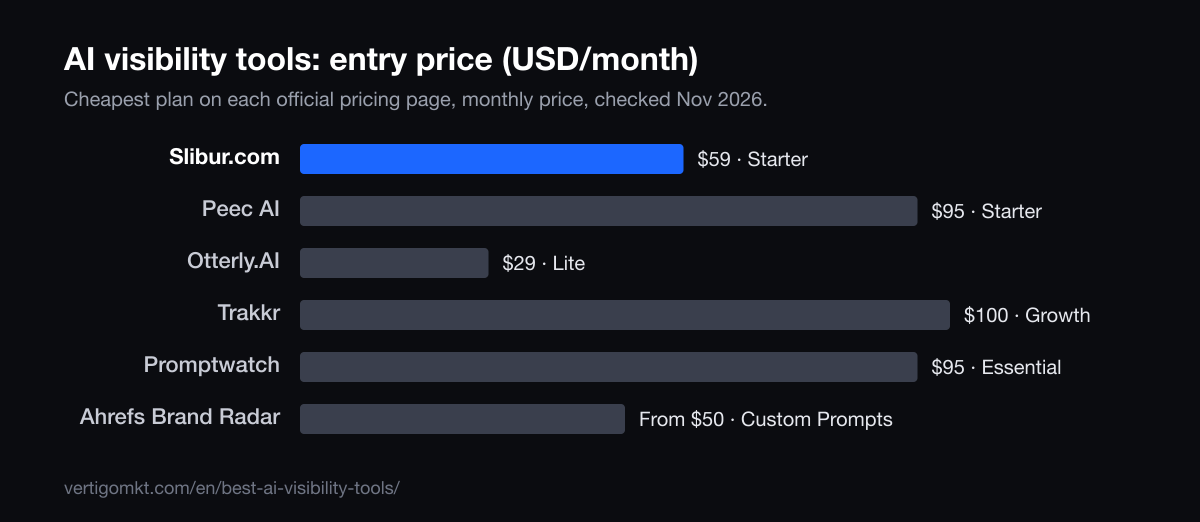
| Tool | Best for | Entry price / month | AI engines | Refresh |
|---|---|---|---|---|
| 1. Slibur.com | Teams that need AI visibility figures they can defend in a board deck | $59 (Starter) | ChatGPT, Google AI Overviews, Claude, Perplexity, Grok (all five on every plan) | ChatGPT and AI Overviews daily; Claude, Perplexity and Grok weekly |
| 2. Peec AI | Large marketing teams centred on Google’s AI | $95 (Starter) | Pick 3: ChatGPT, AI Mode, AI Overviews, Copilot, Gemini, Naver. Perplexity extra | Daily |
| 3. Profound | Global brands with procurement and big budgets | Custom (brands); agency plans from $99 | Trial: ChatGPT, Gemini, AI Overviews; 9 on Enterprise | Daily |
| 4. Otterly.AI | Small teams tracking several countries | $29 (Lite) | ChatGPT, AI Overviews, Perplexity, Copilot. Add-ons: AI Mode +$9, Gemini +$9, Claude +$29 | Daily |
| 5. SE Visible | Share-of-voice reporting at volume | €80 (Basic) | ChatGPT, AI Overviews, AI Mode, Gemini, Copilot. Claude only on Agency (€355), through the API | Daily |
| 6. Scrunch | Brand and technical teams working together | $250 (Core) | ChatGPT, Perplexity, AI Overviews, Copilot; Claude, Grok on Enterprise | Every 72 hours (daily for new prompts in their first 14 days) |
| 7. AthenaHQ | Unlimited seats and many models | $295 (Starter) | 11 models, Claude and Grok included | Credit based |
| 8. HubSpot AEO | Teams running marketing in HubSpot | $50 (25 prompts) | ChatGPT, Gemini, Perplexity | Daily |
| 9. Trakkr | Daily coverage of every major assistant | $100 (Growth) | ChatGPT, Claude, Gemini, Perplexity, AI Overviews, Grok, DeepSeek, Meta AI | Daily |
| 10. Promptwatch | Many models under a monthly cap | $95 (Essential) | All listed models (incl. ChatGPT, AI Overviews, AI Mode, Perplexity, Claude, Gemini) within the cap | Daily |
| 11. Ahrefs Brand Radar | Category-level visibility research | From $50 (custom prompts) | AI Overviews, AI Mode, ChatGPT, Perplexity, Gemini, Copilot, Claude (8 checks per update) | Daily, weekly or monthly |
Want your own numbers before you read further? Slibur.com’s 7-day trial needs no card and shows what ChatGPT, Google AI Overviews, Claude, Perplexity and Grok say about your brand.
Eleven AI visibility tools, ranked
1. Slibur.com
Teams that need AI visibility figures they can defend in a board deck
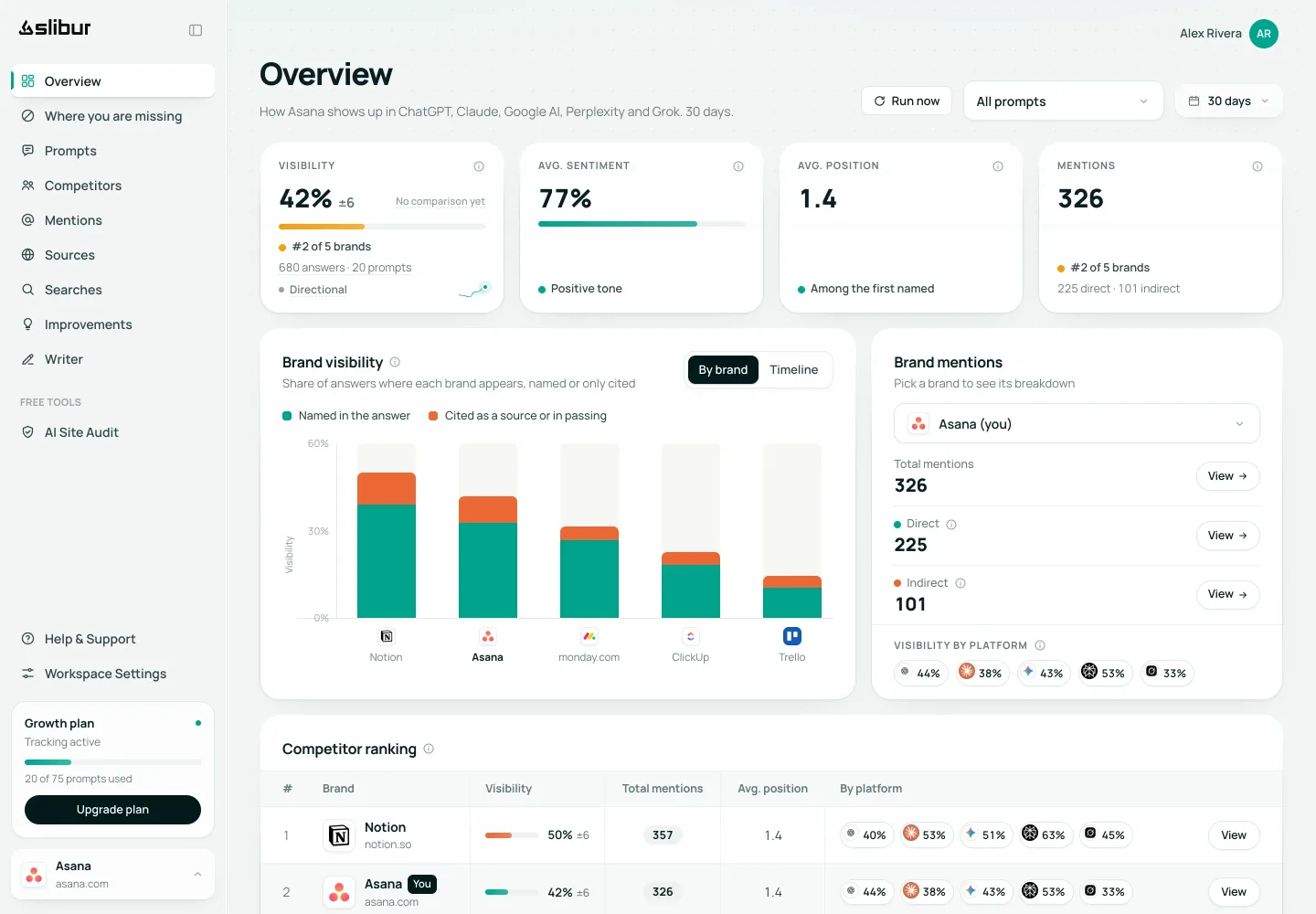
Marketing figures get challenged, so method matters. Slibur.com reads ChatGPT on chatgpt.com and Google’s AI Overview in the live results instead of API replies, sends prompts exactly as customers would type them, counts answers without your brand as zero and gives each engine the same weight in the average. An engine only joins the average once it has at least three answers. Those rules make the visibility number conservative, which is what you want when it goes in front of a CFO.
Around that number, the dashboard shows position, sentiment on a 0 to 100 index, the sources each engine cites (your site, competitors’ sites, third parties), a ranking of up to 25 competitors and the searches the assistant ran. Weekly ideas and an email digest turn movements into talking points for the team.
For marketing teams, check seats before buying: Starter includes 2 members, Growth 10 and Scale unlimited. Each workspace tracks one country and one language, from a list of 40 countries and 7 languages.
Pros
- Conservative, documented method
- Five engines on every plan
- Sources split into yours, rivals’ and third-party
- Weekly email digest for the team
Cons
- Seats limited on Starter and Growth
- One country and language per workspace
- No exports or BI connectors yet
Verdict: The tool to choose when the number has to survive scrutiny. Larger teams should budget for Growth or Scale to get enough seats.
Source: Slibur.com pricing page, checked Nov 2026.
Try Slibur.com free for 7 days2. Peec AI
Large marketing teams centred on Google’s AI
Peec AI gives unlimited users on every plan, which makes it easy to roll out across content, PR and SEO. It analyses visibility, position, sentiment, sources and competitors daily on three engines you choose from ChatGPT, AI Mode, AI Overviews, Copilot, Gemini and Naver, with Google Analytics data alongside.
Starter covers one country in the plan table and costs $95 a month for 50 prompts. Perplexity is extra; Claude and Grok are Enterprise only.
Pros
- Unlimited users
- Daily app-based answers
- Gemini and AI Mode options
Cons
- Three engines per plan
- One country on Starter
- Claude and Grok on Enterprise
Verdict: A team-friendly choice for Google-heavy strategies.
Source: Peec AI pricing page, checked Nov 2026.
3. Profound
Global brands with procurement and big budgets
Profound’s Enterprise plan offers custom regions and languages, unlimited seats and up to nine engines, plus AI traffic analytics, prompt demand estimates and AI agents. It is the most complete package for a multinational marketing organisation.
The trial covers one region and one language with 50 fixed prompts; everything after that is a custom quote.
Pros
- Custom regions and languages
- Unlimited seats
- AI traffic analytics
Cons
- No public price for brands
- Fixed trial prompts
- No Grok listed
Verdict: For global teams that buy enterprise software as a matter of course.
Source: Profound pricing page, checked Oct 2026.
4. Otterly.AI
Small teams tracking several countries
Otterly.AI includes unlimited team members, countries and languages on every plan, which is unusual at $29 a month. Visibility, sentiment and citations are collected daily from the engines’ websites on ChatGPT, AI Overviews, Perplexity and Copilot.
Fifteen prompts on Lite limits how many markets you can cover in depth, and Claude, Gemini and AI Mode are add-ons.
Pros
- Unlimited countries and languages
- Unlimited members
- Low price
Cons
- 15 prompts on Lite
- Add-ons for some engines
- No Grok
Verdict: The cheapest way to watch several markets at once.
Source: Otterly.AI pricing page, checked Oct 2026.
5. SE Visible
Share-of-voice reporting at volume
SE Visible reports share of voice alongside mentions, position, sentiment and citations, and its Basic plan, €80 a month on the pricing page seen from Spain, covers 75 prompts a day, with 200 on Core, enough to report share of voice by product line.
It reads ChatGPT, AI Overviews, AI Mode, Gemini and Copilot; Claude needs the Agency plan.
Pros
- Share of voice at scale
- Browser-based answers
- 10-day trial
Cons
- No Perplexity or Grok
- €80 entry
- Strongest alongside SE Ranking
Verdict: Good for teams reporting share of voice across many topics.
Source: SE Visible pricing page, checked Nov 2026.
6. Scrunch
Brand and technical teams working together
Scrunch combines citations, sentiment and competitors with AI bot traffic, a bridge between marketing and web teams. Core costs $250 a month per brand with 5 user licences, 125 prompts and one country.
Claude, Gemini, AI Mode and Grok are Enterprise only. There is a 7-day trial.
Pros
- Bot traffic plus visibility
- 5 user licences
- 7-day trial
Cons
- $250 per brand
- One country on Core
- Four engines on Core
Verdict: Fits teams where marketing and web share the AI visibility goal.
Source: Scrunch pricing page, checked Oct 2026.
7. AthenaHQ
Unlimited seats and many models
AthenaHQ includes unlimited seats, 11 models and GA4 and Search Console connections on its $295 Starter plan, with a single region and language. The free plan gives 300 credits on five engines.
For a team that wants everyone in the tool and broad model coverage, it is a strong if pricier option.
Pros
- Unlimited seats
- Eleven models
- Analytics connections
Cons
- $295 entry
- Single region and language
- Credit-based
Verdict: For teams that value broad coverage and open access.
Source: AthenaHQ pricing page, checked Oct 2026.
8. HubSpot AEO
Teams running marketing in HubSpot
HubSpot AEO puts AI visibility next to your CRM: visibility, sentiment, share of voice and citations on ChatGPT, Gemini and Perplexity, daily, for $50 a month with 25 prompts.
If campaigns and contacts already live in HubSpot, the context is valuable; as a standalone tool it covers fewer engines.
Pros
- Inside the CRM
- Low price
- Free grader to start
Cons
- Three engines
- No AI Overviews listed
- Best for HubSpot customers
Verdict: Natural for HubSpot-based teams.
Source: HubSpot AEO pricing page, checked Oct 2026.
9. Trakkr
Daily coverage of every major assistant
Trakkr checks 50 prompts every day on ChatGPT, Claude, Gemini, Perplexity, AI Overviews, Grok, DeepSeek and Meta AI for $100 a month.
The trial needs a card and the collection method is not published.
Pros
- Eight engines daily
- 50 prompts
- 14-day trial
Cons
- Card for the trial
- Method not stated
- $100 entry
Verdict: For teams that want every assistant in the report.
Source: Trakkr pricing page, checked Oct 2026.
10. Promptwatch
Many models under a monthly cap
Promptwatch’s $95 Essential plan includes 50 prompts and up to 6,000 answers a month across all its listed models, ChatGPT, AI Overviews, AI Mode, Perplexity, Claude and Gemini among them, with daily refresh.
A 7-day trial is available.
Pros
- Broad model list
- Daily refresh
- 7-day trial
Cons
- Answer cap shared across models
- Method not stated
- $95 entry
Verdict: A balanced option for mid-size teams.
Source: Promptwatch pricing page, checked Nov 2026.
11. Ahrefs Brand Radar
Category-level visibility research
Ahrefs Brand Radar’s AI Visibility Index ($199 a month) shows brand visibility across more than 496 million prompts, which suits category and competitor research. Ahrefs plans include one user each.
Custom prompt tracking starts at $50 a month. No trial.
Pros
- Category-wide research
- Estimated impressions
- Seven engines per prompt
Cons
- One user per Ahrefs plan
- No trial
- Limited for small brands
Verdict: The research layer for teams already in Ahrefs.
Source: Ahrefs Brand Radar pricing page, checked Oct 2026.
AI share of voice, explained
Share of voice in AI is usually your mentions divided by all brand mentions in the answers to your tracked prompts. If ten answers mention brands 40 times and you are named 8 times, your share is 20%.
- It depends on the prompt set. Change the questions and the share changes. Keep the set stable for at least a quarter.
- It hides absence. A high share among answers that mention you says nothing about the answers where you are missing. Read it next to visibility rate.
- It varies by engine. Report it per engine first, then combined.
Not every tool reports a share-of-voice figure; several, Slibur.com included, report visibility and competitor rankings instead, which answer the same question from a different angle.
Seats, countries and languages on entry plans
| Tool | Seats | Countries and languages |
|---|---|---|
| Slibur.com Starter | 2 members (10 on Growth, unlimited on Scale) | One country and language per workspace; 40 countries, 7 languages |
| Peec AI Starter | Unlimited users | 1 country in the plan table; unlimited languages |
| Otterly.AI Lite | Unlimited members | Unlimited countries and languages |
| Scrunch Core | 5 user licences | 1 country, 1 language |
| AthenaHQ Starter | Unlimited seats | Single region and language |
| Profound trial | Unlimited | 1 region, 1 language |
| Semrush toolkit | 1 user; extra users need their own licence | One location and language per campaign; 220+ countries |
| Ahrefs plans | 1 user included | Not stated |
Taken from each vendor’s pricing page, October 2026.
How we compared AI visibility tools
We read each tool’s pricing and documentation pages between October 19 and 24, 2026 and compared what a marketing team relies on: how visibility is measured, the analyses included, engines and refresh rate, seats, countries and languages, and price. Each card links to the source.
Slibur.com is our product. It ranks first on measurement method and engine coverage for the price; its seat and country limits are listed in its card.
- Measurement you can defend
- App or browser answers, a clear definition of visibility and equal treatment of engines.
- Insight to act on
- Sources, sentiment and competitors, not just a score.
- Team fit
- Seats, countries and languages included in the plan.
- Price
- Public entry price and what it really covers.
A monthly AI visibility report in five lines
- Visibility rate for the month versus the previous one, per engine.
- Position when mentioned, and the share of answers where you appear first.
- Competitors that gained or lost ground, with the questions they took.
- Top sources cited for your category, and whether you are present on them.
- Actions for next month: pages to improve, sites to pitch, reviews to earn.
Keep the prompt set fixed so months are comparable. For the analysis behind each line, see our guide to AEO analysis tools.
Frequently asked questions
What is the best AI visibility tool?
We rank Slibur.com first for marketing teams that need defensible numbers: it reads real chatgpt.com and AI Overview answers, counts missing answers as zero, weights engines equally and covers five engines from $59 a month. We make Slibur.com. Peec AI suits teams that need unlimited seats, and Otterly.AI teams tracking several countries on a budget.
What is AI visibility?
The share of AI-written answers, for the questions your customers ask, that mention your brand. It is usually measured per engine (ChatGPT, Google AI Overviews, Perplexity, Claude and others) over a fixed set of prompts.
How do I measure AI visibility?
Choose 20 to 50 prompts that mirror real customer questions, track them on the engines your buyers use with a tool that reads app answers, and report the visibility rate, position, sentiment and competitors monthly. Keep the prompt set stable so changes reflect your work rather than new questions.
Do AI visibility tools track different countries?
Most do, with different rules: Otterly.AI includes unlimited countries and languages, Peec AI lists one country on Starter, and Slibur.com tracks one country and language per workspace from a list of 40. Check the plan before buying if you run several markets.
How much do AI visibility tools cost?
From about $29 to $99 a month for one brand on self-serve plans, around $250 to $300 for broader plans such as Scrunch Core or AthenaHQ Starter, and custom pricing for enterprise platforms such as Profound. Add-on engines and extra seats can raise the bill.
Keep reading
- The 12 best AEO analysis tools in 2026, and what each one really analyzes
- The 14 best AEO tools in 2026: answer engine optimization software compared
- Otterly AI alternatives: 11 tools that include what Otterly charges extra for
- The best ChatGPT rank tracker tools in 2026 for brand mentions and citations
- Vértigo Marketing GEO agency services in the United States
- GEO agency services in the United Kingdom
Sources
Each tool card names the official page its figures come from. The guide also relies on:
- Google Search Central: AI features and your website
- Peec AI pricing
- Semrush: AI Visibility Toolkit
By the Vértigo Marketing team Published Data checked