The 12 best AEO analysis tools in 2026, and what each one really analyzes
Every AEO tool promises insight, but the analyses behind the dashboards differ a lot: some count mentions, others read sources, score sentiment, estimate prompt demand or connect AI traffic. We mapped twelve tools by the analysis they run. Slibur.com is ours and comes first.
A visibility score of 34% is a number, not an analysis. What turns it into a decision is everything around it: which engines that figure comes from, which questions drag it down, which sites the answers lean on, who wins when you lose, and whether the tone around your name is warm or wary.
That is why “AEO analysis tool” is a more useful lens than “AEO tool”. The products below all collect AI answers about brands. They differ in what they do with them. We read each vendor’s documentation and pricing to see which analyses come included, and ranked them on how far those analyses get you towards knowing what to fix.
The six analyses an AEO tool can run
- Visibility analysis
- How often you appear, per engine and per question, over time. The headline number.
- Citation and source analysis
- Which pages the answers cite and whose they are. The basis for any content or PR plan.
- Sentiment analysis
- How you are described. Catches answers that mention you with caveats.
- Competitor analysis
- Who appears instead of you, how often and in what position.
- Prompt and query analysis
- What people ask (prompt volumes) and what engines search for before answering (fan-out).
- Traffic and crawler analysis
- Visits arriving from AI and AI bots reaching your site.
No single tool here does all six on its entry plan. The matrix below shows who covers what.
Best tool for each kind of analysis
- Best all-round analysis: Slibur.com. Visibility, position, sentiment, sources, competitors, indirect mentions and the searches behind each answer, on five engines.
- Best for demand and traffic analysis: Profound. Prompt Volumes and AI traffic analytics on top of visibility, for enterprises.
- Best source analysis for Google’s AI: Peec AI. Daily source and position analysis on the three engines you pick, Gemini and AI Mode included.
- Best market-level analysis: Ahrefs Brand Radar. An index of more than 496 million prompts for category-wide AI visibility.
Which tool runs which analysis
| Tool | Sentiment | Sources / citations | Competitors | Prompt or query research | Traffic or crawlers |
|---|---|---|---|---|---|
| Slibur.com | Yes | Yes, classified | Yes, up to 25 | Fan-out queries | No |
| Profound | Yes | Yes | Yes | Prompt Volumes | AI traffic |
| Peec AI | Yes | Yes | Yes | Not stated | Google Analytics data |
| SE Visible | Yes | Yes | Share of voice | Not stated | No |
| Ahrefs Brand Radar | Not stated | Yes | Yes | Index of 496M+ prompts | Estimated impressions |
| Semrush | Not stated | Yes | Yes | Prompt database | No |
| Scrunch | Yes | Yes | Yes | Not stated | AI bot traffic |
| AthenaHQ | Yes | Yes | Yes | Not stated | GA4 and Search Console |
| Otterly.AI | Yes | Yes | Not stated | Not stated | No |
Based on each vendor’s pricing and product pages, October 2026. “Not stated” means the page does not mention it, not that the feature is absent.
Twelve AEO analysis tools at a glance
| Tool | Best for | Entry price / month | Refresh | Free trial |
|---|---|---|---|---|
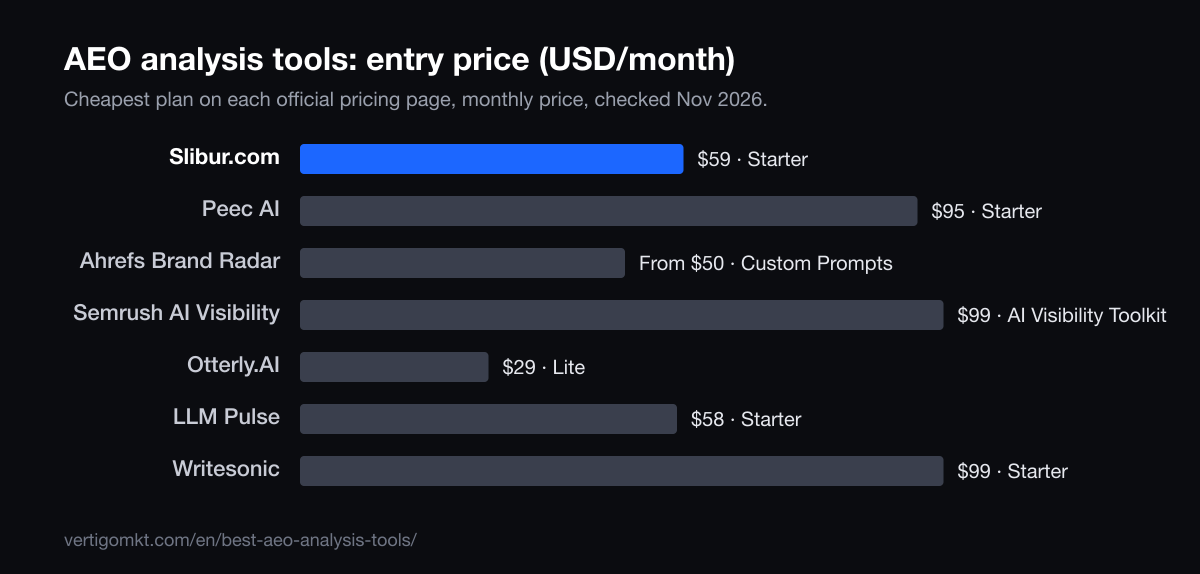
| 1. Slibur.com | Seeing why AI answers favour a competitor, not just that they do | $59 (Starter) | ChatGPT and AI Overviews daily; Claude, Perplexity and Grok weekly | 7 days, no card |
| 2. Profound | Enterprises that want prompt demand and AI traffic in the analysis | Custom (brands); agency plans from $99 | Daily | 7 days, fixed prompts |
| 3. Peec AI | Marketing teams analysing sources on Google’s AI surfaces | $95 (Starter) | Daily | Yes, length not stated |
| 4. SE Visible | Share-of-voice analysis across many prompts | €80 (Basic) | Daily | 10 days (card not stated) |
| 5. Ahrefs Brand Radar | Analysing a whole category before choosing your prompts | From $50 (custom prompts) | Daily, weekly or monthly | No free trial |
| 6. Semrush AI Visibility | Prompt research inside an SEO suite | $99 per domain | Daily (brand reports weekly) | No free trial |
| 7. Scrunch | Analysing AI crawler activity next to visibility | $250 (Core) | Every 72 hours (daily for new prompts in their first 14 days) | 7 days |
| 8. AthenaHQ | Sentiment and citation analysis across many models | $295 (Starter) | Credit based | Free plan, 300 credits |
| 9. Otterly.AI | Basic analysis on a small budget | $29 (Lite) | Daily | 7 days, no card |
| 10. LLM Pulse | Share of voice with GA4 on a weekly plan | $58 (Starter) | Weekly by default; daily is a separate, pricier plan | 14 days on weekly Starter, Growth and Scale, payment method required; daily plans start without a trial |
| 11. Writesonic | Analysis that leads straight into content | $99 (Starter) | Daily | Free start, no card |
| 12. HubSpot AEO | Analysis inside HubSpot | $50 (25 prompts) | Daily | Not stated |
Want your own numbers before you read further? Slibur.com’s 7-day trial needs no card and shows what ChatGPT, Google AI Overviews, Claude, Perplexity and Grok say about your brand.
The analysis tools, ranked
1. Slibur.com
Seeing why AI answers favour a competitor, not just that they do
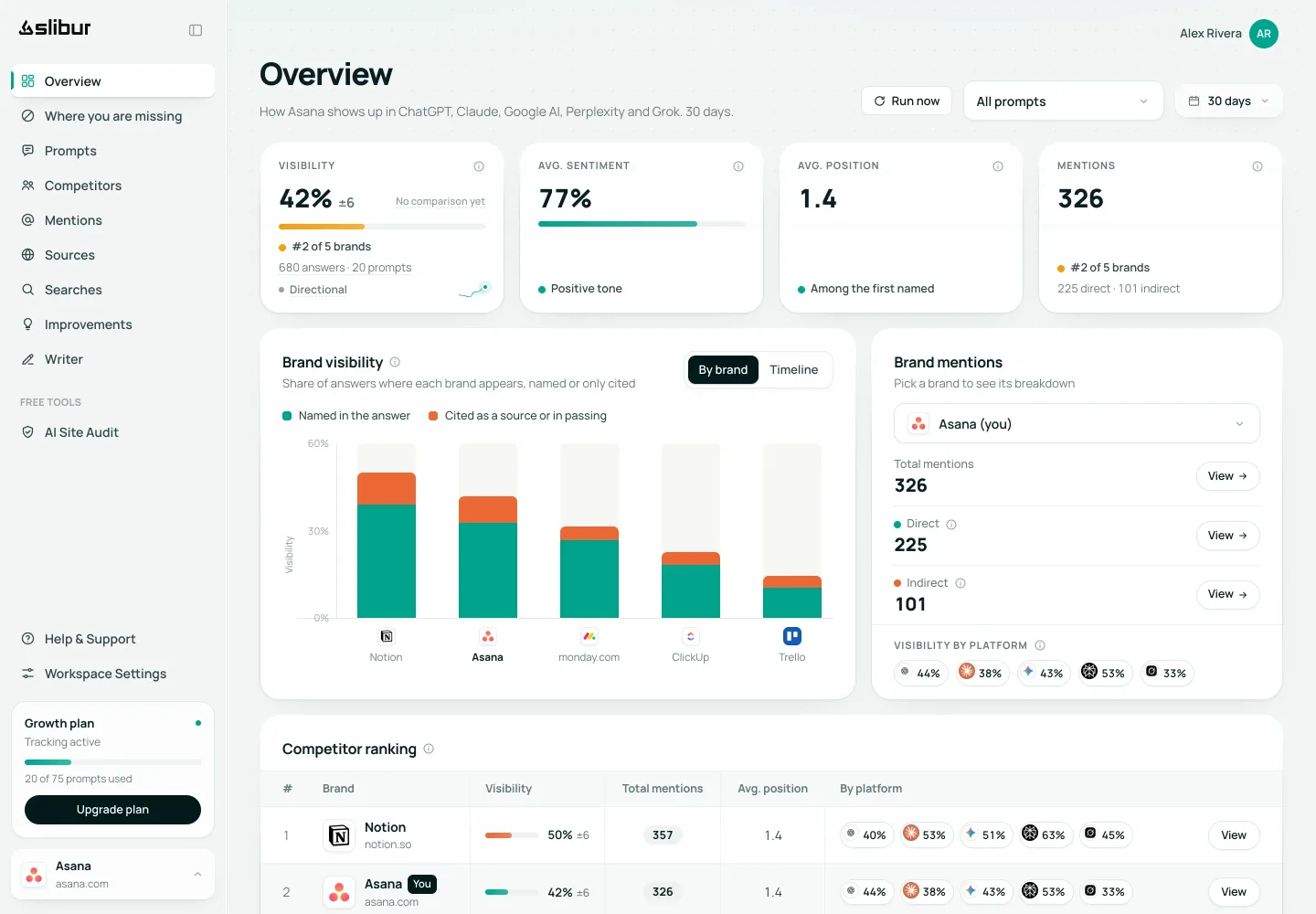
Slibur.com’s analysis starts from answers read the way customers see them (chatgpt.com and live Google AI Overviews daily, Claude, Perplexity and Grok weekly) and layers seven views on top: visibility with missing answers counted as zero, average position, sentiment on a 0 to 100 index, the share of answers that cite your own site, every source domain sorted into yours, competitors’ and third parties’, a ranking of up to 25 rivals, and the fan-out queries each engine ran before answering.
Two analyses are rare in this market. Indirect mentions catch answers that rely on your pages without naming you, a sign that content is working before the brand is. Fan-out queries show the exact web searches behind an answer, which turns AEO analysis into a list of searches your pages need to win. Every engine weighs the same in the averages, so one chatty assistant cannot skew the result.
Weekly ideas translate the patterns into actions, each with the figure that triggered it, for example “sources that recommend rivals” or “named, but your site is not the source”. Plans start at $59 a month with all five engines; the trial is 7 days without a card.
Pros
- Seven analyses on every plan
- Indirect mentions and fan-out queries
- Sources classified as yours, rivals’ or third-party
- Equal weighting across engines
Cons
- No AI traffic or crawler analytics
- No prompt volume estimates
- Gemini, AI Mode and Copilot not covered
Verdict: The deepest per-answer analysis at this price, built to explain who wins and why. Pair it with GA4 if you also need traffic from AI.
Source: Slibur.com pricing page, checked Nov 2026.
Try Slibur.com free for 7 days2. Profound
Enterprises that want prompt demand and AI traffic in the analysis
Profound adds two analyses most trackers lack: Prompt Volumes, an estimate of what people ask AI assistants, and Agent Analytics, which looks at AI-driven traffic. Around them sit share of voice, citations, sentiment, rankings and competitors across up to nine engines on Enterprise, captured in the browser.
For brands, it comes after a 7-day trial with 50 fixed prompts and a custom Enterprise quote.
Pros
- Prompt demand estimates
- AI traffic analysis
- Up to nine engines
Cons
- Custom pricing for brands
- Trial prompts cannot be edited
- No Grok listed
Verdict: The widest analysis suite here, priced and sold for large organisations.
Source: Profound pricing page, checked Oct 2026.
3. Peec AI
Marketing teams analysing sources on Google’s AI surfaces
Peec AI analyses visibility, position, sentiment, sources and competitors every day, with Google Analytics alongside, on three engines chosen from ChatGPT, AI Mode, AI Overviews, Copilot, Gemini and Naver.
Its source reports are a strong point for teams planning PR and content. Starter is $95 a month for 50 prompts; Perplexity is extra and Claude and Grok are Enterprise only.
Pros
- Source and position analysis
- Gemini and AI Mode options
- Google Analytics data
Cons
- Three engines per plan
- Perplexity costs extra
- No Claude or Grok below Enterprise
Verdict: A good analysis tool for Google-centred strategies.
Source: Peec AI pricing page, checked Nov 2026.
4. SE Visible
Share-of-voice analysis across many prompts
SE Visible reports mentions, position, sentiment, share of voice and citations, read through the browser. Its Basic plan analyses 75 prompts a day for €80 a month (the price shown in Spain), and Core 200, enough for share-of-voice figures that hold up over time.
Engines are ChatGPT, AI Overviews, AI Mode, Gemini and Copilot; Claude is only on Agency, by API, and Perplexity and Grok are absent.
Pros
- Large samples for share of voice
- Five metrics included
- Browser-based answers
Cons
- No Perplexity or Grok
- €80 entry
- Best inside SE Ranking
Verdict: The volume analyst’s choice.
Source: SE Visible pricing page, checked Nov 2026.
5. Ahrefs Brand Radar
Analysing a whole category before choosing your prompts
Ahrefs Brand Radar analyses mentions, citations, share of voice, estimated impressions and competitors. Its AI Visibility Index, $199 a month, runs that analysis across more than 496 million prompts, which is useful to see who dominates a category before you write a single tracked question.
If you only need your own questions, custom prompts cost $50 a month for 2,500 checks, spread over seven engines. Ahrefs itself notes that the index works best for established brands.
Pros
- Category-wide index
- Estimated impressions
- Seven engines per prompt
Cons
- No trial
- Thin coverage for small brands
- Check budget to manage
Verdict: Excellent for market analysis; track your own prompts elsewhere if you are small.
Source: Ahrefs Brand Radar pricing page, checked Oct 2026.
6. Semrush AI Visibility
Prompt research inside an SEO suite
Semrush’s AI Visibility Toolkit analyses visibility, mentions, position, sources and competitors, and includes a prompt database for research, read from the apps according to Semrush. It costs $99 a month per domain with 25 tracked prompts.
Tracking follows one engine per campaign: ChatGPT Search, AI Mode or Gemini.
Pros
- Prompt database for research
- Sits next to SEO data
- Daily tracking
Cons
- One engine per campaign
- No Claude, Grok or AI Overviews tracking
- No trial
Verdict: Handy research layer for Semrush users.
Source: Semrush AI Visibility pricing page, checked Nov 2026.
7. Scrunch
Analysing AI crawler activity next to visibility
Scrunch combines citations, sentiment and competitors with an analysis of AI bot traffic to your site, which connects visibility problems to whether crawlers are reaching your pages at all.
Core costs $250 a month per brand for 125 prompts and 5,000 responses on four engines.
Pros
- AI bot traffic analysis
- Citations and sentiment
- 7-day trial
Cons
- $250 entry
- Four engines on Core
- Per-brand pricing
Verdict: For technical teams diagnosing crawl and visibility together.
Source: Scrunch pricing page, checked Oct 2026.
8. AthenaHQ
Sentiment and citation analysis across many models
AthenaHQ analyses sentiment, citations and competitors across 11 models on its $295 Starter plan, with GA4 and Search Console connected for context. The free plan, 300 credits on five engines, gives a first read.
Credit-based pricing means you decide how much analysis each prompt gets.
Pros
- Eleven models
- Analytics connections
- Free plan
Cons
- $295 entry
- Credits need planning
- No paid trial
Verdict: Broad analysis for teams with larger budgets.
Source: AthenaHQ pricing page, checked Oct 2026.
9. Otterly.AI
Basic analysis on a small budget
Otterly.AI covers the essentials: visibility, sentiment and citations, refreshed daily from the engines’ websites, for $29 a month and 15 prompts.
It does not go as deep into competitors or query analysis as the tools above, and Claude, Gemini and AI Mode are add-ons.
Pros
- Daily essentials for $29
- Website-based answers
- No-card trial
Cons
- Lighter analysis
- Small prompt allowance
- Add-ons for some engines
Verdict: Enough analysis to start; you may outgrow it.
Source: Otterly.AI pricing page, checked Oct 2026.
10. LLM Pulse
Share of voice with GA4 on a weekly plan
LLM Pulse analyses visibility, share of voice, mentions and citations, adds sentiment from its Growth plan and connects GA4. Its entry plan tracks 50 prompts weekly for 49 € a month (about $58), or daily for 79 €.
Claude, Copilot and Grok are add-ons; the trial needs a card.
Pros
- 50 prompts on entry
- GA4 connection
- Weekly option is cheap
Cons
- Sentiment not on entry plan
- Add-ons for Claude and Grok
- Card for the trial
Verdict: Affordable share-of-voice analysis if weekly is enough.
Source: LLM Pulse pricing page, checked Nov 2026.
11. Writesonic
Analysis that leads straight into content
Writesonic analyses competitors and connects Search Console on its $99 Starter plan, with sentiment and GA4 on higher plans, and pairs the findings with content and site audit tools.
Its analysis is lighter than specialists’, but the step from finding to fixing is shorter.
Pros
- Analysis plus writing and audits
- Search Console data
- Free start
Cons
- Three engines on Starter
- Sentiment on higher plans
- Tracking is one module of many
Verdict: For teams that act on analysis by publishing.
Source: Writesonic pricing page, checked Oct 2026.
12. HubSpot AEO
Analysis inside HubSpot
HubSpot AEO analyses visibility, sentiment, share of voice and citations daily on ChatGPT, Gemini and Perplexity for $50 a month with 25 prompts. The free AI Search Grader gives a one-time score first.
Its value grows when the analysis sits next to your CRM data.
Pros
- Low price
- Free one-time grader
- CRM context
Cons
- Three engines
- No AI Overviews listed
- Best for HubSpot users
Verdict: A natural add for HubSpot shops.
Source: HubSpot AEO pricing page, checked Oct 2026.
How we evaluated AEO analysis tools
For each tool we listed the analyses its official pages say are included (visibility, position, sentiment, sources, competitors, prompt research, traffic or crawler data), along with engines, refresh rate and price. Pages were read between October 19 and 24, 2026, and every card links to its source.
We ranked on depth of analysis per dollar, then on how close the underlying answers are to what users see. Slibur.com, our product, ranks first on that basis; its missing analyses are listed openly.
- Breadth of analysis
- How many of the core analyses come with the entry plan.
- Quality of the raw data
- App or browser answers rather than API replies, and enough engines to avoid blind spots.
- Actionability
- Whether the analysis points to a fix: a source to win, a page to improve, a rival to watch.
- Cost
- Entry price and whether key analyses are locked behind higher plans.
How to read an AEO analysis without fooling yourself
- Check what counts as zero. A visibility rate that ignores answers where you are absent is inflated. Ask how each tool treats them.
- Look per engine before the average. A strong ChatGPT figure can hide a weak AI Overviews one, and your buyers may use the second.
- Read sources by owner. Your site, competitors’ sites and third parties need different actions: improve, outflank or get listed.
- Compare four-week windows. Single runs vary by design; trends are what you report.
- Tie it to a decision. Every analysis should end with a page to change, a site to pitch or a rival to study.
Common mistakes in AEO analysis
Testing with your own brand name. Prompts that name you prove nothing. Write them as a stranger would.
Too few prompts. Five questions give noisy results; twenty to fifty give patterns.
Ignoring citations. The researchers who coined generative engine optimization found that adding sources, statistics and quotes raised visibility in generated answers by up to 40% (GEO study, arXiv). The sources an answer cites are where that game is played.
Chasing every engine equally. Weigh engines by where your customers ask. A B2B software company and a local clinic should not read the same dashboard the same way. Our AEO tracking tools guide covers cadence and volume in more depth.
Frequently asked questions
What is the best AEO analysis tool?
We rank Slibur.com first because it combines visibility, position, sentiment, classified sources, competitor rankings, indirect mentions and fan-out queries on five engines from $59 a month. Slibur.com is our product. Profound adds prompt demand and AI traffic for enterprises, and Ahrefs is the strongest for market-wide research.
What does an AEO analysis include?
At its fullest: how often you appear in AI answers, in what position, with what sentiment, which sources the answers cite, which competitors win instead, what people ask and what engines search for, and the traffic AI sends to your site. Most tools cover part of that list.
What is an AEO visibility tool?
A tool that measures how visible your brand is in answers from AI engines such as ChatGPT, Google AI Overviews, Perplexity and Claude. AEO visibility is usually reported as the share of tracked answers that mention you, broken down by engine and question.
How is AEO visibility calculated?
Typically as mentions divided by answers collected, for a fixed set of prompts. Methods differ on whether answers without your brand count as zero, whether each engine weighs the same and whether answers come from the app or an API, so compare figures only within the same tool.
Can AEO analysis show traffic from ChatGPT?
Some tools connect analytics or report AI traffic (Profound, Peec AI with Google Analytics, AthenaHQ with GA4). You can also see visits from chatgpt.com and perplexity.ai in GA4 yourself. Visibility analysis and traffic analysis answer different questions, so you usually need both.
How often should I run an AEO analysis?
Review weekly and report monthly. Let the tool collect daily on fast-moving engines, but base decisions on four-week trends rather than single days.
Keep reading
- The 14 best AEO tools in 2026: answer engine optimization software compared
- The 11 best AEO tracking tools in 2026, judged by what they measure
- Otterly AI alternatives: 11 tools that include what Otterly charges extra for
- The best ChatGPT rank tracker tools in 2026 for brand mentions and citations
- Vértigo Marketing GEO agency services in the United States
- GEO agency services in the United Kingdom
Sources
Each tool card names the official page its figures come from. The guide also relies on:
- Aggarwal et al., GEO: Generative Engine Optimization (arXiv)
- Ahrefs Brand Radar methodology
- Semrush: AI Visibility data
By the Vértigo Marketing team Published Data checked