Where does ChatGPT get its information? Training data, live search and the sites it cites
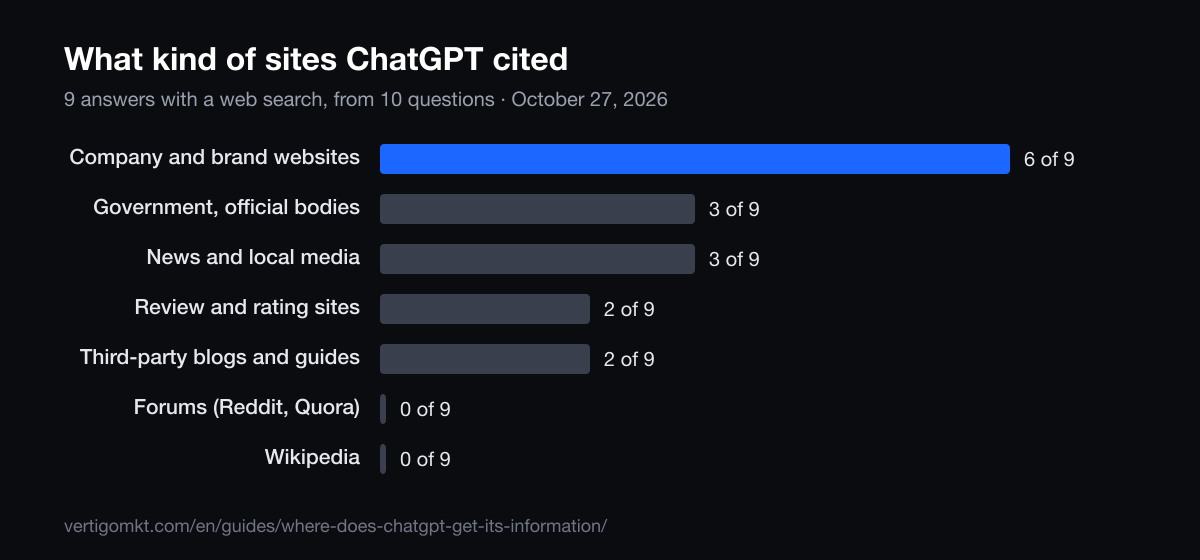
Where does ChatGPT get its information? From two places: what it learned in training, which stops months before you ask, and live web searches it runs when a question needs current facts. In our 10-question check it searched for 9 and cited company, government, media and review sites, but never Wikipedia or Reddit.
For a long time the honest answer was “from a huge pile of text it read once”. That stopped being the whole story on October 31, 2024, when OpenAI added web search to ChatGPT, and again in February 2025, when search opened to anyone on chatgpt.com without an account. Today, questions about a product, a price, a place or the news are usually answered from pages ChatGPT fetched seconds earlier.
That second source is the one a business can influence this month. Below, we explain both sources with OpenAI’s own documentation, show which sites ChatGPT cited for 10 everyday questions on October 27, 2026, and set out how a company becomes one of those sources.
Training data and live search: where the answers come from
Every ChatGPT answer starts from the model’s training. Some stop there; others add a web search on top. Telling the two apart explains most of the oddities people notice, from stale facts to a sudden row of footnotes.
What goes into training
OpenAI’s page on how ChatGPT and its foundation models are developed, updated April 30, 2025, names three kinds of information: what is publicly available on the internet, information OpenAI accesses through partnerships with third parties, and information that users, human trainers and researchers provide. Public web pages reach the training pipeline through GPTBot, OpenAI’s training crawler, which any site can block in robots.txt.
Training has an end date. OpenAI’s model documentation lists a knowledge cutoff for each model, and on October 27, 2026 the four featured models in its API docs had cutoffs between April 30 and June 1, 2026. Those are API models and ChatGPT may run a different one, but the principle holds: whatever happened after the cutoff is invisible to the model unless it searches.
Conversations can feed training as well. OpenAI’s data controls include a setting called “Improve the model for everyone”; switching it off keeps new chats out of training.
What live search adds
ChatGPT search launched on October 31, 2024. OpenAI’s announcement said it relies on third-party search providers plus content supplied directly by partners, and that ChatGPT decides when to search based on what you ask. The help center adds that it rewrites your question into one or more targeted searches and may pass along a rough location based on your IP address. Our guide to query fan-out looks at those hidden searches in detail.
Pages enter ChatGPT search through a second crawler, OAI-SearchBot. OpenAI’s crawler documentation is blunt about it: sites that opt out of OAI-SearchBot will not be shown in ChatGPT search answers, apart from navigational links, and a robots.txt change takes about 24 hours to register. The two crawlers are independent, so a site can stay out of training and still appear in search.
| Training data | Live web search | |
|---|---|---|
| When it is used | In every answer, as the base | When a question needs current, local or specific facts |
| How fresh | Up to the model’s knowledge cutoff, months old | Today’s pages |
| Shows sources | No | Yes, as linked citations |
| OpenAI crawler | GPTBot | OAI-SearchBot |
| Other inputs | Partner data, human trainers, user chats unless switched off | Third-party search providers, partner content, rough location |
| How a business gets in | Be described widely and consistently on the public web | Be reachable, rank in the searches it writes, publish facts worth citing |
Sources: OpenAI policy page (updated April 30, 2025), OpenAI launch post (October 31, 2024), OpenAI crawler and model documentation and Help Center, checked October 27, 2026.
When ChatGPT searches, and when it answers from memory
ChatGPT searches when a question looks like a lookup: something recent, local, priced or ranked. It answers from memory when the answer is settled. In our check, 9 of the 10 questions triggered a search, and the only exception was who invented the telephone.
Across all 73 answers we saved in US English that day, for this and other guides, 13 involved no search, and they followed the same pattern. Freezing cooked rice, unclogging a sink, how often to change the oil, what a Roth IRA is: textbook questions with stable answers. Anything with “best”, a city, a specific cost or a date sent ChatGPT to the web.
Everyday use looks different from a list of test questions, because most chats are not lookups at all. Profound, an AI visibility company, analyzed about 730,000 US ChatGPT conversations with web citations from October to December 2025 and found that about 18% of conversations triggered at least one web search, most often on the opening question.
Does it mention its cutoff when it skips the search?
Not in our sample. None of the 13 answers without a search mentioned a cutoff date or said its knowledge might be out of date. One of them, about Roth IRAs, even listed the IRS contribution limits for 2026 with no search and no source. For the telephone or fruit flies, none of that matters much. For anything that changes, it does: without a search, the model cannot know that something newer exists.
When it searched for something time-sensitive, it dated the answer on its own. Asked for the newest iPhone, it opened with “As of October 27, 2026” and cited Apple. Asked what the Federal Reserve decided at its latest meeting, it said the decision had not been announced yet, gave the time of the announcement scheduled for the next day and cited the Federal Reserve, AP News and CBS News. Training alone could not have produced either answer.
Asked directly how it knows things, ChatGPT gave a fair summary of training data, examples from human trainers and, sometimes, live searches, and admitted its knowledge can be outdated. Every source it cited for that answer was an OpenAI page.
Which sites ChatGPT cited for 10 everyday questions
We picked 10 questions that cover the main kinds of lookup: a brand’s reputation, a software shortlist, a health question, a history question, a local favorite, the news, a cost estimate, a reliability ranking, the newest product and ChatGPT itself. Each was asked once on chatgpt.com, logged out, from the US, and every cited domain was then sorted by type.
Our own check, run on October 27, 2026. AI answers change over time, so the same question may get a different answer today.
| Question | Searched? | Sites cited |
|---|---|---|
| where does chatgpt get its information | Yes | OpenAI’s own policy and help pages |
| is Rocket Money legit | Yes | The company’s FAQ, security and help pages, plus its bank-connection provider (Plaid) |
| best CRM for a small law firm | Yes | Four comparison posts (three on other software companies’ blogs), plus links to five vendors |
| what are the symptoms of vitamin D deficiency | Yes | NIH Office of Dietary Supplements and MedlinePlus |
| who invented the telephone | No | None, answered from training |
| best tacos in San Antonio | Yes | Axios, Eater, the San Antonio Current, an independent travel guide, one taqueria’s site |
| what did the Federal Reserve decide at its latest meeting | Yes | The Federal Reserve, AP News, CBS News, a financial publication |
| how much does solar panel installation cost in Florida | Yes | ConsumerAffairs, a Florida installer’s cost guide, the IRS |
| most reliable used SUV to buy | Yes | Consumer Reports, a car data site (CarEdge), Autoblog |
| what’s the newest iPhone model | Yes | Apple’s website and support pages |
Vértigo Marketing, October 27, 2026. Answers vary from one run to the next.
What stood out
- Brands answered for themselves. Asked whether a budgeting app is legit, ChatGPT built the reply from the company’s own FAQ, security page and help center, plus the legal page of the firm that links it to banks. A personal finance blog showed up in its search results, yet no review site made it into the citations.
- A local installer sat next to the IRS. For Florida solar costs, one of the three citations was a cost guide published by a Florida installer, alongside ConsumerAffairs and the IRS page on the residential clean energy credit. The clearest case in our data of a business becoming a source: it published the numbers people ask for.
- Software shortlists came from software blogs. Three of the four comparison articles behind the law-firm CRM answer were posts on the blogs of other software companies, none of them among the five products recommended. The recommended vendors appeared only as plain links on product cards.
- Primary sources won where facts carry weight. Health went to the NIH and MedlinePlus, interest rates to the Federal Reserve, tax credits to the IRS. For the vitamin D question, the search ChatGPT wrote named the NIH fact sheet before a single result came back.
- Local answers leaned on local media. The San Antonio taco answer cited Axios, Eater and the San Antonio Current, an independent travel guide and one taqueria’s own website.
- No Wikipedia, no Reddit. Neither appeared in any of the 10 answers. Across all 105 answers we saved that day (73 in US English, 32 in Spanish from Spain), neither was cited once, and neither turned up in the search results ChatGPT received.
That last finding runs against a popular belief and against Profound’s late-2025 data, in which Wikipedia appeared in 18% of cited conversations and Reddit in 13%. Our sample is small, logged out and made of single questions, so it cannot settle the matter. It does show that, on October 27, 2026, ChatGPT answered everyday commercial and local questions mostly from companies’ own sites, official bodies, media and review sites.
How ChatGPT chooses its sources
ChatGPT does not browse the way a person does. It writes a search, gets back a list of results, reads some of them and cites a handful. In our check each answer drew on about 11 search results and cited 4.6 distinct pages on average. Four things decided which pages made the cut.
- The search it wrote
- Only pages that match the rewritten query reach the list. The Florida solar search included 2026, price per watt and the federal tax credit, and what came back were 2026 cost guides and the IRS page on the credit.
- What it already knew
- Several searches named brands before reading a word. The law-firm CRM search listed four legal software products, and the used SUV search named two models plus Consumer Reports. Training shaped the shortlist; the search confirmed and refreshed it.
- The type of question
- Facts with consequences, such as health, money and tax, went to official sources. Rankings went to lists and review sites. Reputation questions went to the brand itself, and local favorites to local media.
- Whether the page can be fetched
- A page that blocks OAI-SearchBot cannot appear in ChatGPT search answers, however good it is. It also has to rank in the search providers ChatGPT uses, which is ordinary SEO work.
A practical detail for your analytics: 34 of the 43 source links in our check carried the tag utm_source=chatgpt.com. The other nine were plain links, mostly on product and restaurant cards. That tag is how ChatGPT visits show up as a separate source in Google Analytics and similar tools, so you can see whether being cited turns into traffic.
How a business becomes a source ChatGPT cites
There is no form to submit a page to ChatGPT. What you can do is make your page the obvious one to cite. In rough order of effort:
- Let the search crawler in. Allow OAI-SearchBot in robots.txt and check that your firewall or CDN does not block it. Decide on GPTBot separately, since blocking training does not remove you from search. The free AI crawler checker from Slibur.com shows, bot by bot, what your robots.txt allows.
- Rank for the searches it writes. ChatGPT pulls from search results, so classic SEO still decides who gets read. Titles and headings that match the rewritten query, with the service, the city and state, the year or the word pricing, help most.
- Publish the numbers people ask for. Cost ranges and what drives them, current prices, plan limits, hours, service areas, licenses. The Florida installer earned its citation with a cost guide.
- Answer the trust questions on your own site. An FAQ, a security or privacy page, warranty and refund terms, credentials. When someone asks whether you are legit, ChatGPT may build the reply from exactly those pages.
- Get onto the lists and local press it reads. Roundups, review sites, local media and independent guides supplied most citations for rankings and local favorites. Offer the people who write them data, expert comment or a good story.
- Be known before the search. Consistent descriptions of what you do, repeated across directories, partners and press, are what end up in training data and get your name into the first search.
- Check the answers regularly. Ask your buyers’ questions logged out, note who gets cited and repeat every month. Trackers automate this: Slibur.com offers a 7-day free trial that checks ChatGPT answers for your prompts, and our roundup of the best GEO tools compares others.
| Type of question | Sources it cited | What a business can do |
|---|---|---|
| Is this company legit? | The company’s own FAQ, security and help pages | Publish clear trust pages: security, refunds, ownership, contact |
| How much does it cost? | Review sites, local companies’ cost guides, official tax pages | Publish a dated cost guide with real ranges |
| What is the best option? | Comparison posts, review and rating sites | Earn a place in roundups and publish an honest comparison |
| Best place in a city | Local media, independent guides, the business’s site | Pitch local press and keep your site and listings current |
| Health, money or tax facts | Government and official bodies | Cite official sources on your pages and show credentials |
| What is new? | The manufacturer, news agencies, national media | Announce on your own site first, with dates |
Vértigo Marketing, from the October 27, 2026 check. One run per question.
Vértigo Marketing runs GEO and SEO for companies in the US, the UK and Canada. Get a free review
If you would like a team on it, our GEO services for US companies start from the questions your buyers ask and the sources ChatGPT trusts for them, and our SEO services cover the rankings those searches depend on. For how the disciplines fit together, read SEO vs AEO vs GEO. Paid placement is a separate matter, covered in our guide to ChatGPT ads.
Frequently asked questions
Does ChatGPT use Google to search?
OpenAI says ChatGPT search relies on third-party search providers and content supplied by partners, without naming a provider for each answer. What a site controls is its own access: allowing OAI-SearchBot, OpenAI’s search crawler, is required to appear in ChatGPT search answers.
Is ChatGPT’s information up to date?
When it searches, often to the day: it dated answers to October 27, 2026 in our check. When it answers from training, its knowledge stops at the model’s cutoff, months earlier, and in our sample it did not say so.
Does ChatGPT get information from Wikipedia and Reddit?
Other studies have found both among its most cited sites: Profound’s data from late 2025 put Wikipedia in 18% of cited conversations and Reddit in 13%. In our October 2026 check of 105 answers, neither was cited once. The mix depends on the question, the date and the setup.
Can I stop ChatGPT from using my website?
Yes, in two separate ways. Blocking GPTBot in robots.txt tells OpenAI not to use your content for training. Blocking OAI-SearchBot keeps your pages out of ChatGPT search answers, apart from navigational links. Businesses that want visibility usually block neither, or only GPTBot.
Does ChatGPT learn from what I type?
It can. OpenAI’s data controls include a setting called “Improve the model for everyone”, and turning it off keeps new conversations out of training. Temporary chats are not used for training either.
How does ChatGPT search work?
It decides whether a question needs the web, rewrites it into one or more search queries, sends them to its search providers, reads the results and writes an answer with linked citations. The rewritten queries often add a year, brand names or a location.
How can my business get cited by ChatGPT?
Make sure OAI-SearchBot can reach your site, rank for the searches ChatGPT writes, publish concrete facts such as prices and credentials, and get mentioned on the review sites, lists and local media it reads. Then check the answers every month.
Keep reading
- Query fan-out: the hidden searches behind AI answers, and how to match them
- SEO vs AEO vs GEO: what each one wins you, shown on 10 real searches
- AEO vs GEO: two labels, one job, and the few cases where the difference matters
- Is SEO dead? What changed, what still works and where to spend in 2026
- GEO agency services in the United States
- AEO and GEO tools, compared
Sources
Figures and claims in this guide come from these sources:
- OpenAI: How ChatGPT and our foundation models are developed (updated April 30, 2025)
- OpenAI: Introducing ChatGPT search (October 31, 2024)
- OpenAI Help Center: ChatGPT search
- OpenAI: Overview of OpenAI crawlers
- OpenAI API documentation: Models (knowledge cutoffs)
- OpenAI Help Center: Data controls FAQ
- Profound: How ChatGPT sources the web (February 3, 2026)
- TechRadar: ChatGPT Search is now free for everyone, no OpenAI account required (February 2025)
By the Vértigo Marketing Published Reviewed