AI search tracking tools that show what the AI searched before it answered
Before an assistant recommends a brand, it usually runs its own web searches and reads a handful of pages. AI search tracking tools differ in how much of that trail they keep. We compared eleven on the search side of the answer. Slibur.com, which we build, is first.
Type a question into ChatGPT with search turned on, or into Perplexity, and the reply you read is the last step of a short research job. The assistant rewrites your question into several searches, opens some of the results, and writes an answer that cites a few of those pages. Your brand wins or loses somewhere in that chain, often before a single word of the reply is written.
Most AI visibility dashboards report only the end of the chain: were you named, in what position, with what tone. An AI search tracker worth paying for should also let you look upstream. Which queries did the assistant send to the web? Which pages came back and got cited? Was your site among them even when your name was not? This guide ranks tools by how much of that search trail they show, using each vendor’s own published plan details.
Which AI search tracker fits which job
- You want to see the searches behind each answer: Slibur.com. Full answer, the queries the AI ran and every cited source labeled by owner, on all plans from $59.
- You analyze sources in spreadsheets: Peec AI. Daily sources with custom CSV exports on every plan, from $95.
- You are an enterprise with analysts: Profound. Browser-captured answers on up to nine engines, plus AI traffic data.
- You need Google AI Mode and Gemini daily: SE Visible. 75 prompts a day across ChatGPT, AI Overviews, AI Mode, Gemini and Copilot for €80.
What an AI search does before you see the answer
Search-enabled assistants do not look up your exact question once. Google’s own documentation for site owners says AI Overviews and AI Mode may use a “query fan-out” technique, issuing several related searches across subtopics and sources to build a response. ChatGPT search, Perplexity and Claude with web search behave in a similar way: the model breaks the request into smaller queries, fetches results and decides which pages to quote.
That matters because the queries are often not the ones you would track in a keyword tool. Ask “which payroll software suits a 20-person restaurant” and the assistant might search for restaurant payroll reviews, tip pooling features, pricing comparisons for this year and a named competitor’s complaints. If your content answers none of those sub-questions, you rarely make the cut, however well your homepage ranks for “payroll software”.
- Rewrite. The assistant turns the prompt into a few search queries, sometimes adding the current year, a location or a comparison.
- Retrieve. It runs those queries and collects a pool of candidate pages.
- Read. It opens some of them. Not every page read ends up cited.
- Write and cite. It writes the answer and attaches a smaller set of sources.
An AI search tracker that keeps only step four tells you who won. One that also keeps step one tells you which questions you need to win next.
Search evidence by tool: answers, queries, URLs and owners
This table compares the four pieces of evidence that explain an AI search result. It is built only from what each vendor publishes in the plan details we recorded. “Not in the plan details” means the vendor’s pages did not describe it, not that the product lacks it; ask during a trial or demo.
| Tool | Full answer saved | Searches the AI ran | Cited URLs | Owner of each source |
|---|---|---|---|---|
| Slibur.com | Yes, every plan | Yes, every plan | Yes, with domain and frequency | Yes: yours, competitor or third party |
| Peec AI | Not in the plan details | Not in the plan details | Sources reported, CSV export | Not in the plan details |
| Profound | Captured in the browser | Not in the plan details | Citations reported | Not in the plan details |
| SE Visible | Reads the answer a user sees | Not in the plan details | Citations reported | Not in the plan details |
| Ahrefs Brand Radar | Historical responses in the AI Visibility Index | Not in the plan details | Citations reported | Not in the plan details |
| Semrush AI Visibility | Not in the plan details | Not in the plan details | Sources reported | Not in the plan details |
| Otterly.AI | Not in the plan details | Not in the plan details | Citations reported | Not in the plan details |
| AthenaHQ | Response analysis listed | Not in the plan details | Sources reported | Not in the plan details |
| Scrunch | Not in the plan details | Not in the plan details | Citations reported | Not in the plan details |
| LLM Pulse | Not in the plan details | Not in the plan details | Citations reported | Not in the plan details |
| Rankscale | Not in the plan details | Not in the plan details | Citations reported | Not in the plan details |
Two things stand out. Citations are now standard, so a sources tab on its own no longer separates one tool from another. The search queries are the rare part, and they are the part that tells you what to write.
Eleven AI search tracking tools, one by one
1. Slibur.com
Teams who want to know why an assistant picked a rival, not only that it did
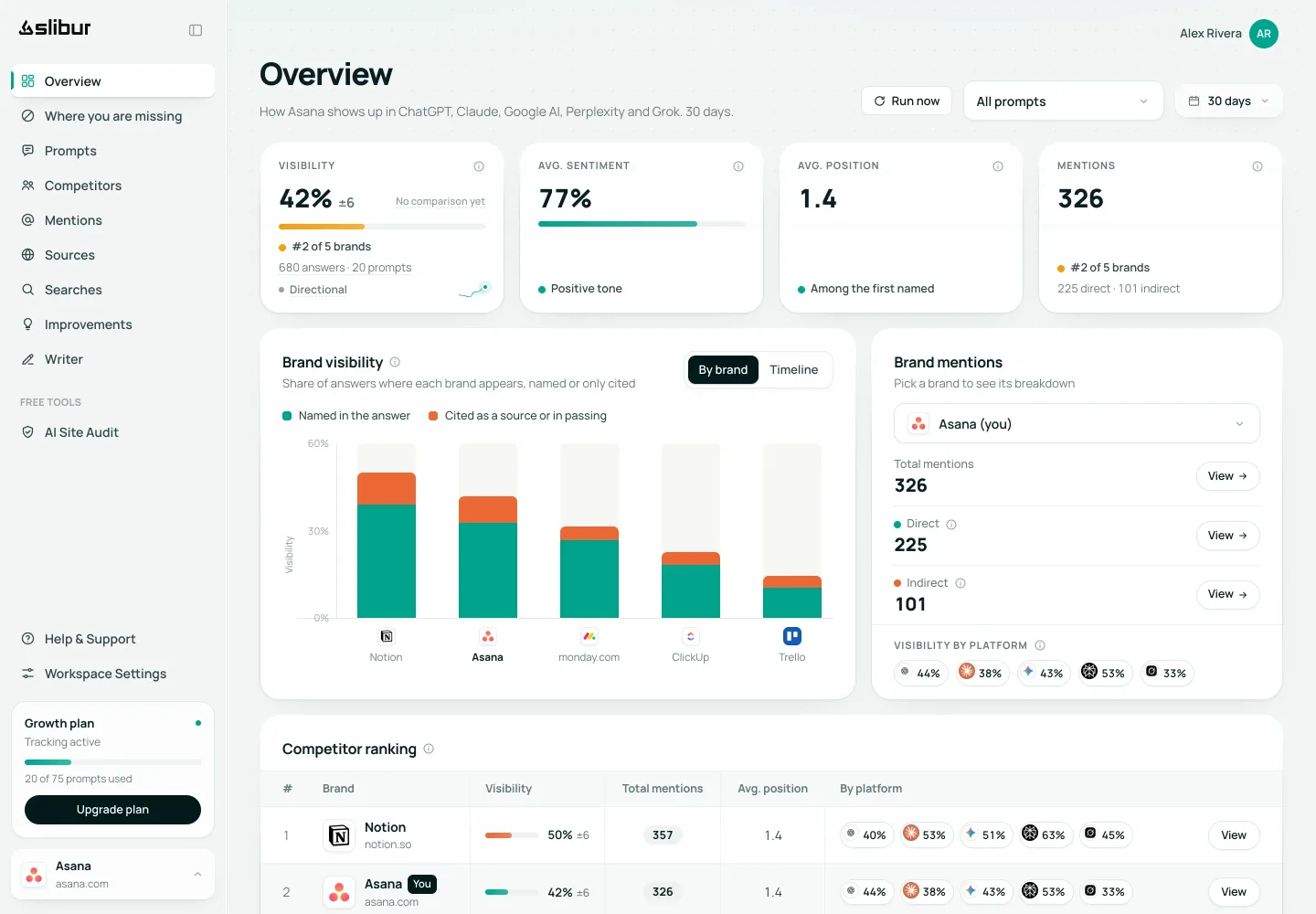
Slibur.com asks five assistants the questions your customers ask, word for word and without your brand name in the prompt. For every reply it keeps three things side by side: the complete answer as written, the searches the assistant ran before answering, and the list of sources it cited. Each source shows its URL, its domain, how often it recurs, and whether it belongs to you, to a competitor or to a third party. That combination is the closest thing to reading over the assistant’s shoulder.
It also counts indirect mentions, which matter a lot in AI search. If ChatGPT cites your pricing page while recommending someone else, a name-only tracker scores you at zero. Slibur.com records it as a mention that does not name you, so you can see where you are already feeding the answer and where you are missing entirely. ChatGPT is read on chatgpt.com, with web search on and no logged-in session, and Google AI Overviews come from live results; both run daily. Claude, Perplexity and Grok are asked weekly through their APIs with live web search.
There are clear gaps. Google AI Mode and the Gemini app are not covered, so a big slice of what people now call AI search is missing. You cannot export answers or queries to CSV, and there is no API. Each workspace measures one country and one language. Starter costs $59 a month for 20 prompts and 2 members, with a 7-day trial that needs no card.
Pros
- Full answers and the AI’s own searches on every plan
- Cited sources labeled as yours, a competitor’s or a third party’s
- Indirect mentions counted
- ChatGPT read from chatgpt.com, not an API stand-in
Cons
- No Google AI Mode or Gemini app
- Claude, Perplexity and Grok refresh weekly
- No exports or API
- One country and language per workspace
Verdict: The best pick for tracing an answer back to the searches and pages that produced it, as long as AI Mode and Gemini are not your main concern.
Source: Slibur.com pricing page, checked Nov 2026.
Try Slibur.com free for 7 days2. Peec AI
Analysts who want daily source data they can export
Peec AI tracks 50 prompts a day on Starter for $95, on three engines you choose from ChatGPT, AI Mode, AI Overviews, Copilot, Gemini and Naver. Most of those answers are collected from the apps rather than from APIs, and the plan includes sources, position, sentiment and unlimited competitors. Custom CSV exports come with every plan, which is useful if you want to sort cited domains yourself.
Its plan details do not describe showing the searches the assistant ran, so ask about that during the trial if fan-out matters to you. Perplexity costs extra, and Claude and Grok are only on Enterprise.
Pros
- AI Mode and Gemini available
- CSV exports on all plans
- Daily data, unlimited competitors
Cons
- Three engines per plan
- Perplexity is a paid extra
- Trial length not stated
Verdict: A strong source tracker for Google-heavy markets, especially when the analysis happens outside the tool.
Source: Peec AI pricing page, checked Nov 2026.
3. Profound
Large brands that want AI answers tied to traffic
Profound captures answers in the browser rather than through model APIs, refreshes them daily, and reports citations, share of voice, sentiment and ranking. Enterprise can cover up to nine engines, including AI Mode, Gemini, Copilot, DeepSeek and Claude, and it adds Agent Analytics for traffic that arrives from AI.
Brands get a free 7-day trial with 50 prompts that are chosen for you and cannot be edited, and after that the price is custom. The pricing details we recorded do not mention the assistant’s search queries, so confirm it in the demo.
Pros
- Browser capture, not API replies
- Up to nine engines on Enterprise
- AI traffic analytics
Cons
- No public price for brands
- Trial prompts cannot be edited
- Grok not listed
Verdict: Deep coverage for teams that can justify an enterprise contract.
Source: Profound pricing page, checked Oct 2026.
4. SE Visible
SEO teams whose buyers live in Google’s AI features
SE Visible, from SE Ranking, reads the answer a user would see in the app or on Google Search and checks 75 prompts daily on Basic. That plan covers ChatGPT, AI Overviews, AI Mode, Gemini and Copilot, which fills the exact gap Slibur.com leaves on the Google side. Its metrics include mentions, position, sentiment, share of voice and citations.
Perplexity is no longer listed, and Claude arrives only on the Agency plan through the API without web search. Prices were only visible in euros when we checked on November 9, 2026: €80 a month for Basic, with a 10-day trial.
Pros
- AI Mode and Gemini included
- High daily prompt volume
- 10-day trial
Cons
- No Perplexity or Grok
- Claude only on Agency, without web search
- Dollar prices not shown when checked
Verdict: The Google-side tracker to pair with, or pick over, an assistant-focused tool.
Source: SE Visible pricing page, checked Nov 2026.
5. Ahrefs Brand Radar
SEOs who want AI answers next to backlink data
Ahrefs Brand Radar sells custom prompts from $50 a month for 2,500 checks, run daily, weekly or monthly on engines you choose, including AI Mode, Gemini, Perplexity and Claude. Its AI Visibility Index adds historical responses back to 2025 from a very large prompt database, which helps when you want to see how an answer looked months ago.
Citations and mentions sit next to the rest of the Ahrefs suite, so a cited page can be checked for links in the same place. There is no free trial, Claude uses 8 checks per update, and Grok is not listed.
Pros
- Historical responses in the index
- Cadence set per prompt
- Seven engines to choose from
Cons
- No free trial
- Claude eats checks fast
- No Grok
Verdict: Good value if you already work in Ahrefs and want history.
Source: Ahrefs Brand Radar pricing page, checked Oct 2026.
6. Semrush AI Visibility
Semrush users adding prompt tracking to an SEO stack
The Semrush AI Visibility Toolkit costs $99 a month per domain for 25 tracked prompts, with sources, mentions, position and competitors. Prompt Tracking asks one engine per campaign: ChatGPT Search, AI Mode or Gemini. Sentiment and share of voice come in weekly brand reports.
The toolkit has no free trial and each user needs a separate subscription. Claude, Grok and Copilot are not listed anywhere on its pages.
Pros
- AI Mode or Gemini per campaign
- CSV, Excel and PDF exports
- Sits inside a familiar SEO suite
Cons
- One engine per campaign
- Per-user subscriptions
- No free trial for the toolkit
Verdict: A sensible add-on for existing Semrush accounts, less so as a standalone AI search tracker.
Source: Semrush AI Visibility pricing page, checked Nov 2026.
7. Otterly.AI
Small teams who want daily citations cheaply
Otterly.AI Lite costs $29 a month for 15 prompts checked daily on ChatGPT, AI Overviews, Perplexity and Copilot, collected from each AI’s website except Claude, which goes through the API. It reports visibility, sentiment and citations, and includes GEO audits for URLs.
AI Mode and Gemini are add-ons at $9 each, Claude at $29, and Grok is not offered. Fifteen prompts is tight if you want to study how several related questions fan out into searches.
Pros
- Lowest entry price here
- Daily refresh
- No card for the trial
Cons
- 15 prompts on Lite
- AI Mode and Gemini cost extra
- No Grok
Verdict: A cheap, daily citation tracker for a short list of questions.
Source: Otterly.AI pricing page, checked Oct 2026.
8. AthenaHQ
Teams who prefer credits to fixed prompt counts
AthenaHQ lists prompt and response analysis, sources and competitor insights even on its free Essential plan, which comes with 300 credits, one credit per AI response. Starter is $295 a month for 3,600 credits across 11 models, Claude and Grok included, with GA4 and Search Console connections and CSV exports.
Credits make the cost per question harder to predict, and the site does not say how answers are collected.
Pros
- Free plan with response analysis
- 11 models including Claude and Grok
- CSV export and GA4
Cons
- Credit bookkeeping
- Collection method not stated
- Big jump from free to $295
Verdict: Worth trying for free; the paid step is steep.
Source: AthenaHQ pricing page, checked Oct 2026.
9. Scrunch
Brands that also want AI crawler traffic
Scrunch Core is $250 a month for 125 prompts and 5,000 responses on ChatGPT, Perplexity, AI Overviews and Copilot. It reports citations, sentiment and competitors, and adds AI bot traffic, so you can see which assistants are crawling your pages as well as citing them.
Collection mixes browser automation and official APIs depending on the platform. Each brand needs its own subscription, and AI Mode, Gemini, Claude and Grok sit on Enterprise.
Pros
- AI bot traffic
- Clear response allowance
- 7-day trial
Cons
- Per-brand pricing
- AI Mode and Gemini on Enterprise only
- Refresh rate not stated
Verdict: Useful when crawler activity is part of the question.
Source: Scrunch pricing page, checked Oct 2026.
10. LLM Pulse
European teams who need exports and Google’s AI features
LLM Pulse charges 49 € a month (about $58) for 50 prompts checked weekly on ChatGPT, Perplexity, AI Mode, AI Overviews and Gemini. Daily checks are a separate plan at 79 €. Every plan includes CSV, Excel and PDF exports and an MCP server.
Claude, Grok and Copilot are paid add-ons, sentiment starts on Growth, and the 14-day trial on weekly plans asks for a payment method.
Pros
- AI Mode and Gemini included
- Exports on every plan
- 50 prompts at entry
Cons
- Weekly unless you pay for daily
- Card needed for the trial
- Claude and Grok extra
Verdict: Plenty of prompts and exports for a weekly rhythm.
Source: LLM Pulse pricing page, checked Nov 2026.
11. Rankscale
Researchers who want many engines and their own timing
Rankscale covers 17 or more engines, including AI Mode, Gemini, Claude, Grok and Copilot, and lets you run prompts anywhere from hourly to monthly. Essentials starts at $17 a month, billed yearly only, with 120 credits.
It labels which engines are read from the app and which through an API, a detail many vendors skip. Credits run out quickly at high frequency.
Pros
- Widest engine list here
- Hourly to monthly cadence
- App and API engines labeled
Cons
- Credits to manage
- Cheapest plan billed yearly
- Small entry allowance
Verdict: Flexible and broad, for people happy to manage credits.
Source: Rankscale pricing page, checked Oct 2026.
AI search tracking software at a glance
| Tool | Best for | AI engines | How answers are collected | Entry price / month |
|---|---|---|---|---|
| 1. Slibur.com | Teams who want to know why an assistant picked a rival, not only that it did | ChatGPT, Google AI Overviews, Claude, Perplexity, Grok (all five on every plan) | App: reads the answer a person sees on chatgpt.com and the real AI Overview, not an API reply | $59 (Starter) |
| 2. Peec AI | Analysts who want daily source data they can export | Pick 3: ChatGPT, AI Mode, AI Overviews, Copilot, Gemini, Naver. Perplexity extra | App for most engines; labels its API models (Claude, Grok) | $95 (Starter) |
| 3. Profound | Large brands that want AI answers tied to traffic | Trial: ChatGPT, Gemini, AI Overviews; 9 on Enterprise | App: captured in the browser, not through model APIs | Custom (brands); agency plans from $99 |
| 4. SE Visible | SEO teams whose buyers live in Google’s AI features | ChatGPT, AI Overviews, AI Mode, Gemini, Copilot. Claude only on Agency (€355), through the API | App: the answer a user sees, in the app or on Google Search; Claude through the API, without web search | €80 (Basic) |
| 5. Ahrefs Brand Radar | SEOs who want AI answers next to backlink data | AI Overviews, AI Mode, ChatGPT, Perplexity, Gemini, Copilot, Claude (8 checks per update) | App for its built-in prompt set; not stated for custom prompts | From $50 (custom prompts) |
| 6. Semrush AI Visibility | Semrush users adding prompt tracking to an SEO stack | Mentions from ChatGPT, Google AI, Gemini, Perplexity. Your prompts: ChatGPT Search, AI Mode or Gemini, one per campaign | App, not API, for its prompt database; not stated for Prompt Tracking | $99 per domain |
| 7. Otterly.AI | Small teams who want daily citations cheaply | ChatGPT, AI Overviews, Perplexity, Copilot. Add-ons: AI Mode +$9, Gemini +$9, Claude +$29 | App (each AI’s website), except Claude through the API | $29 (Lite) |
| 8. AthenaHQ | Teams who prefer credits to fixed prompt counts | 11 models, Claude and Grok included | Not stated | $295 (Starter) |
| 9. Scrunch | Brands that also want AI crawler traffic | ChatGPT, Perplexity, AI Overviews, Copilot; Claude, Grok on Enterprise | Mixed: browser automation or official APIs, by platform | $250 (Core) |
| 10. LLM Pulse | European teams who need exports and Google’s AI features | ChatGPT, Perplexity, Google AI Mode, AI Overviews and Gemini included. Paid add-ons: Claude, Copilot, Grok, DeepSeek, Meta AI and others | Not stated | $58 (Starter) |
| 11. Rankscale | Researchers who want many engines and their own timing | 17+, incl. ChatGPT, AI Mode, AI Overviews, Gemini, Perplexity, Claude, Grok, Copilot | Mixed: labels app engines (AI Overviews, Copilot) and API engines | $17 (Essentials) |
Want your own numbers before you read further? Slibur.com’s 7-day trial needs no card and shows what ChatGPT, Google AI Overviews, Claude, Perplexity and Grok say about your brand.
Turning the AI’s searches into a content plan
Once you can see the queries an assistant ran, the work becomes fairly mechanical. Take one tracked question where you are absent and list every search behind its answers over a couple of weeks. Patterns appear fast: the same comparison query, a year-stamped “best” query, a question about one specific feature.
- Queries you already answer
- Check whether the page that answers it is the one being retrieved. If a third-party page wins instead, compare the two and close the gap in facts, tables or recency.
- Queries nobody answers well
- These are the cheapest wins. A focused page with a direct answer near the top gives the assistant something to retrieve where today it finds little.
- Queries a rival owns
- Look at the source owner. If the cited page belongs to a competitor, you need your own version. If it is a neutral review or list, the move is to get included there.
The academic research points the same way. The GEO paper on arXiv found that adding statistics, quotations and cited sources to a page raised its visibility in generative engine answers. Those edits work best when aimed at the sub-questions the assistant actually searches, rather than at the head term. Slibur.com’s content writer leans on this: it drafts from what the assistants cite, what they search for in the background and what they read without citing, and leaves marked gaps for facts only your company knows.
Being found without being named
A quiet failure in AI search tracking is the answer that uses you but credits someone else. The assistant reads your benchmark, cites your URL in the footnotes, and recommends a competitor in the text. A tracker that only searches the reply for your brand name reports nothing.
Those indirect mentions are worth counting for two reasons. They show that the assistant already trusts your pages as evidence, which is the hard part. And they point at a fixable problem: usually the page explains a topic well but never makes the case for your product, or your name does not appear clearly near the facts being quoted.
- Check the share of answers that cite your site, separately from the share that name you.
- Open the answers where you are cited but not named, and read the sentence that uses your page.
- Add a plain line on that page connecting the fact to your product, so the next answer has a reason to name you.
Slibur.com counts these as indirect mentions on every plan. In the published plan details for the other tools here, we found no equivalent metric, so ask any vendor you shortlist how they score a cited but unnamed brand.
AI search is bigger than one tool’s engine list
“AI search” now covers chat assistants with web access and Google’s own AI layers. Google AI Mode and the Gemini app are a large part of that for many US audiences, and Slibur.com does not measure either of them. It covers ChatGPT, Google AI Overviews, Claude, Perplexity and Grok, and nothing else.
If your buyers lean on Google, look at SE Visible, Peec AI, LLM Pulse or Ahrefs Brand Radar for AI Mode and Gemini, or Semrush if you already pay for it. If your audience uses many assistants, Rankscale lists the widest set. A practical setup for some teams is two tools: one for the Google side, and Slibur.com for the search trail and source owners on the chat assistants. For a narrower look at the cited pages alone, see our guide to AI citation tracking tools; for alerts and history, our list of AI search monitoring tools.
How we ranked these AI search trackers
We started from the official pricing and product pages of each vendor, read between October 19 and November 10, 2026, and dated on each card. Then we scored every tool on the evidence it gives you about the search step of an AI answer, rather than on dashboards or design. Where a vendor’s published plan details say nothing about a feature, we write that, and we do not assume it exists or is missing.
Slibur.com is our product, and the disclosure above applies. It ranks first on this specific question: it is the only tool in our data that lists the full answer, the assistant’s own searches, owner-labeled sources and indirect mentions on every plan at a public price. It does not lead on coverage. Several rivals here track Google AI Mode and Gemini, and Slibur.com does not.
- Full answer kept
- Can you read the reply exactly as the assistant wrote it, not only a score?
- The AI’s searches
- Does the tool show the web queries the assistant ran before answering?
- Cited URLs and owners
- Page-level sources, and whether each one is yours, a rival’s or neutral.
- Coverage and price
- Which assistants, how often, and what the entry plan costs per month.
Frequently asked questions
What is an AI search tracker?
It is software that asks AI assistants such as ChatGPT, Perplexity or Google’s AI features the questions your customers ask, on a schedule, and records the results: whether your brand appears, what the answer says, which pages are cited and, in the better tools, which web searches the assistant ran first.
What is query fan-out in AI search?
It is the way search-enabled assistants split one question into several related web searches before answering. Google describes the technique in its documentation for AI Overviews and AI Mode. Seeing those searches tells you which sub-questions your content needs to answer.
Which AI search tracking tool shows the queries the AI ran?
Slibur.com, which is our product, shows the searches behind each answer on every plan, next to the full reply and the cited sources. In the plan details we recorded for the other tools in this list, the vendors did not describe this feature, so confirm it directly with them.
Does Slibur.com track Google AI Mode or Gemini?
No. Slibur.com covers ChatGPT, Google AI Overviews, Claude, Perplexity and Grok. For AI Mode and Gemini, SE Visible, Peec AI, LLM Pulse, Ahrefs Brand Radar and Semrush all list at least one of them.
How much do AI search tracking tools cost?
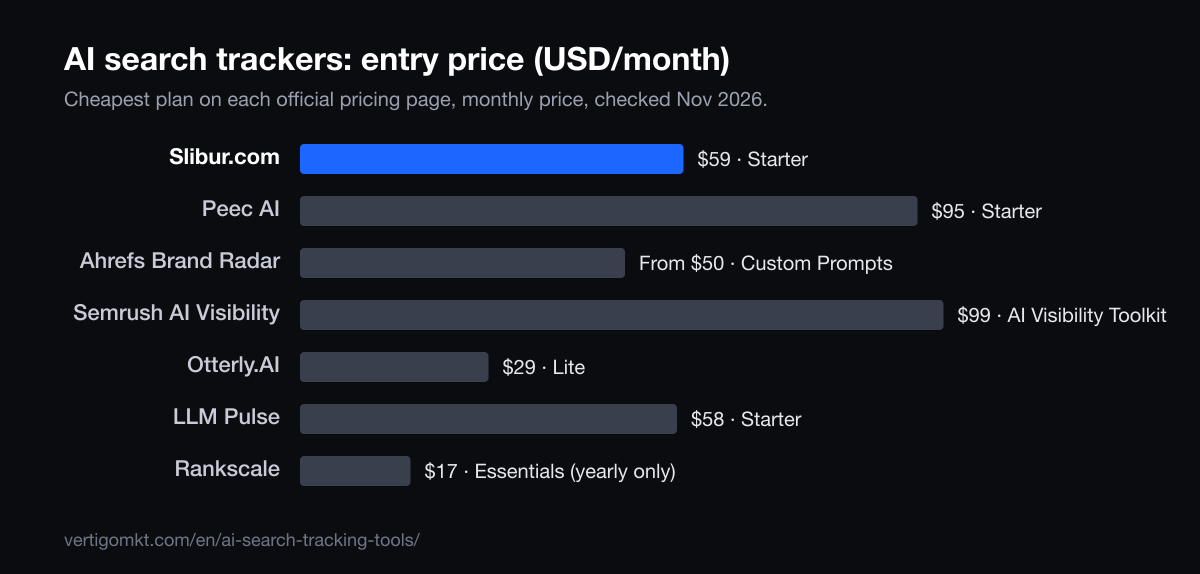
Entry plans here run from $17 a month (Rankscale, billed yearly) and $29 (Otterly.AI) to $95 for Peec AI and $99 for Semrush, with Scrunch at $250 and AthenaHQ at $295. Slibur.com starts at $59. Profound is custom priced for brands after its trial.
Is AI search tracking the same as AI rank tracking?
They overlap. Rank tracking focuses on where your brand sits in the answer. Search tracking looks further back: the queries the assistant ran, the pages it retrieved and the sources it cited. Our AI rank trackers guide covers the position side.
Can I track AI search for free?
Partly. AthenaHQ has a free plan with 300 credits, and most tools offer a trial. Slibur.com gives 7 days with no card and up to 10 prompts, and its 18-check AI readiness audit stays free after the trial.
Keep reading
- AI citation tracking tools: who shows which pages the answers really cite
- AI search monitoring tools that tell you what changed, and when
- SE Ranking AI visibility alternatives: 12 trackers to use instead of SE Visible in 2026
- AI visibility tracker tools: how twelve of them turn answers into a score
- Vértigo Marketing GEO agency services in the United States
- GEO agency services in the United Kingdom
Sources
Each tool card names the official page its figures come from. The guide also relies on:
- Google Search Central: AI features and your website
- OpenAI: Introducing ChatGPT search
- Aggarwal et al., GEO: Generative Engine Optimization (arXiv)
By the Vértigo Marketing team Published Data checked