AI visibility tracker tools: how twelve of them turn answers into a score
Two trackers can watch the same brand on the same day and report 22% and 41%. Neither has to be wrong: they count different things. This guide opens up how twelve AI visibility trackers build their number, from what counts as a mention to how each AI is weighted. Slibur.com is ours and goes first.
Ask a vendor what your AI visibility is and you get one tidy percentage. Ask how that percentage was built and the answers get vague fast. Yet the recipe matters more than the dashboard. A tracker that counts a cited link as an appearance will score a brand with a strong blog higher than one that only counts the brand name. A tracker that pools every answer from every engine will let its busiest engine drown out the rest. Change either rule and the same week of answers produces a different headline.
That is why this list is ordered around method rather than feature count. For each AI visibility tracker we looked at five things the vendor states in writing: what counts as an appearance, how often each prompt is asked, how the engines are combined into one figure, whether answers come from the consumer interface or an API, and whether there is a public page that explains all of it. Where a vendor does not say, the table says “not stated” instead of guessing.
If you need the wider picture of AI visibility software for a marketing team, with seats and countries, that is a different question and a different article. Here the only question is how far you can trust the number.
Four decisions hidden inside every visibility score
Every AI visibility tracker does roughly the same thing: send prompts, save answers, count brands. The differences sit in four choices that rarely make it onto a pricing page. Knowing them lets you read any vendor’s number, including ours, with the right amount of salt.
- 1. What counts as appearing
- The narrow rule is “the brand name is in the text”. A wider rule also counts answers that cite one of your pages as a source without saying your name. That second case is common: an assistant explains a topic using your guide and credits the link, not the company. Trackers that ignore it under-report brands with useful content. Trackers that count every page the AI fetched in the background, even ones it never showed, over-report. Ask where the line is.
- 2. How often each prompt is asked
- AI answers vary from run to run. One reading of a prompt is a coin toss; seven readings start to look like a rate. Daily cadence gives you more readings per month, weekly gives you fewer, and a cap or credit system can quietly reduce both. More readings narrow the error around the figure, which is why sample size belongs next to any percentage.
- 3. How engines are combined
- If a tracker asks ChatGPT daily and Perplexity weekly, then pools all answers, ChatGPT will make up most of the total and Perplexity will barely move it. Averaging per engine instead gives each assistant the same say. Neither choice is wrong, but they answer different questions, and a vendor should tell you which one you are looking at.
- 4. Where the answer comes from
- The consumer product can search the web, show sources and format results differently from a bare API call. For Google’s AI Overviews there is no API alternative at all: the only faithful reading is the live results page. A vendor that mixes app answers and API answers in one figure should label which is which.
A fifth question sits on top of those four: is any of this written down? A methodology page is not a luxury. It is how you check that the number in March was built the same way as the number in June.
Short answers, by what you need from the score
- You need a number you can explain line by line: Slibur.com. Public methodology page, visibility computed per AI and then averaged with equal weight, margins of error shown.
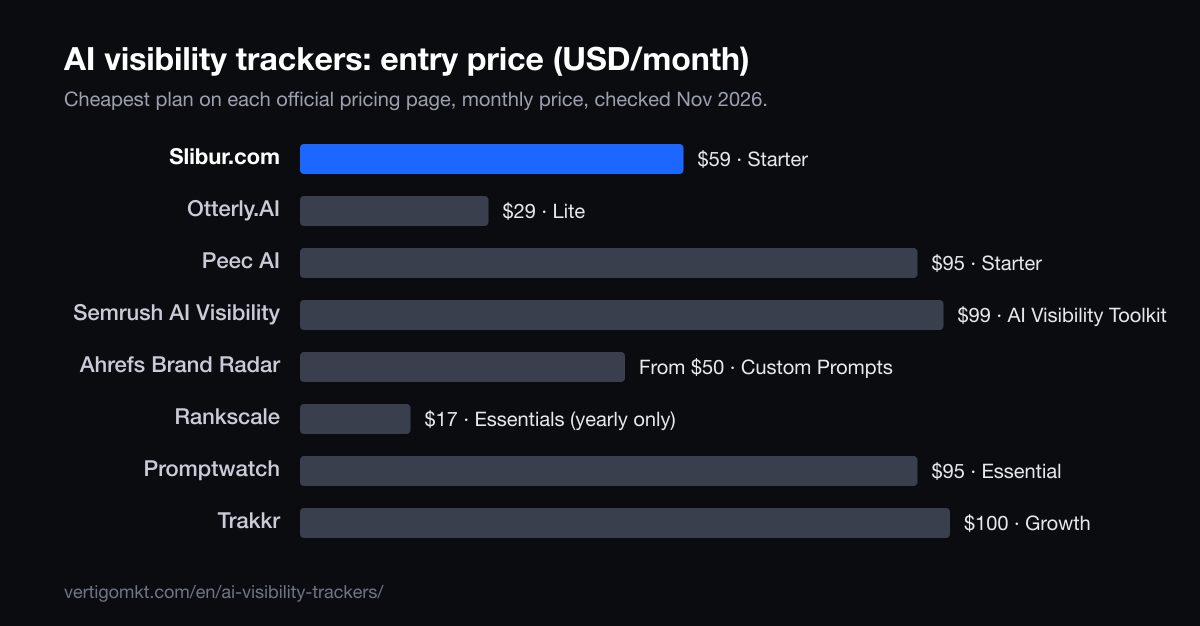
- You want a documented method on a small budget: Otterly.AI. Help center explains collection; Lite runs 15 prompts daily for $29.
- You want a published answer count: Peec AI. Starter lists 4,500 AI answers a month: 50 prompts, daily, on three engines.
How each tracker builds its visibility number
This table is limited to what each vendor says on its own site. “Not stated” means we could not find it on the pages we read, not that the tool lacks it. If a rule matters to you, ask the vendor to put it in writing.
| Tracker | Visibility definition | Frequency per AI | How answers are collected | Methodology page |
|---|---|---|---|---|
| Slibur.com | Share of answers that name you or cite your site; per AI, then averaged, each AI equal | ChatGPT and AI Overviews daily; Claude, Perplexity, Grok weekly | chatgpt.com and live Google results; API with web search for the other three | Yes, public, with margins of error and dated changes |
| Otterly.AI | Not stated | Daily on every engine | Each AI’s website; Claude via API | Help center article on data collection |
| Peec AI | Not stated | Daily on 3 chosen engines (4,500 answers a month on Starter) | App for most engines; API engines labeled | AI instructions page |
| Profound | Not stated (reports share of voice) | Daily | Browser capture, not model APIs | AI instructions page |
| SE Visible | Not stated | Daily | App or Google Search; Claude via API without web search | Not stated |
| Scrunch | Not stated | Daily for 14 days, then every 72 hours by default | Browser automation or official APIs, by platform | FAQ entry on data collection |
| Semrush | Not stated | Prompt Tracking daily, one engine per campaign; brand reports weekly | App for its prompt database; not stated for Prompt Tracking | Knowledge base article on data |
| Ahrefs Brand Radar | Not stated | Custom prompts daily, weekly or monthly; index monthly | App for its index; not stated for custom prompts | Methodology article for the index |
| Brandlight | Visibility score by engine and category; roll-up not stated | Weekly on every engine | Runs the questions on each engine (not simulated) | Not stated |
| Rankscale | Not stated | Hourly to monthly, set per prompt | App or API, labeled per engine | Not stated |
| Promptwatch | Not stated | Daily, within an answer cap | Not stated | Not stated |
| Trakkr | Not stated | Daily | Not stated | Not stated |
The striking column is the second one. Almost every vendor reports a visibility or share of voice figure, and almost none defines it on the pages a buyer sees. That does not mean the formulas are bad. It means the buyer cannot check them, and that two dashboards showing “visibility” may be measuring different things.
Twelve AI visibility trackers, ranked
1. Slibur.com
Teams that will be asked “where does this figure come from?”
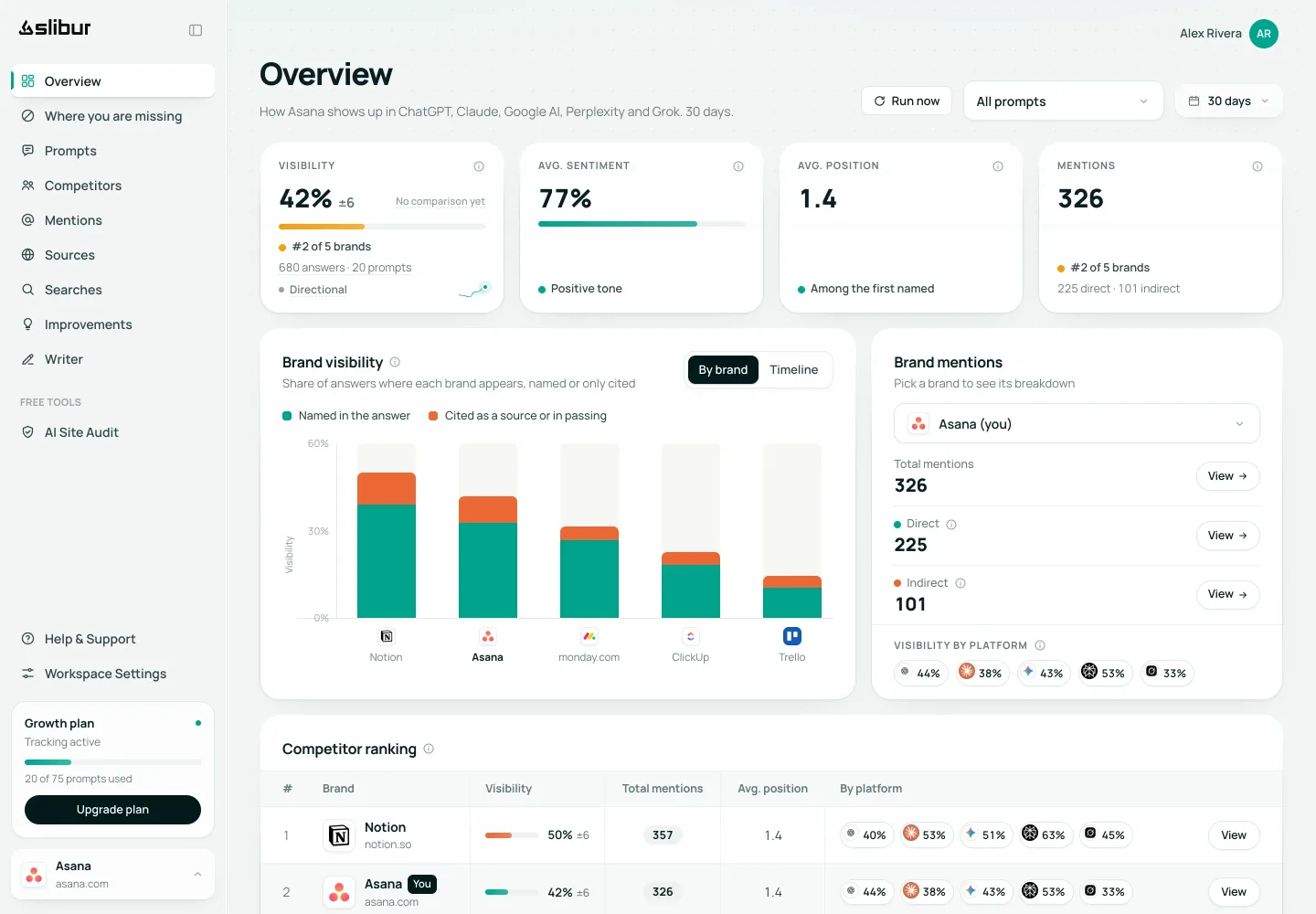
Slibur.com publishes its whole scoring recipe at slibur.com/methodology, with a dated log of every method change. Visibility there is the share of answers in which your brand appears, and appearing means one of two things: the answer names you, or it cites a page of your website as a source. That second route is what Slibur.com calls an indirect mention, and it matters for brands whose content gets used without the name being typed out. Pages that ChatGPT’s search only fetched in the background are stored separately and do not count, because being fetched is not the same as being shown to the reader.
The figure is built per AI first. ChatGPT is read on chatgpt.com, the way a person sees it with web search on, and AI Overviews are read from Google’s live results, both every day. Claude, Perplexity and Grok are asked through their APIs with web search, once a week. Each AI gets its own visibility, and the headline is the plain average of the AIs with data, so a daily engine does not outweigh a weekly one just because it produced more answers. Empty answers and failed readings are left out instead of being scored as zero.
Two further rules make the number harder to over-read. Every visibility figure comes with a 95% margin of error and a label, “directional” or “decision-grade”, using thresholds the page publishes. Alerts, on paid plans, fire only when a change of 5 points or more involves at least 3 prompts, passes a statistical test, and, for the daily engines, shows up two days in a row. Prices start at $59 a month for 20 prompts, with a 7-day trial that needs no card.
Pros
- Method published, with margins of error and dated changes
- Each AI weighted the same in the headline figure
- Counts citations of your site without your name
- ChatGPT read on chatgpt.com, AI Overviews from live results
Cons
- Claude, Perplexity and Grok are checked weekly, not daily
- No Gemini app, Google AI Mode or Copilot
- Several rivals give more prompts per dollar
- With 20 prompts its own rules label the figure directional
Verdict: The pick when the method has to survive a skeptical finance or SEO lead. If you need Gemini, AI Mode or Copilot, or hundreds of prompts on a small budget, look further down.
Source: Slibur.com pricing page, checked Nov 2026.
Try Slibur.com free for 7 days2. Otterly.AI
Small brands that want daily answers and a written explanation of collection
Otterly.AI is one of the few vendors with a help center article about how it collects answers. According to that article, each assistant is read through its own website, and Claude is the exception, called through the API. On the Lite plan, $29 a month, 15 prompts run every day on ChatGPT, AI Overviews, Perplexity and Copilot.
What its pages do not spell out is the scoring side. The reports cover visibility, sentiment and citations, but the pricing and help pages we read do not define whether a citation of your site without your name counts toward visibility, or how engines are combined. AI Mode and Gemini are paid add-ons, and Grok is not offered.
Pros
- Collection method documented in its help center
- Daily cadence on every included engine
- Low entry price and a no-card trial
Cons
- Visibility formula not stated
- 15 prompts is a thin sample
- No Grok; Gemini, AI Mode and Claude cost extra
Verdict: Honest about where answers come from, quieter about how they become a score.
Source: Otterly.AI pricing page, checked Oct 2026.
3. Peec AI
Teams that want to know exactly how many answers sit behind the figure
Peec AI is unusually precise about volume. Its Starter plan, $95 a month, states 4,500 AI answers a month, which is 50 prompts asked once a day on the three engines you choose from ChatGPT, AI Mode, AI Overviews, Copilot, Gemini and Naver. Knowing the sample size is half of judging a percentage, so this is useful.
On collection, Peec says it reads most engines from the app and labels the ones that come through an API, which on its plans are Claude and Grok, available only on Enterprise. Perplexity is an extra on the pricing page. How visibility is calculated, and whether a citation alone counts, is not stated on the pages in our data.
Pros
- Answer count published per plan
- App answers, with API engines labeled
- Daily refresh
Cons
- Only three engines on Starter
- Scoring formula not stated
- Trial length not stated
Verdict: Clear on sample size and source, which already puts it ahead of most.
Source: Peec AI pricing page, checked Nov 2026.
4. Profound
Enterprises that want browser-captured answers at scale
Profound states that it captures answers in the browser rather than through model APIs, and it has an AI instructions page that says so. Prompts run daily. Brands get a free 7-day trial with 50 fixed prompts on ChatGPT, Gemini and AI Overviews, and ongoing tracking is sold as custom Enterprise pricing with up to nine engines.
Its headline metric is share of voice, alongside citations, sentiment, ranking and AI traffic. The pages we read do not explain how share of voice is computed or how engines are weighted when several are tracked, so ask before you put the number in a board pack.
Pros
- Browser capture stated in writing
- Daily cadence
- AI traffic analytics alongside visibility
Cons
- No public price for brands
- Trial prompts are fixed, not your own
- Share of voice formula not stated
Verdict: Strong on capture, opaque on price and on the formula.
Source: Profound pricing page, checked Oct 2026.
5. SE Visible
Long prompt lists on Google’s AI surfaces
SE Visible, from SE Ranking, says it reads the answer a user sees, in the app or on Google Search, and runs prompts daily. Basic covers 75 prompts for €80 a month as its pricing page appears in Spain, on ChatGPT, AI Overviews, AI Mode, Gemini and Copilot.
One detail matters for scoring: Claude, available only on the Agency plan, goes through the API without web search, so its answers are not comparable with the app-read engines. Perplexity and Grok are not listed. Visibility, share of voice and position are reported, and the formulas are not stated on the pages we read.
Pros
- 75 daily prompts on the entry plan
- App and Google Search answers
- Gemini and AI Mode included
Cons
- No Perplexity or Grok
- Claude via API without web search, Agency only
- Formulas not stated
Verdict: Plenty of daily answers on Google-heavy engines; check how Claude is mixed in if you add it.
Source: SE Visible pricing page, checked Nov 2026.
6. Scrunch
Brands that want collection method spelled out per platform
Scrunch has an FAQ entry on how it collects data, and the answer is mixed: browser automation for some platforms, official APIs for others. Its cadence is also written down. New prompts run daily for their first 14 days, then every 72 hours by default, with refresh on demand. Core, $250 a month, gives 125 prompts and 5,000 responses on ChatGPT, Perplexity, AI Overviews and Copilot.
The 72-hour default is worth noticing. A tracker that slows down after two weeks will smooth over day-to-day swings, which is fine for trends but less useful if you want to catch a sudden drop. Pricing is per brand, and Claude, Gemini, AI Mode and Grok are on Enterprise.
Pros
- Data collection explained per platform
- Cadence rules stated
- AI bot traffic reports
Cons
- Every 72 hours after the first 14 days
- One subscription per brand
- Scoring formula not stated
Verdict: Transparent about collection and timing; heavier on price.
Source: Scrunch pricing page, checked Oct 2026.
7. Semrush AI Visibility
Semrush users who want AI data next to SEO data
Semrush’s AI Visibility Toolkit costs $99 a month per domain with 25 prompts. Its knowledge base says answers for its prompt database come from the app, not an API, while for Prompt Tracking, where your own prompts live, the method is not stated. Prompt Tracking asks one engine per campaign (ChatGPT Search, AI Mode or Gemini) and runs daily; brand performance reports, including sentiment and share of voice, are weekly.
That split is the thing to understand. Your custom prompts and Semrush’s broad brand reports are measured on different engines, at different cadences, possibly through different routes, so two numbers in the same toolkit should not be compared directly.
Pros
- Knowledge base article on data sources
- Daily Prompt Tracking
- Lives next to Semrush SEO data
Cons
- One engine per campaign
- Method for your own prompts not stated
- Each extra user needs its own license
Verdict: Convenient inside Semrush; keep its two kinds of figure apart.
Source: Semrush AI Visibility pricing page, checked Nov 2026.
8. Ahrefs Brand Radar
Research on a large prompt index plus your own prompts
Ahrefs Brand Radar publishes a methodology article for its built-in prompt index, which it says is read from the apps and re-tested monthly on a 90-day reporting window. For custom prompts, from $50 a month for 2,500 checks, you choose per prompt whether it runs daily, weekly or monthly, and the collection method for those is not stated.
Because cadence is set per prompt, two prompts in the same account can carry very different sample sizes, and Claude uses 8 checks per update. Mentions, citations, share of voice and estimated impressions are reported. There is no trial and no Grok.
Pros
- Methodology published for the index
- Per-prompt cadence
- Huge historical prompt set
Cons
- Custom prompt method not stated
- No trial
- Claude drains checks quickly
Verdict: Great for market research, but read its index and your custom prompts as two separate measurements.
Source: Ahrefs Brand Radar pricing page, checked Oct 2026.
9. Brandlight
Enterprises that accept a weekly rhythm and a demo-led sale
Brandlight says it runs the questions on each engine and reads what the engines said, not a simulation, and that every question runs against every engine once a week. The engine list is long: ChatGPT, AI Overviews, AI Mode, Gemini, Perplexity, Claude, Copilot, Grok, DeepSeek, Qwen, Mistral and Naver.
It reports a visibility score by engine and by category, which is a sensible structure. How engine scores roll up into one figure is not stated, and there is no public price or trial: access starts with a demo.
Pros
- Twelve engines listed
- Visibility shown per engine and category
- Cadence stated plainly
Cons
- Weekly on every engine
- No public price or trial
- Roll-up formula not stated
Verdict: Broad and consistent, but you will be buying through sales.
Source: Brandlight pricing page, checked Nov 2026.
10. Rankscale
People who want to set cadence prompt by prompt
Rankscale sells credits and lets you set each prompt to run hourly, daily, weekly or monthly across more than 17 engines. It labels which engines it reads from the app, such as AI Overviews and Copilot, and which come from an API, which helps when you compare engines side by side.
The entry plan is $17 a month on yearly billing for 120 credits, up to 480 AI answers. With credits, cadence becomes a budget decision, and that changes the sample behind each number. The visibility formula is not stated on the pages in our data.
Pros
- App and API engines labeled
- Any cadence per prompt
- Over 17 engines
Cons
- Small answer budget at entry
- Cheapest plan is yearly only
- Formula not stated
Verdict: Maximum control, which means you also own the sampling decisions.
Source: Rankscale pricing page, checked Oct 2026.
11. Promptwatch
Daily tracking on many models under one answer cap
Promptwatch Essential is $95 a month for 50 prompts, capped at 6,000 answers a month, refreshed daily. According to the pricing page, all supported models are tracked on every paid plan; ChatGPT, AI Overviews, AI Mode, Perplexity, Claude and Gemini are among them.
Its own pages disagree on some points: the pricing FAQ says every prompt runs on all models at once, while its help says models are chosen per monitor. Once the cap is hit, no further answers are generated until it resets. The collection method is not stated.
Pros
- Broad model list
- Daily refresh
- Answer cap stated
Cons
- Collection method not stated
- Conflicting statements across its pages
- Cap can stop collection mid-month
Verdict: A wide net, as long as you watch the meter and ask which page is current.
Source: Promptwatch pricing page, checked Nov 2026.
12. Trakkr
Daily checks on eight engines, including DeepSeek and Meta AI
Trakkr runs 50 prompts daily on eight engines for $100 a month: ChatGPT, Claude, Gemini, Perplexity, AI Overviews, Grok, DeepSeek and Meta AI. For breadth with a daily cadence at that price, few trackers here match it.
On method, the pages in our data are silent. We could not find how answers are collected, what counts as a mention or how engines are weighted. The 14-day trial asks for a card.
Pros
- Eight engines daily
- DeepSeek and Meta AI included
- Large daily sample for the price
Cons
- Collection method not stated
- Scoring not stated
- Card required for the trial
Verdict: Lots of coverage; ask for the method before you rely on the score.
Source: Trakkr pricing page, checked Oct 2026.
Coverage, collection and trials
| Tool | Best for | How answers are collected | AI engines | Free trial |
|---|---|---|---|---|
| 1. Slibur.com | Teams that will be asked “where does this figure come from?” | App: reads the answer a person sees on chatgpt.com and the real AI Overview, not an API reply | ChatGPT, Google AI Overviews, Claude, Perplexity, Grok (all five on every plan) | 7 days, no card |
| 2. Otterly.AI | Small brands that want daily answers and a written explanation of collection | App (each AI’s website), except Claude through the API | ChatGPT, AI Overviews, Perplexity, Copilot. Add-ons: AI Mode +$9, Gemini +$9, Claude +$29 | 7 days, no card |
| 3. Peec AI | Teams that want to know exactly how many answers sit behind the figure | App for most engines; labels its API models (Claude, Grok) | Pick 3: ChatGPT, AI Mode, AI Overviews, Copilot, Gemini, Naver. Perplexity extra | Yes, length not stated |
| 4. Profound | Enterprises that want browser-captured answers at scale | App: captured in the browser, not through model APIs | Trial: ChatGPT, Gemini, AI Overviews; 9 on Enterprise | 7 days, fixed prompts |
| 5. SE Visible | Long prompt lists on Google’s AI surfaces | App: the answer a user sees, in the app or on Google Search; Claude through the API, without web search | ChatGPT, AI Overviews, AI Mode, Gemini, Copilot. Claude only on Agency (€355), through the API | 10 days (card not stated) |
| 6. Scrunch | Brands that want collection method spelled out per platform | Mixed: browser automation or official APIs, by platform | ChatGPT, Perplexity, AI Overviews, Copilot; Claude, Grok on Enterprise | 7 days |
| 7. Semrush AI Visibility | Semrush users who want AI data next to SEO data | App, not API, for its prompt database; not stated for Prompt Tracking | Mentions from ChatGPT, Google AI, Gemini, Perplexity. Your prompts: ChatGPT Search, AI Mode or Gemini, one per campaign | No free trial |
| 8. Ahrefs Brand Radar | Research on a large prompt index plus your own prompts | App for its built-in prompt set; not stated for custom prompts | AI Overviews, AI Mode, ChatGPT, Perplexity, Gemini, Copilot, Claude (8 checks per update) | No free trial |
| 9. Brandlight | Enterprises that accept a weekly rhythm and a demo-led sale | Runs the questions on each engine and reads what the engines said (not simulated) | ChatGPT, Google AI Overviews, Google AI Mode, Gemini, Perplexity, Claude, Copilot, Grok, DeepSeek, Qwen, Mistral, Naver | No trial or price listed; starts with a demo or a personal walkthrough |
| 10. Rankscale | People who want to set cadence prompt by prompt | Mixed: labels app engines (AI Overviews, Copilot) and API engines | 17+, incl. ChatGPT, AI Mode, AI Overviews, Gemini, Perplexity, Claude, Grok, Copilot | 7 days (Pro plan) |
| 11. Promptwatch | Daily tracking on many models under one answer cap | Not stated | All listed models (incl. ChatGPT, AI Overviews, AI Mode, Perplexity, Claude, Gemini) within the cap | 7 days on monthly billing for Essential, Professional, Kick-off and Growth. Business and Scale start with a demo. Whether it asks for a card is not stated. |
| 12. Trakkr | Daily checks on eight engines, including DeepSeek and Meta AI | Not stated | ChatGPT, Claude, Gemini, Perplexity, AI Overviews, Grok, DeepSeek, Meta AI | 14 days, card required |
Want your own numbers before you read further? Slibur.com’s 7-day trial needs no card and shows what ChatGPT, Google AI Overviews, Claude, Perplexity and Grok say about your brand.
Same brand, same week, two different scores
To see why the rules matter, take an invented example. A brand tracks 20 prompts. ChatGPT is read every day for a week, so 140 answers. Perplexity is read once, so 20 answers. The brand appears in 28 of the ChatGPT answers and 12 of the Perplexity ones.
- Pooled answers: 40 appearances out of 160 answers, or 25%. ChatGPT supplies seven of every eight answers, so the score is mostly a ChatGPT score.
- Averaged per engine: ChatGPT is 20% and Perplexity is 60%. The equal-weight average is 40%.
- Name only versus name or citation: if 6 of those ChatGPT answers cited the brand’s guide without naming it, a name-only tracker reports 22 appearances instead of 28, and the ChatGPT figure drops to about 16%.
Same answers, three defensible numbers between 16% and 40% for ChatGPT and the total. None is fake. They are different definitions. This is why moving from one tracker to another often looks like a sudden jump or crash in visibility, and why comparing your figure with a number from a competitor’s case study is close to meaningless unless both sides used the same recipe.
Sample size adds another layer. With 20 prompts and a week of data, a figure of 25% could easily sit anywhere within several points either side. Slibur.com prints that range next to each figure; most trackers leave you to estimate it. A simple rule of thumb if your tool does not show it: do not react to a move of a few points on a small prompt set until it has held for two or three readings.
Academic work on generative engines points the same way. The 2023 GEO paper from Princeton and partners measured visibility through how much of a generated answer was attributed to a source, not just whether a name appeared, which is closer to counting citations than to counting names. If citations are how assistants credit your work, a tracker that ignores them misses part of the story. Our guide to AI citation tracking tools goes deeper on that side.
Eight questions to send before you buy a tracker
Most of the “not stated” cells above can be filled in with a short email. These are the questions worth asking, in roughly the order they change your number.
- Does an answer that cites my website without naming my brand count toward visibility?
- Do pages the AI fetched but did not show to the reader count as citations?
- Is the headline figure an average of engines or a pool of all answers? If pooled, which engine supplies most answers?
- How many times is each prompt asked per engine per month on my plan, and what happens when I hit a cap?
- For each engine, do you read the consumer app, a browser session, or an API? With web search on or off?
- Are empty answers, failed readings and days with no AI Overview counted as zero or left out?
- Do you show a margin of error, or at least the number of answers behind each figure?
- Where is the method written down, and do you log changes to it with dates?
A vendor that answers all eight clearly is giving you something you can audit. One that answers only with feature lists is asking you to trust the number. Either can be a reasonable purchase, but you should know which one you are making.
Keep the answers on file. When the score changes after a product update, the first thing to check is whether the recipe changed, not your brand. Google’s own guidance on AI features is a useful reminder here: AI Overviews draw on its index and appear only when its systems decide they help, so a tracker that reads them can record “no overview today” as a legitimate result. How the tool handles that day is part of the method too. For ongoing alerting on top of scoring, see our list of AI search monitoring tools.
How we ordered these AI visibility trackers
We read each vendor’s pricing, help, methodology and AI instructions pages between October 19 and November 13, 2026, and Slibur.com’s own methodology page on November 19, 2026. We did not run paid accounts on rival products, so nothing here describes how a dashboard feels to use. Everything in the cards is what a vendor commits to in writing.
Trackers move up when they state what counts as an appearance, how engines are combined, how often prompts run and whether answers come from the consumer interface. They move down when those things are missing. Slibur.com is our product and is first because it publishes all five, with margins of error. On engine count, daily coverage of Claude, Perplexity and Grok, and prompts per dollar, other tools in this list do better, and the cards say which.
- Appearance rule
- Is visibility defined, and does a citation of your site without your name count?
- Weighting
- Is the headline figure an average of engines, a pool of answers, or not stated?
- Cadence per engine
- How often each prompt is asked on each AI, as stated by the vendor.
- Collection route
- Consumer app or browser versus API, and whether the vendor labels which.
- Public method
- Whether a page explains the scoring, not only the features.
Frequently asked questions
What is an AI visibility tracker?
Software that asks AI assistants such as ChatGPT, Google AI Overviews, Perplexity or Claude a fixed set of buyer questions on a schedule, saves each answer, and reports how often your brand appears, in what position and next to which sources and competitors.
How is AI visibility calculated?
Usually as the share of answers in which your brand appears. Trackers differ on what counts as appearing (name only, or also a citation of your site), on whether empty answers count as zero, and on whether engines are averaged or pooled. Ask for the exact definition.
What is the best AI visibility tracker in 2026?
If you need a figure you can explain, we rank Slibur.com first: its scoring method is public, each AI is weighted equally and margins of error are shown, from $59 a month with a no-card trial. Slibur.com is our product. For more engines daily, Trakkr covers eight for $100; for long Google-focused prompt lists, SE Visible offers 75 daily prompts for €80.
Why do two AI visibility tools give me different scores?
Because they count different things. One may count citations without your name, another only names. One may average engines, another pool all answers so its daily engine dominates. Different cadences and collection routes add more spread. Compare trends within one tool, not levels across tools.
Do AI visibility trackers use the real ChatGPT or the API?
It varies. Slibur.com reads chatgpt.com; Otterly.AI, Peec AI, Profound and SE Visible say they read the app or browser for most engines. Scrunch and Rankscale mix routes and label them. Several vendors do not state their method at all.
How many prompts does an AI visibility tracker need?
Enough that the figure is not noise. With 20 prompts, trends are visible but single readings move a lot; Slibur.com’s own thresholds call that directional. Start with the questions closest to a purchase and add prompts once you know which topics matter.
Can an AI visibility tracker show traffic or sales from AI?
Most cannot, Slibur.com included. They measure presence in answers. Visits from assistants show up in your analytics as referrals from domains such as chatgpt.com or perplexity.ai, and many recommendations never produce a click.
Sources
Each tool card names the official page its figures come from. The guide also relies on:
- GEO: Generative Engine Optimization (arXiv, 2023)
- Google Search Central: AI features and your website
- OpenAI: Introducing ChatGPT search
By the Vértigo Marketing team Published Data checked
Keep reading
- AI search monitoring tools that tell you what changed, and when
- AI citation tracking tools: who shows which pages the answers really cite
- The best LLM optimization tools in 2026, from AI answers to a fix list
- SE Ranking AI visibility alternatives: 12 trackers to use instead of SE Visible in 2026
- Vértigo Marketing GEO agency services in the United States
- GEO agency services in the United Kingdom