Which AI rank tracker measures position properly? Nine tools for 2026
There is no page two in a chatbot, so an AI rank tracker has to define “rank” for itself. Some count list position, others mention rate or share of voice. We compared nine on what they measure and how often. Slibur.com, our own product, comes first.
Classic rank tracking is simple to explain: a keyword, a URL, a number from 1 to 100. AI answers break that model. The same question can produce a numbered list, a paragraph naming three vendors, or a reply with no brands at all, and asking again may reshuffle the order.
So the tools below all call themselves trackers, but they report different things. Before comparing prices, it helps to know which number you actually want on your weekly report, and which tools produce it from answers people really see.
What “rank” means inside an AI answer
Vendors use the word loosely. Four metrics get sold under it, and they can disagree about the same brand in the same week.
| Metric | What it counts | Good for | Watch out for |
|---|---|---|---|
| Average position | Where you appear among brands named, when you appear | Seeing whether you lead or trail a shortlist | Ignores answers that skip you, so a small sample can look great |
| Visibility or mention rate | Share of answers where you show up | Your overall reach on a topic | First and last place count the same |
| Share of voice | Your mentions against all tracked rivals | Reporting to leadership | Depends entirely on which rivals you added |
| Citation rate | Share of answers that link to your site | Measuring content wins | Engines cite at very different rates |
Read position and visibility together. Position 1.5 on 4% of answers is a much weaker result than position 3 on 60%, even though the first number looks better in a slide. A tracker that shows only one of them can easily flatter you.
AI rank trackers compared
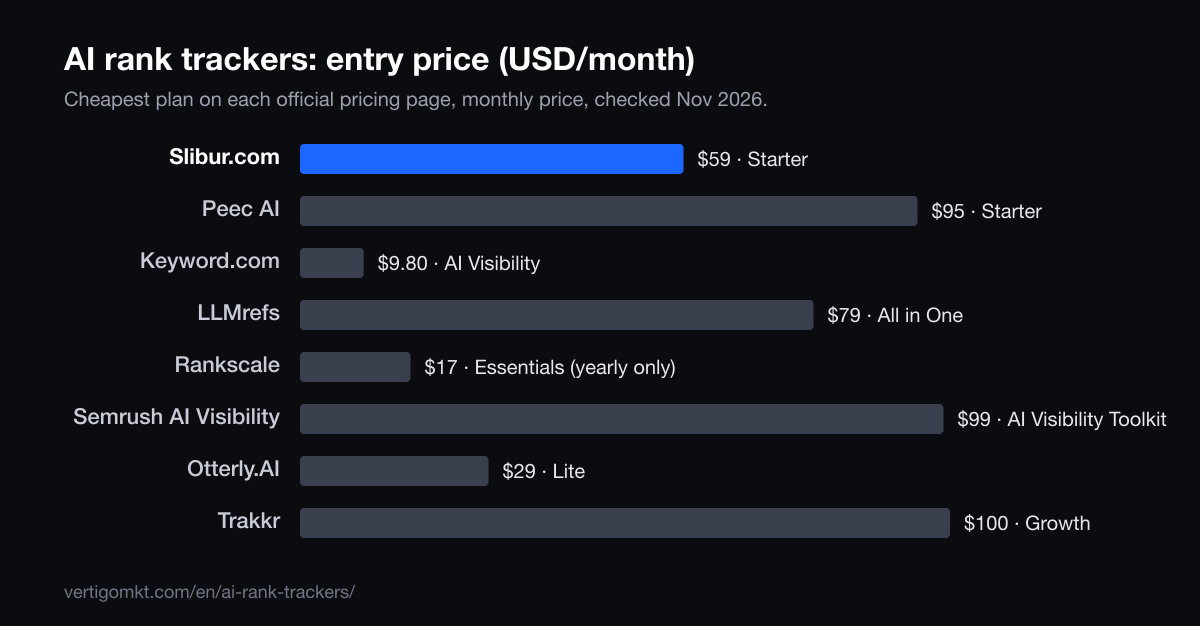
| Tool | Best for | Refresh | Entry price / month |
|---|---|---|---|
| 1. Slibur.com | Teams that want position and visibility together, on real answers | ChatGPT and AI Overviews daily; Claude, Perplexity and Grok weekly | $59 (Starter) |
| 2. SE Visible | SEO teams tracking hundreds of queries | Daily | €80 (Basic) |
| 3. Peec AI | Marketing teams sharing one daily dashboard | Daily | $95 (Starter) |
| 4. Keyword.com | Very small budgets and SEOs who know Keyword.com | Daily, weekly or monthly (uses credits) | $9.80 (AI Visibility) |
| 5. LLMrefs | Tracking from an existing keyword list | Weekly | $79 (All in One) |
| 6. Rankscale | Custom schedules, including hourly | Hourly to monthly, your choice | $17 (Essentials) |
| 7. Semrush AI Visibility | Existing Semrush subscribers | Daily (brand reports weekly) | $99 per domain |
| 8. Otterly.AI | A simple daily tracker for a few prompts | Daily | $29 (Lite) |
| 9. Trakkr | Daily rank across eight engines | Daily | $100 (Growth) |
Want your own numbers before you read further? Slibur.com’s 7-day trial needs no card and shows what ChatGPT, Google AI Overviews, Claude, Perplexity and Grok say about your brand.
Which tracker for which job
- Best all-round AI rank tracker: Slibur.com. Average position, visibility and rivals on five engines from $59, with ChatGPT and AI Overviews read daily.
- Best for daily Google AI rankings: SE Visible. 75 daily prompts on ChatGPT, AI Overviews, AI Mode, Gemini and Copilot for €80.
- Best for daily team reporting: Peec AI. Position, sentiment and sources daily, with unlimited users.
- Cheapest way in: Keyword.com. A rank tracker’s AI add-on from $9.80, on credits.
Nine AI rank trackers, in order
1. Slibur.com
Teams that want position and visibility together, on real answers
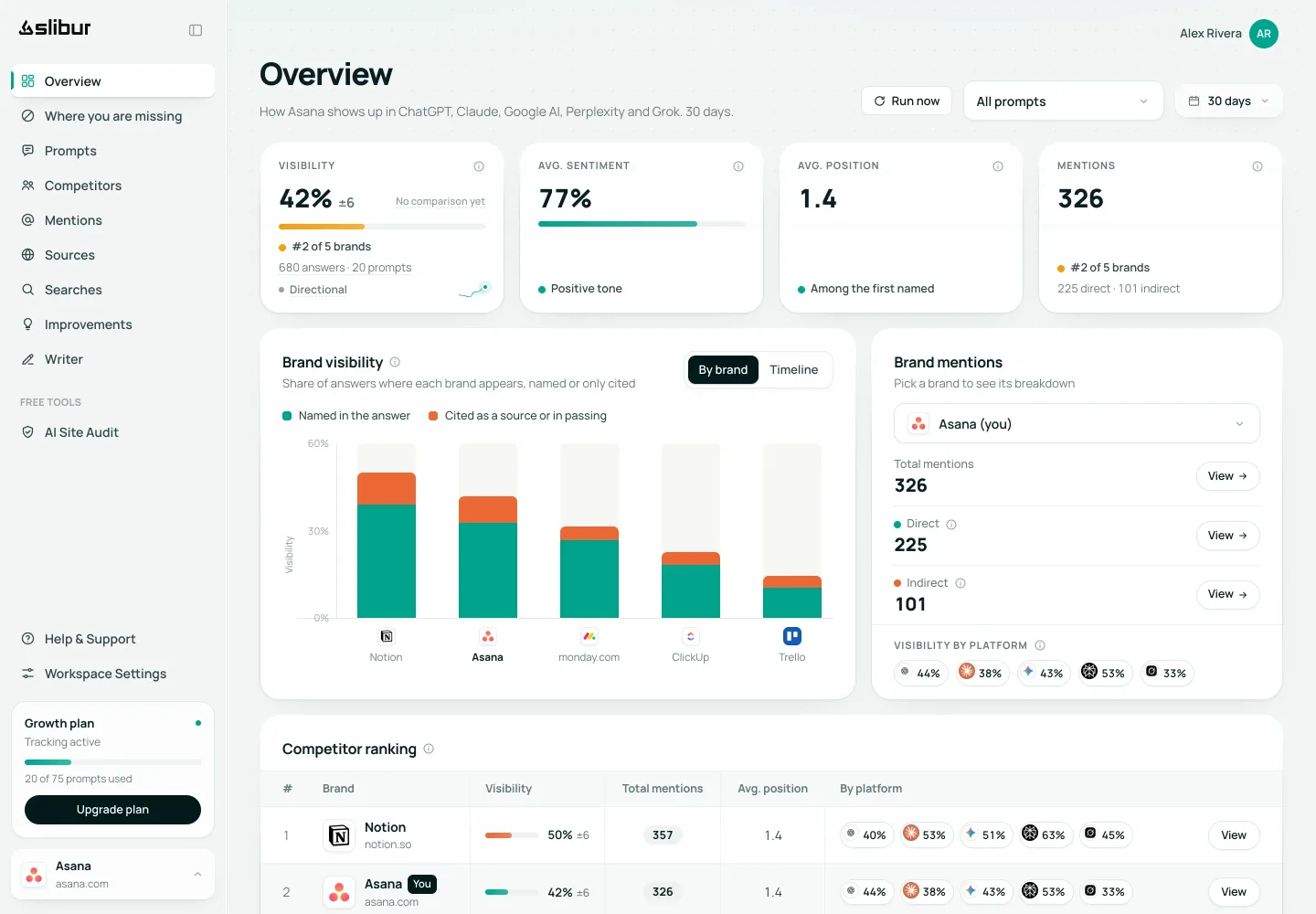
Slibur.com reports your average position whenever an answer names you, next to a visibility score counting every answer where you appear, by name or by citation. Answers that leave you out count as zero, and each engine carries equal weight, so a strong showing in one assistant cannot hide a blank in another. Your rivals appear in the same ranking, up to 25 of them.
ChatGPT is read from chatgpt.com and Google AI Overviews from the live results every day. Claude, Perplexity and Grok are checked weekly by API with web search on. You write the prompts yourself, which keeps the ranking tied to questions you care about, and the Run now button gives you a fresh measurement on paid plans whenever you want one.
Starter is $59 for 20 prompts, Growth $129 for 75 and Scale $299 for 250, with a 7-day no-card trial. It does not cover Gemini or AI Mode, and there is no data export.
Pros
- Position and visibility in one view
- Answers read from the real pages for ChatGPT and AI Overviews
- Prompts you write yourself
- Unlimited manual runs on paid plans
Cons
- Claude, Perplexity and Grok only weekly by schedule
- No Gemini or AI Mode
- No exports or API
Verdict: The balanced choice for tracking rank on the assistants most buyers use. If you need Gemini or AI Mode, go to SE Visible or Peec AI.
Source: Slibur.com pricing page, checked Nov 2026.
Try Slibur.com free for 7 days2. SE Visible
SEO teams tracking hundreds of queries
SE Visible, from SE Ranking, feels closest to a traditional rank tracker: lots of queries, daily updates, mentions, position, share of voice and citations. Basic, shown at €80 a month in Spain, covers 75 prompts on ChatGPT, AI Overviews, AI Mode, Gemini and Copilot, gathered from the browser interface.
Daily checks smooth out the randomness in AI answers, which suits position metrics well. Perplexity and Grok do not appear, and Claude is only on the Agency plan, through the API.
Pros
- Daily refresh on five engines
- Browser-collected answers
- AI Mode and Gemini
Cons
- No Perplexity
- No Grok
- More useful alongside SE Ranking
Verdict: The Google-heavy pick under $100.
Source: SE Visible pricing page, checked Nov 2026.
3. Peec AI
Marketing teams sharing one daily dashboard
Peec AI tracks visibility, position, sentiment and sources every day for 50 prompts at $95 a month, with three engines of your choice and unlimited users. Most engines are read from their apps, and Peec labels which ones run by API.
Perplexity is an extra and Claude and Grok sit in Enterprise, so a five-engine rank report costs a lot more here.
Pros
- Daily on all selected engines
- Unlimited seats
- CSV exports
Cons
- Three engines per plan
- Perplexity costs extra
- Claude and Grok on Enterprise
Verdict: A clean daily tracker for teams focused on three assistants.
Source: Peec AI pricing page, checked Nov 2026.
4. Keyword.com
Very small budgets and SEOs who know Keyword.com
Keyword.com comes from classic rank tracking, and its AI Visibility plan starts at $9.80 for 20 credits, roughly 80 runs. Claude, Perplexity and Grok use credits four times faster than ChatGPT or Gemini.
You choose daily, weekly or monthly runs, and the budget disappears quickly on daily checks. The 14-day trial asks for no card.
Pros
- Lowest entry price
- Choose the schedule
- No-card trial
Cons
- Small credit pool
- Some engines cost 4x credits
- Method not stated
Verdict: A cheap experiment, less suited to serious tracking.
Source: Keyword.com pricing page, checked Nov 2026.
5. LLMrefs
Tracking from an existing keyword list
LLMrefs starts from keywords, which will feel familiar to SEOs: you add keywords and it generates the prompts, then reports share of voice, position, citations and competitors on 500 prompts weekly for $79.
Weekly refresh limits how fast you can see a change, and generated prompts may not match the wording of your buyers.
Pros
- Keyword-first workflow
- About ten engines
- 500 prompts
Cons
- Weekly only
- Less control over prompts
- Price marked limited time
Verdict: Comfortable for keyword-minded SEOs on a budget.
Source: LLMrefs pricing page, checked Oct 2026.
6. Rankscale
Custom schedules, including hourly
Rankscale lets you set cadence from hourly to monthly across more than 17 engines, paying in credits. Essentials is $17 on a yearly bill for up to 480 answers; Pro is $99 for up to 4,800.
Flexibility has a price in attention, since someone has to decide how to spend the credits each month.
Pros
- Hourly option
- More than 17 engines
- Low entry price
Cons
- Credits to manage
- Cheapest plan is yearly only
- Setup takes effort
Verdict: For analysts who like control.
Source: Rankscale pricing page, checked Oct 2026.
7. Semrush AI Visibility
Existing Semrush subscribers
Semrush adds Prompt Tracking to its AI Visibility Toolkit at $99 per domain: 25 prompts with daily updates, position, mentions and sources, in the same place as your organic rankings.
One engine per campaign means separate campaigns for ChatGPT Search, AI Mode and Gemini. The pricing page adds Perplexity mentions; Claude and Grok are not offered.
Pros
- Next to organic rankings
- Export formats
- Daily updates
Cons
- One engine per campaign
- No free trial for the toolkit
- Per-domain, per-user costs
Verdict: Sensible only if Semrush is already home.
Source: Semrush AI Visibility pricing page, checked Nov 2026.
8. Otterly.AI
A simple daily tracker for a few prompts
Otterly.AI offers 15 prompts on ChatGPT, AI Overviews, Perplexity and Copilot for $29, updated daily and read from each engine’s website. It focuses on visibility, sentiment and citations more than on position.
Claude, Gemini and AI Mode are paid add-ons.
Pros
- Low flat price
- Daily data
- No-card trial
Cons
- 15 prompts
- Add-on pricing adds up
- Position is less central
Verdict: A good first daily report for a single brand.
Source: Otterly.AI pricing page, checked Oct 2026.
9. Trakkr
Daily rank across eight engines
Trakkr’s $100 Growth plan checks 50 prompts every day on ChatGPT, Claude, Gemini, Perplexity, AI Overviews, Grok, DeepSeek and Meta AI, the widest daily list at that price among these trackers.
The method is not stated and the 14-day trial needs a card, so ask how answers are gathered before relying on the numbers.
Pros
- Eight engines daily
- DeepSeek and Meta AI
- 50 prompts
Cons
- Card required for the trial
- Method not stated
- $100 entry
Verdict: The pick when daily breadth beats everything else.
Source: Trakkr pricing page, checked Oct 2026.
Do you need daily rank checks?
Daily data earns its cost on engines that change quickly and matter most to you. Google rewrites AI Overviews often, and ChatGPT’s answers move as it searches different pages. For those two, a daily line helps you separate noise from a trend.
Assistants with fewer buyers in your market rarely justify the same spend. Weekly checks tell you the direction, and most teams only act on a weekly rhythm anyway. Hourly runs can suit research, but no one rewrites a page because of a change at 3 p.m.
A handy test: look at what you did after last month’s report. If nobody changed anything because of a single day’s movement, you are paying for precision you do not use, and more prompts would serve you better than more frequent runs.
How AI rank tracking differs from SEO rank tracking
- Prompts instead of keywords. People ask long questions with context, so “best CRM for a 10-person law firm” behaves differently from “CRM software”.
- Brand instead of URL. You are tracking whether a name appears, with or without a link.
- Samples instead of one result. The same prompt can return different answers, so results are averages over many runs.
- No shared public index to check. Each assistant has its own sources and habits, and personalization can shift what a real user sees.
None of this makes classic rankings obsolete. Google’s guidance is that the same SEO fundamentals apply to its AI features, and pages that rank well organically frequently feed AI Overviews. Keep your SEO tracker and add an AI layer. If ChatGPT is your only concern, our ChatGPT rank trackers guide goes deeper on that one assistant.
Setting up a tracker so the numbers mean something
- Write prompts in your buyers’ words, from sales calls and support tickets, without your brand name in them.
- Group them by product or topic so one category’s movement does not hide another’s.
- Add three to five real competitors, including the one your sales team hears about most.
- Leave it alone for two weeks to build a baseline before you judge anything.
- Keep your prompt list stable. Each change breaks the comparison with earlier weeks, so add new prompts rather than rewording old ones.
Use one tool for trends. Switching vendors, or comparing two side by side, tends to raise more questions than it answers, since each one collects and scores answers differently.
How we ranked these AI rank trackers
We read official pricing and documentation between October 19 and 24, 2026, and noted the metrics each tool names, its schedule, how it collects answers and what the entry plan includes. Vendor claims were not independently audited. Each card links to its source.
Slibur.com is our product, and we say so on every page. We placed it first for pairing position with a visibility score on five engines at a public price, using answers read from the real ChatGPT and Google pages. Three of its engines update weekly on schedule, which is a genuine disadvantage against the daily tools in this list.
- What “rank” means
- Position, visibility, share of voice, and whether the tool explains the calculation.
- Answer source
- Real app or page versus API, stated per engine.
- Cadence
- How often each engine refreshes on the entry plan.
- Cost for real use
- Public price and prompts, including what add-ons and credits do to the bill.
Frequently asked questions
What is the best AI rank tracker?
We rank Slibur.com first for average position and visibility on five engines from $59 a month, with ChatGPT and AI Overviews read daily from the real pages. It is our product. SE Visible tracks 75 daily prompts for €80 a month and Trakkr covers eight engines daily for $100.
Can you really rank in ChatGPT or other AI tools?
Not in the fixed sense of a results page. Answers vary, and many contain no list. What you can measure is how often you appear across many runs, and where you tend to sit when brands are listed.
How does an AI rank tracker work?
It sends a set of prompts to AI assistants on a schedule, through their apps or APIs, then reads the answers to find brand names, order, sentiment and links. Results are averaged over runs and compared with rivals.
Is there a free AI rank checker?
There are free one-off checks, such as SE Ranking’s 5 daily checks or HubSpot’s AI Search Grader, and they show a snapshot. Ongoing tracking generally needs a paid plan or a time-limited trial.
How often do AI rankings change?
Constantly in small ways, because answers are generated afresh. Meaningful shifts usually appear across days or weeks. That is why averages over 7 or 30 days are more useful than any single reading.
Should I replace my SEO rank tracker?
No. Organic rankings still drive traffic and feed AI features such as AI Overviews. Add AI tracking alongside it, then compare the two to see where you rank well on Google but go unmentioned by assistants.
Keep reading
- The best ChatGPT rank tracker tools in 2026 for brand mentions and citations
- The 11 best AEO tracking tools in 2026, judged by what they measure
- The 8 best GEO audit tools in 2026, with a 20-point checklist to run your own
- AI citation tracking tools: who shows which pages the answers really cite
- Vértigo Marketing GEO agency services in the United States
- GEO agency services in the United Kingdom
Sources
Each tool card names the official page its figures come from. The guide also relies on:
- Google Search Central: AI features and your website
- SE Visible: plans and answer quotas
- Aggarwal et al., GEO: Generative Engine Optimization (arXiv)
By the Vértigo Marketing team Published Data checked