The best AEO tools for ecommerce in 2026, for stores that want AI to recommend them
When a shopper asks an AI assistant for the best running shoes or a gift under $100, a few products and stores get named. These eleven tools measure whether yours are among them and which sites the AI trusts. Slibur.com, which we make, is first.
Ecommerce has a particular problem with AI answers. A shopper who asks for “the best standing desk under $500” gets a short list, a few links and a verdict, and the decision is half made before any store page loads. If your products or your store are missing from that list, you are missing from the shortlist.
Measuring this is different from measuring brand visibility for a service company. A store cares about product categories, comparisons, price brackets and the retailers and review sites that answers cite. We compared eleven AEO tools with that in mind.
Picks by type of store
- Best for most online stores: Slibur.com. Product questions on five engines, with the retailers and review sites behind each answer.
- Best for Google’s AI shopping journeys: Peec AI. Pick AI Mode, AI Overviews and Gemini as your three engines, daily.
- Best for large catalogues: SE Visible. 75 daily prompts on Basic, and 200 or 1,000 on the higher plans.
How AI assistants recommend products
With web search on, assistants such as ChatGPT and Perplexity read reviews, comparison articles, forums and store pages, then summarise. Google’s AI Overviews draw on its index for product research queries. The products and stores named are the ones the web talks about most clearly for that need.
For a store, that means the battle often happens off your own site: in review roundups, buying guides, marketplace listings and forum threads. A tracker that shows the sources behind each answer tells you which of those to work on first.
Ecommerce AEO tools at a glance
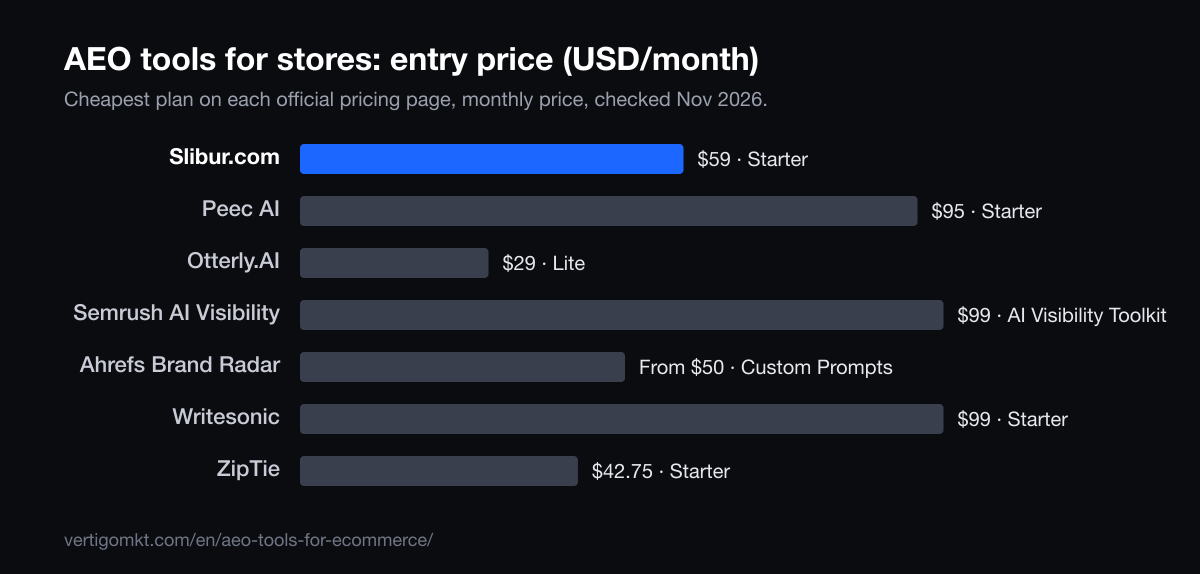
| Tool | Best for | Entry price / month | Prompts (entry plan) | AI engines |
|---|---|---|---|---|
| 1. Slibur.com | Stores that want to see which products, retailers and reviews AI recommends | $59 (Starter) | 20 | ChatGPT, Google AI Overviews, Claude, Perplexity, Grok (all five on every plan) |
| 2. Peec AI | Stores whose shoppers start on Google | $95 (Starter) | 50 | Pick 3: ChatGPT, AI Mode, AI Overviews, Copilot, Gemini, Naver. Perplexity extra |
| 3. SE Visible | Stores with many product categories | €80 (Basic) | 75 | ChatGPT, AI Overviews, AI Mode, Gemini, Copilot. Claude only on Agency (€355), through the API |
| 4. Otterly.AI | Small stores on a budget | $29 (Lite) | 15 | ChatGPT, AI Overviews, Perplexity, Copilot. Add-ons: AI Mode +$9, Gemini +$9, Claude +$29 |
| 5. Semrush AI Visibility | Stores already doing SEO in Semrush | $99 per domain | 25 (50 more for $60/mo) | Mentions from ChatGPT, Google AI, Gemini, Perplexity. Your prompts: ChatGPT Search, AI Mode or Gemini, one per campaign |
| 6. Ahrefs Brand Radar | Category research before choosing products to track | From $50 (custom prompts) | 2,500 checks (about 80 daily prompts on 1 engine) | AI Overviews, AI Mode, ChatGPT, Perplexity, Gemini, Copilot, Claude (8 checks per update) |
| 7. Scrunch | Stores checking AI crawler access to product pages | $250 (Core) | Not stated | ChatGPT, Perplexity, AI Overviews, Copilot; Claude, Grok on Enterprise |
| 8. Profound | Enterprise retailers | Custom (brands); agency plans from $99 | Not stated | Trial: ChatGPT, Gemini, AI Overviews; 9 on Enterprise |
| 9. AthenaHQ | Stores selling in markets with diverse assistants | $295 (Starter) | Not stated | 11 models, Claude and Grok included |
| 10. Writesonic | Stores that need product content at scale | $99 (Starter) | 50 | ChatGPT, Gemini, Google AI Overviews |
| 11. ZipTie | Many daily product prompts for little money | $42.75 (Starter) | 50 | ChatGPT, AI Overviews, Perplexity in this preset. Up to 7 engines; each one raises the price |
Want your own numbers before you read further? Slibur.com’s 7-day trial needs no card and shows what ChatGPT, Google AI Overviews, Claude, Perplexity and Grok say about your brand.
Eleven AEO tools for online stores
1. Slibur.com
Stores that want to see which products, retailers and reviews AI recommends
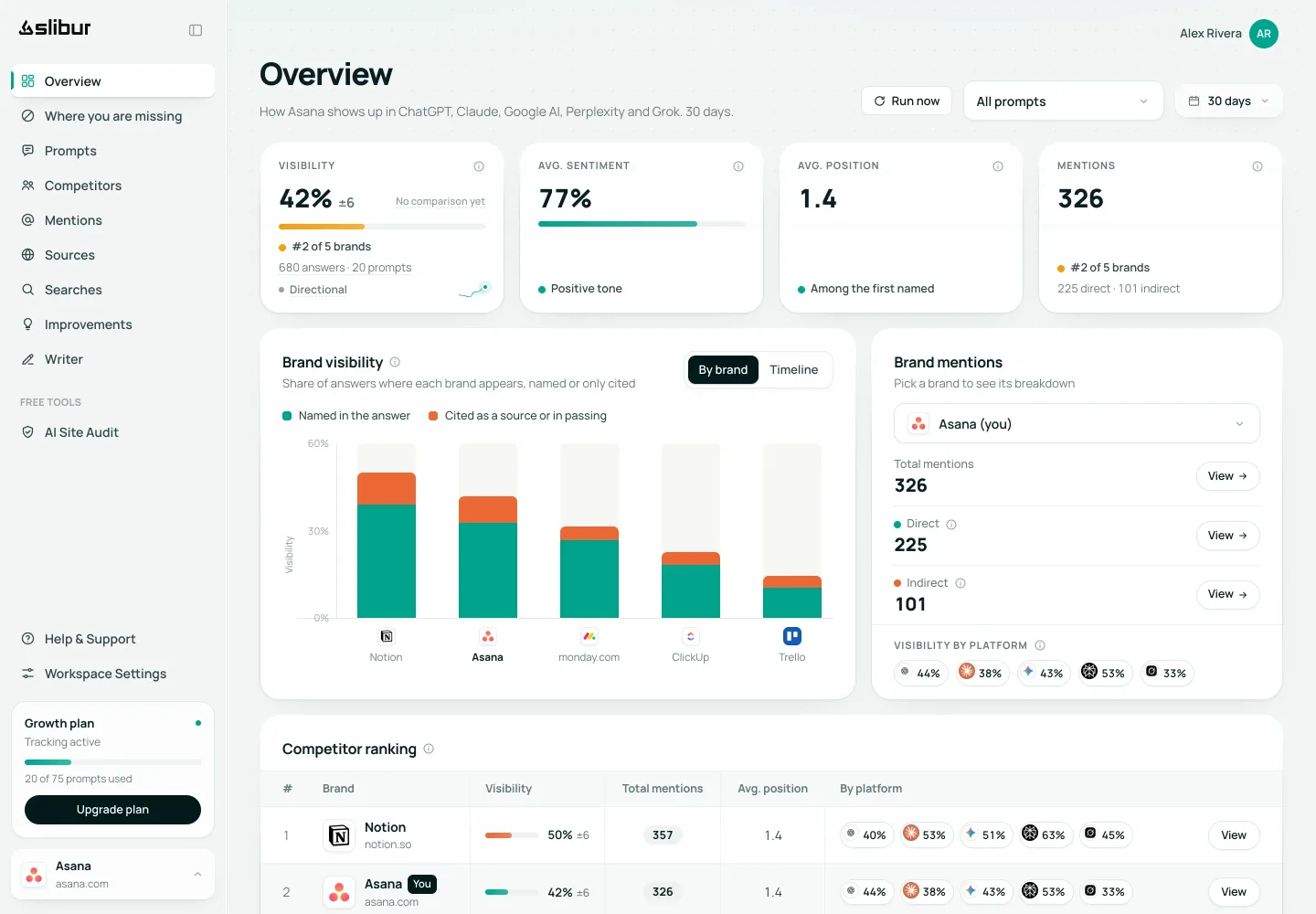
For a store, the most useful part of Slibur.com is the source analysis. Every answer to a product question is stored with the sites it cites, sorted into your own domain, competitors’ domains and third parties such as marketplaces, review sites and publishers. Over a few weeks that becomes a map of where AI assistants go to decide which products to recommend in your category.
Prompts such as “best trail running shoes for wide feet” or “quietest dishwasher under $800” run on ChatGPT (read from chatgpt.com) and Google AI Overviews daily, and on Claude, Perplexity and Grok weekly. Competitor rankings show which brands and stores win each product question, and indirect mentions reveal answers that use your product pages without naming your store.
There is no product feed connection and no separate tracking of shopping cards inside AI answers; Slibur.com reads the answer text and its sources. Starter costs $59 a month for 20 prompts; Growth, with 75 prompts, suits stores with several categories.
Pros
- Sources split into your site, rivals and marketplaces
- Product questions on five engines
- Competitor ranking per question
- No-card 7-day trial
Cons
- No product feed or shopping card tracking
- Larger catalogues need Growth or Scale
- No Gemini, AI Mode or Copilot
Verdict: The most practical way for a store to learn which sites decide AI product recommendations in its niche, and to measure progress there.
Source: Slibur.com pricing page, checked Nov 2026.
Try Slibur.com free for 7 days2. Peec AI
Stores whose shoppers start on Google
Peec AI lets you choose AI Mode, AI Overviews and Gemini as your three engines, a sensible set for stores that depend on Google traffic. It tracks visibility, position, sentiment and sources daily, with Google Analytics data alongside, starting at $95 a month for 50 prompts.
Perplexity is extra and Claude and Grok are Enterprise only.
Pros
- Google AI surfaces as standard options
- Daily data
- Google Analytics data
Cons
- Three engines per plan
- Perplexity extra
- $95 entry
Verdict: A good fit for Google-dependent stores.
Source: Peec AI pricing page, checked Nov 2026.
3. SE Visible
Stores with many product categories
Product catalogues need many prompts. SE Visible’s Basic plan, €80 a month as shown in Spain, covers 75 of them, checked daily on ChatGPT, AI Overviews, AI Mode, Gemini and Copilot through the browser, and its Core and Agency plans step up to 200 and 1,000.
Perplexity is no longer on its engine list, Claude only comes with Agency (by API, without web search) and Grok is absent. The trial lasts 10 days.
Pros
- 75 prompts on Basic, 200 on Core
- Google AI surfaces included
- Browser-based answers
Cons
- No Perplexity or Grok
- €80 entry
- Best inside SE Ranking
Verdict: The volume choice for big catalogues.
Source: SE Visible pricing page, checked Nov 2026.
4. Otterly.AI
Small stores on a budget
Otterly.AI’s $29 Lite plan tracks 15 prompts daily on ChatGPT, AI Overviews, Perplexity and Copilot, from the engines’ websites. For a small store with one or two hero products, that is enough to start.
Gemini and AI Mode cost $9 each on Lite; unlimited countries suit stores that ship internationally.
Pros
- Low price
- Unlimited countries and languages
- No-card trial
Cons
- 15 prompts
- Google AI Mode and Gemini are add-ons
- No Grok
Verdict: A cheap start for small and cross-border stores.
Source: Otterly.AI pricing page, checked Oct 2026.
5. Semrush AI Visibility
Stores already doing SEO in Semrush
Semrush’s AI Visibility Toolkit adds prompt tracking and a prompt database to the suite for $99 a month per domain with 25 prompts. Each campaign follows one engine: ChatGPT Search, AI Mode or Gemini.
Useful if your product SEO already runs in Semrush; thin as a standalone AEO tool.
Pros
- Next to product SEO data
- Prompt database
- Daily tracking
Cons
- One engine per campaign
- No AI Overviews tracking
- No trial
Verdict: Convenient for Semrush-based teams.
Source: Semrush AI Visibility pricing page, checked Nov 2026.
6. Ahrefs Brand Radar
Category research before choosing products to track
Ahrefs Brand Radar’s AI Visibility Index ($199 a month) shows which brands appear across more than 496 million prompts, handy for spotting the product questions where competitors dominate. Custom prompts start at $50 a month.
No trial; coverage is thinner for small brands.
Pros
- Category-wide prompt research
- Seven engines per prompt
- Pairs with Ahrefs
Cons
- No trial
- Limited for small brands
- Checks to budget
Verdict: For category research by established brands.
Source: Ahrefs Brand Radar pricing page, checked Oct 2026.
7. Scrunch
Stores checking AI crawler access to product pages
Scrunch reports AI bot traffic, which helps stores see whether AI crawlers reach product and category pages at all, a common issue on JavaScript-heavy storefronts. Core is $250 a month per brand for 125 prompts on four engines.
Other engines are Enterprise only.
Pros
- AI bot traffic analysis
- 125 prompts
- 7-day trial
Cons
- $250 entry
- Four engines
- Per-brand pricing
Verdict: For stores with technical questions about crawling.
Source: Scrunch pricing page, checked Oct 2026.
8. Profound
Enterprise retailers
Profound suits large retailers that want AI traffic analytics, prompt demand estimates and up to nine engines under one contract. Answers are captured in the browser.
Brands pay custom prices after a 7-day trial with fixed prompts.
Pros
- AI traffic analytics
- Prompt demand estimates
- Up to nine engines
Cons
- Custom pricing
- Fixed trial prompts
- No Grok listed
Verdict: For enterprise ecommerce teams.
Source: Profound pricing page, checked Oct 2026.
9. AthenaHQ
Stores selling in markets with diverse assistants
AthenaHQ’s $295 Starter plan covers 11 models, including DeepSeek, Meta AI and Mistral, with GA4 and Search Console connected. The free plan offers 300 credits on five engines.
Useful for stores selling where less common assistants are popular.
Pros
- Eleven models
- GA4 and Search Console
- Free plan
Cons
- $295 entry
- Credits to plan
- Single region and language
Verdict: Broad model coverage for bigger budgets.
Source: AthenaHQ pricing page, checked Oct 2026.
10. Writesonic
Stores that need product content at scale
Writesonic combines daily tracking on ChatGPT, Gemini and AI Overviews with AI writing and site audits for $99 a month. Stores that need buying guides and comparison pages may value the writing side.
Edit generated content carefully: shoppers and AI both reward specific, accurate product detail.
Pros
- Writing and tracking together
- Site audits
- Free start
Cons
- Three engines
- Generated text needs editing
- Sentiment on higher plans
Verdict: For stores that publish a lot of guides.
Source: Writesonic pricing page, checked Oct 2026.
11. ZipTie
Many daily product prompts for little money
ZipTie’s preset tracks 50 prompts daily on ChatGPT, AI Overviews and Perplexity for $42.75 a month, a lot of product questions for the price.
Each extra engine adds cost; the trial is 7 days without a card.
Pros
- 50 daily prompts
- Low price
- No-card trial
Cons
- Three engines in the preset
- Method not stated
- Engines cost extra
Verdict: Good value for tracking many products.
Source: ZipTie pricing page, checked Oct 2026.
Prompts every store should track
- Best-in-category: “best espresso machine for beginners”.
- Price bracket: “best wireless earbuds under $100”.
- Use case: “running shoes for flat feet and long distances”.
- Comparison: “Brand A vs Brand B robot vacuum for pet hair”.
- Store choice: “where to buy refurbished MacBooks with warranty”.
- Trust: “is [your store] legit?”, the one prompt where using your own name makes sense.
Group prompts by category so you can see which ranges AI favours. Our guide to keyword research tools for AEO explains how to build the list.
What AEO tools do not track for stores yet
None of the pricing pages we read lists, as a separate feature, tracking of shopping cards or product carousels inside AI answers, or a connection to your product feed. Most tools read the answer text and its links. If shopping placements matter to you, ask vendors directly how they handle them.
Traffic is another gap: visibility tools measure answers, not orders. Use GA4 to see visits from chatgpt.com or perplexity.ai and their conversion rate, and keep the two views side by side.
An ecommerce AEO checklist
- Product pages readable without JavaScript: name, price, key specs and availability in the HTML.
- Product and review structured data on product pages.
- AI crawlers allowed in robots.txt, and not blocked by your CDN or firewall.
- Presence on the review and comparison sites that answers cite for your category.
- Clear policies: shipping, returns and warranty written plainly, since shoppers ask about them.
- Buying guides with real data: measurements, tests, comparisons. The researchers behind generative engine optimization found statistics and citations raise visibility in generated answers (GEO study).
How we chose tools for ecommerce
We compared each tool’s official pricing and documentation, read between October 19 and 24, 2026, on what a store needs: enough prompts for its categories, the engines shoppers use, source analysis that shows retailers and review sites, and price. Every card links to its source.
Slibur.com is our own product. It ranks first for its source analysis and engine coverage at a store-friendly price; its lack of product feed and shopping card tracking is stated in its card.
- Prompt volume
- Enough questions to cover product categories and price brackets.
- Shopper engines
- Google’s AI surfaces and ChatGPT first, then Perplexity and others.
- Source analysis
- Seeing which marketplaces, reviewers and publishers answers rely on.
- Price for a store
- Entry price and the plan a real catalogue needs.
Frequently asked questions
What is the best AEO tool for ecommerce?
We rank Slibur.com first because it tracks product questions on five engines and classifies the sources behind each answer into your site, rivals and third parties such as marketplaces and reviewers, from $59 a month. Slibur.com is our product. SE Visible suits large catalogues and Peec AI stores that rely on Google’s AI surfaces.
Can AEO tools track products in ChatGPT shopping results?
Not as a stated feature on the pricing pages we read. Most tools read the answer text and its links. If product cards or carousels matter to your store, ask each vendor how they capture them before buying.
How many prompts does an online store need?
Start with 20 to 50 covering your main categories, price brackets and comparisons. Large catalogues may need 100 or more, which is where volume plans such as SE Visible or higher tiers of other tools come in.
Which AI engines matter most for ecommerce?
Google’s AI Overviews and AI Mode for shoppers who start on Google, and ChatGPT for product research. Perplexity is popular for detailed comparisons. Track the engines where your customers research, and check AI referral traffic in GA4 to confirm.
How can a store get recommended by AI?
Make product pages crawlable and specific, use product and review structured data, earn coverage on the review and comparison sites AI cites, and publish buying guides with real data. No tool or agency can guarantee recommendations.
Keep reading
- The 14 best AEO tools in 2026: answer engine optimization software compared
- Keyword research tools for AEO: 9 ways to find the prompts that matter in 2026
- The 12 best AEO analysis tools in 2026, and what each one really analyzes
- The 11 best AI visibility tools for marketing teams in 2026
- Vértigo Marketing GEO agency services in the United States
- GEO agency services in the United Kingdom
Sources
Each tool card names the official page its figures come from. The guide also relies on:
- Google Search Central: AI features and your website
- OpenAI: overview of OpenAI crawlers
- Aggarwal et al., GEO: Generative Engine Optimization (arXiv)
By the Vértigo Marketing team Published Data checked