What we measure when we do GEO in Waterloo
Here the result can be counted: how many times AI names your brand and how high up in the answer.
More than 200 clients trust us.
GEO, also called AI SEO, is how a company gets named when people take their questions to ChatGPT or Gemini instead of Google. For businesses in Waterloo, we measure what AI says about your brand today and do the work needed for it to cite you.
Featured in the Spanish press


















And so on, past 200 clients.
Here the result can be counted: how many times AI names your brand and how high up in the answer.
2
ways an assistant can answer: by searching the web at that moment or from what it learned months ago. We work on both.
How AI answers
3
checks on each question: does it name you, who does it put first and where does it get that from.
What we measure
1
review a month of every question we track, with before and after screenshots.
Follow-up
4
places where we measure your brand: ChatGPT, Gemini, Perplexity and the AI answers in Google.
Where your customers ask
ChatGPTGeminiPerplexityGoogle AI
WaterlooCanadaWorldwide
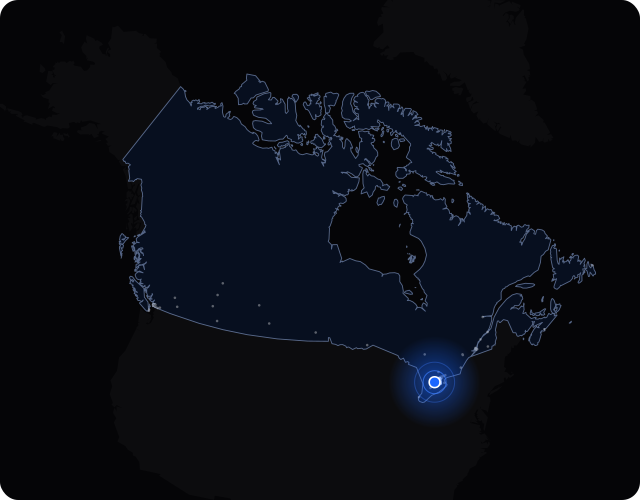
Waterloo is home to around 100,000 people. It is in Ontario. In Ontario we cover 26 cities.
For smaller cities AI often has little to go on and ends up recommending companies from the nearest big city. Giving it well-organized information is how you get it to name you instead. Our office is in Murcia, Spain, about 6,500 km (4,000 miles) away and usually 6 hours ahead of you. We meet by video call. If your business is in Kitchener, Cambridge or Guelph, there is a page like this one for each.
Population figures: GeoNames.
GEO, sector by sector
People ask AI about symptoms before they ask about clinics. If your pages answer those questions under a named, registered practitioner, you have a better chance of being the clinic it names in Waterloo.
Before asking for a quote, many people ask AI what a renovation costs and who to call. We publish your guide prices and your finished jobs so it has something to work with.
More and more visitors ask AI to plan where to eat. What it says comes from reviews, guides and local press, and that is where you need to appear.
Each assistant finds its information in a different way. Some search the web live as they answer and others reply from what they learned in training, months ago. Knowing which one your customer uses changes the plan.
We check what each assistant knows about your company and whether what it says is correct. Sometimes it does name you, but describes you badly or with old details.
We collect the doubts your customer settles before buying: prices, comparisons, who to go to. Those are the questions you want to appear in.
We rewrite your key pages with clear answers, your own data and a structure that engines can read and use as a source.
We make it clear who you are, what you do and where. It sounds minor, but it is the most common fault when an assistant describes a company badly.
AI recommends whoever it sees recommended. We aim to get you into the articles, lists and publications it uses as references in your sector.
We measure the visits that come from ChatGPT, Perplexity or Gemini and what those visitors do on your website, to find out whether the mentions bring customers.
AI does not show a list for you to choose from. It chooses for you. When someone asks about a physiotherapist in Waterloo, they get a few names, and the first one has the advantage.
Illustrative simulation. AI answers change every time a question is asked and nobody can guarantee a specific recommendation.
We ask each engine about your sector and your brand to find out where we are starting from.
You receive a document with the answers, the sources and the actions we propose, from most to least important.
Content, structured data and media mentions, month by month, with tasks you know about in advance.
Every month we put the same questions to each engine and compare. What works gets more time and what does not gets changed.
5.0
34 Google reviews
“Friendly, effective and quick to sort things out. 100% recommended.”
“Without a doubt the best marketing decision I have made.”
“I am really happy with the guys at Vértigo, Jesús and Raúl.”
Can't find your question? Write to us and we'll reply within 24 hours.
Talk to the teamGEO stands for generative engine optimization. It is the work of getting assistants such as ChatGPT, Gemini and Perplexity, and the AI results in Google, to name and recommend your company when someone asks about what you sell. You will also see it called AI SEO or AI search optimization.
SEO earns you a position in a list and the click that follows. GEO earns you a mention inside an answer, sometimes with a link and sometimes without. Much of the groundwork is shared, but GEO puts more weight on what third-party sources say about your company.
It does. For local questions, assistants draw heavily on map listings, review sites and neighbourhood press, all things a business in Waterloo can improve. A national name is not required. Accurate details, recent reviews and pages that say plainly what you do and where are what count.
You rarely have to rebuild it. The usual work is rewriting some pages, adding the ones that are missing and marking up your data properly. We only propose a new website when the current one is hard for search engines and AI crawlers to read.
For the most part, yes. When AI links to your website and someone clicks, the source is recorded. What leaves no trace is the person who reads the answer and looks you up by name afterwards, which is why we also watch searches for your brand.
More or less. GEO, AI SEO, AI search optimization and AEO (answer engine optimization) are names for the same aim: being cited and recommended in answers written by AI. The industry has not settled on one term. We say GEO, but the work is identical whatever you call it.
We analyze what AI says today about your company and your competitors, at local, national or international level. You receive a report with the actions for your brand in order of priority.
GEO auditNo obligation
RequestWe will get back to you as soon as possible.