The AEO tools for SaaS worth paying for when buyers ask AI what to buy
Software buyers now ask ChatGPT for a shortlist before they ever visit a pricing page. These AEO tools for SaaS show whether you make that list, and who does instead. Slibur.com, which we build, ranks first; eight others suit different stages and stacks.

SaaS is unusually exposed to AI answers. Your buyers do research online, compare many vendors, and phrase their needs in full sentences: “what’s the best help desk for a 20-person startup that uses Slack?” That is exactly the kind of question an assistant answers well, and it answers with names.
Being left out of those names is hard to notice, since no report in your analytics shows a shortlist you were never on. The tools here measure that gap. For a software company, what matters most is how they handle category, comparison and alternatives prompts, and whether they show which rival wins each one.
The five prompt types every SaaS company should track
Generic brand monitoring misses how software gets bought. Build your list from these types, in the wording your sales team hears on calls.
- Category
- “Best project management software.” Broad and competitive, and it shows whether assistants consider you a real player.
- Use case or segment
- “Best project management tool for construction companies.” Usually where a smaller vendor can actually win.
- Comparison
- “Asana vs your brand.” Read these answers closely, because assistants often state outdated features or prices.
- Alternatives
- “Alternatives to [market leader].” High buying intent, since the reader already wants to switch.
- Integration
- “Which help desks integrate with Jira?” Very common in B2B, and a fact your docs can settle if they are easy to read.
Skip prompts containing your own name except for comparison checks. An assistant will happily describe you when asked; what you want to know is whether it brings you up unprompted.
Picks by company stage
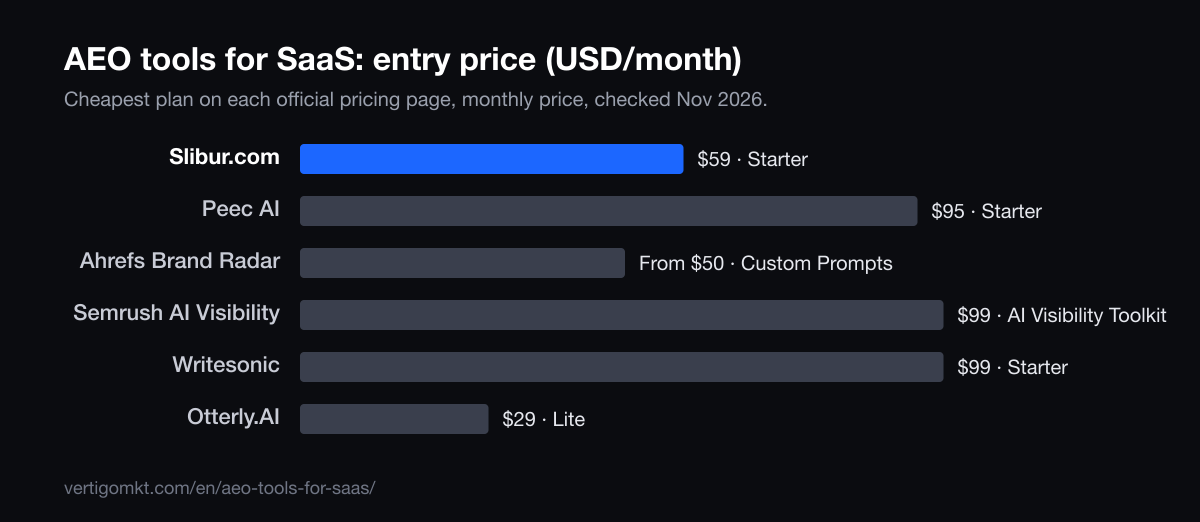
- Best for seed to mid-stage SaaS: Slibur.com. Competitor ranking on five engines from $59, with a no-card trial.
- Best for growing marketing teams: Peec AI. Unlimited seats, unlimited competitors and CSV exports from $95.
- Best if SEO already runs on Ahrefs: Ahrefs Brand Radar. AI data next to backlinks and content tools.
- Best inside a HubSpot stack: HubSpot AEO. AEO tracking for $50 a month in the CRM many SaaS firms already use.
Nine tools for SaaS teams
1. Slibur.com
SaaS teams tracking category and comparison prompts against named rivals
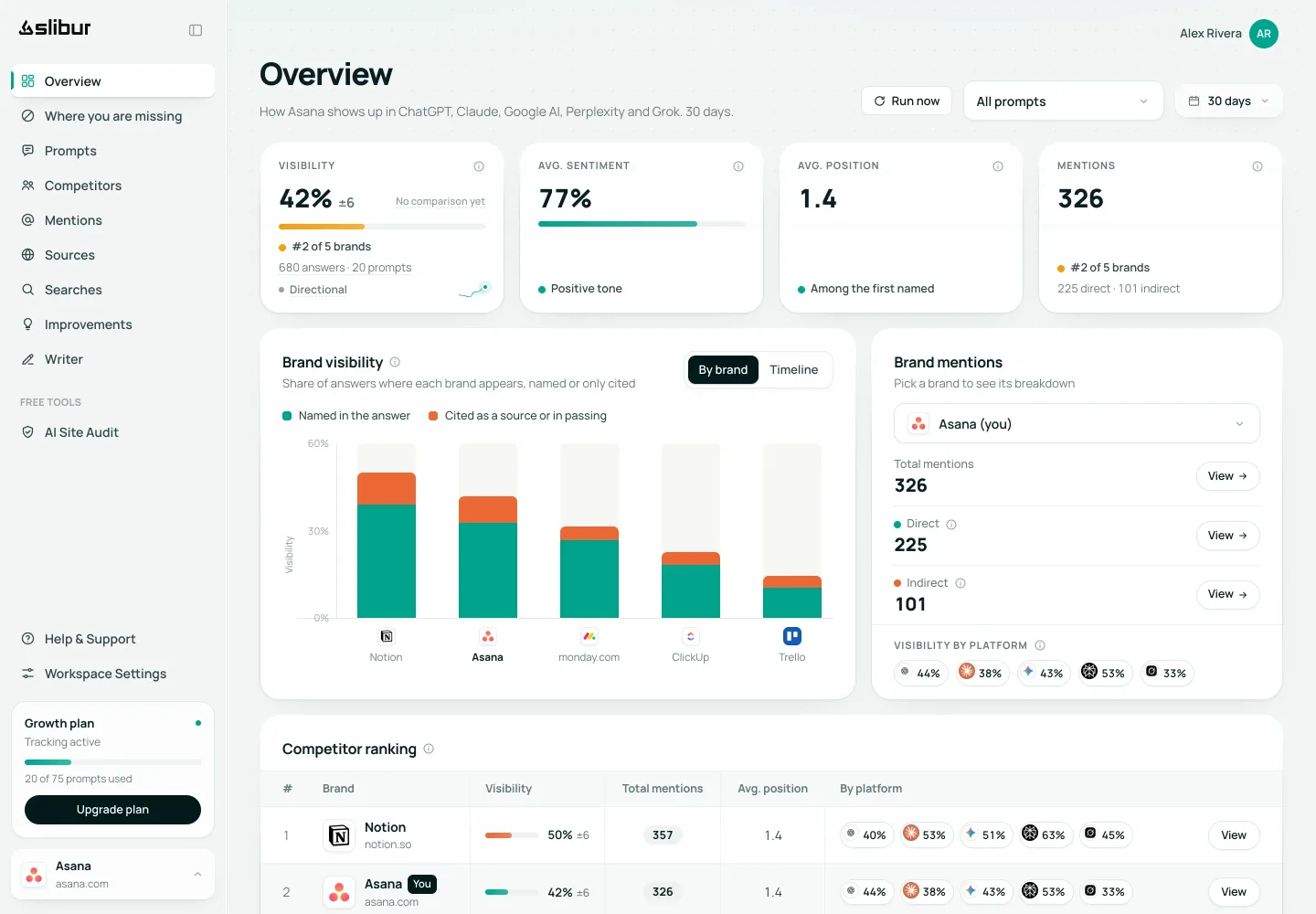
You write your own prompts, so “best X for Y” and “X vs Y” go in exactly as your prospects say them. Slibur.com then shows a ranking of you against up to 25 competitors on ChatGPT, Google AI Overviews, Claude, Perplexity and Grok. Technical buyers often turn to Claude, and here it is included in the base price.
The weekly ideas call out rivals pulling far ahead, brands the assistants recommend that you are not tracking yet, and sources that favor competitors. For a founder or a one-person marketing team, that list often says more than the dashboard.
Starter is $59 for 20 prompts and Growth is $129 for 75. There is no CRM link, no GA4 connection and no way to tie a mention to pipeline, so revenue attribution needs other tools.
Pros
- Claude and Grok on every plan
- Rival ranking with up to 25 competitors
- Spots untracked brands the assistants recommend
- No-card trial
Cons
- No GA4, CRM or API integration
- No traffic or pipeline data
- No Gemini, AI Mode or Copilot
Verdict: Quick to set up and clear on who beats you. Larger SaaS teams needing attribution or integrations should look further down.
Source: Slibur.com pricing page, checked Nov 2026.
Try Slibur.com free for 7 days2. Peec AI
Marketing teams with several people working on AI search
Peec AI gives everyone a login, which suits SaaS teams where content, product marketing and SEO all want the data. Starter costs $95 for 50 prompts and three engines, daily, with unlimited competitors and Google Analytics data available in the product.
Higher plans add an API from Pro at $245. Copilot is available as one of your three picks, handy if you sell to Microsoft-heavy companies.
Pros
- Unlimited users and competitors
- Copilot option
- CSV exports
Cons
- Three engines per plan
- Claude on Enterprise only
- Perplexity extra
Verdict: A comfortable shared dashboard for growth teams.
Source: Peec AI pricing page, checked Nov 2026.
3. Ahrefs Brand Radar
SEO-led SaaS growth teams
Many SaaS companies grew on organic content and already pay for Ahrefs. Brand Radar sits in the same suite, tracks mentions, citations and share of voice, and offers custom prompts from $50 a month if you buy it alone.
For teams on Lite at $129, five daily prompts are included, which is thin. No trial is offered.
Pros
- Links AI data with SEO tools
- Seven engines by prompt
- API and MCP on full plans
Cons
- No free trial
- Few prompts on Lite
- No Grok
Verdict: The easy add-on for SEO-first teams.
Source: Ahrefs Brand Radar pricing page, checked Oct 2026.
4. HubSpot AEO
Companies that run marketing on HubSpot
HubSpot AEO costs $50 a month for 25 prompts across ChatGPT, Gemini and Perplexity, with visibility, sentiment, share of voice and citations refreshed daily. Plenty of B2B software teams already live in HubSpot, so adoption is easy.
Three engines is a short list, Claude is missing, and the collection method is not stated. The free AI Search Grader is a useful first look.
Pros
- HubSpot brand and ecosystem
- Free one-time grader
- Daily data
Cons
- Three engines
- No Claude
- Method not stated
Verdict: Convenient for HubSpot houses, basic for anyone else.
Source: HubSpot AEO pricing page, checked Oct 2026.
5. Profound
Late-stage and enterprise SaaS
Profound targets big software brands: up to nine engines captured in the browser, citations, sentiment, prompt volume estimates and agent analytics that look at AI-sourced traffic.
It is custom priced for brands after a short trial on fixed prompts, so it fits companies with a defined budget and procurement.
Pros
- Enterprise depth
- AI traffic analytics
- Browser-based capture
Cons
- No public brand price
- Fixed trial prompts
- Overkill for early teams
Verdict: For the marketing org of a large public or late-stage SaaS.
Source: Profound pricing page, checked Oct 2026.
6. Scrunch
Technical teams watching AI crawlers
Scrunch adds AI bot traffic to the usual citations and sentiment, helpful if your docs or developer pages are a main acquisition channel and you want to see what AI crawlers fetch. Core is $250 for 125 prompts.
Claude and Grok need Enterprise, and refresh slows to every 72 hours after two weeks.
Pros
- AI bot traffic
- Method documented
- 7-day trial
Cons
- $250 entry
- Claude on Enterprise
- 72-hour default refresh
Verdict: Interesting for developer-focused products.
Source: Scrunch pricing page, checked Oct 2026.
7. Semrush AI Visibility
Semrush customers testing AI prompts
The Semrush AI Visibility Toolkit tracks ChatGPT Search, AI Mode or Gemini, one per campaign, and its pricing page now lists Perplexity mentions too, at $99 per domain with 25 prompts included. If Semrush already runs your keyword research, it keeps the workflow in one tab.
SaaS teams with several product lines will find the per-domain and per-user pricing adds up.
Pros
- Familiar interface
- Good export options
- Daily prompt tracking
Cons
- No Claude or Grok
- One engine per campaign
- No free trial for the toolkit
Verdict: Fine as an extension of Semrush, limited alone.
Source: Semrush AI Visibility pricing page, checked Nov 2026.
8. Writesonic
Small teams wanting tracking plus content
Writesonic’s $99 Starter tracks 50 prompts daily on ChatGPT, Gemini and AI Overviews and comes with content writing tools and site audits, connected to Search Console.
Sentiment and GA4 wait for higher plans. Teams with their own writers may not need the rest of the package.
Pros
- Tracking and writing in one
- Search Console
- Free start, no card
Cons
- Three engines
- Sentiment on higher plans
- Method not stated
Verdict: For lean teams without a content workflow.
Source: Writesonic pricing page, checked Oct 2026.
9. Otterly.AI
Pre-seed startups checking the basics
At $29 for 15 prompts, Otterly.AI lets a founder see whether the product shows up at all on ChatGPT, AI Overviews, Perplexity and Copilot, daily, with unlimited members.
Fifteen prompts covers your category and two or three comparisons, and little more. Claude costs an extra $29.
Pros
- Low cost
- Daily data
- No-card trial
Cons
- Few prompts
- Claude is an add-on
- No Grok
Verdict: A sensible first check for a very early company.
Source: Otterly.AI pricing page, checked Oct 2026.
AEO tools for SaaS compared
| Tool | Best for | AI engines | Entry price / month |
|---|---|---|---|
| 1. Slibur.com | SaaS teams tracking category and comparison prompts against named rivals | ChatGPT, Google AI Overviews, Claude, Perplexity, Grok (all five on every plan) | $59 (Starter) |
| 2. Peec AI | Marketing teams with several people working on AI search | Pick 3: ChatGPT, AI Mode, AI Overviews, Copilot, Gemini, Naver. Perplexity extra | $95 (Starter) |
| 3. Ahrefs Brand Radar | SEO-led SaaS growth teams | AI Overviews, AI Mode, ChatGPT, Perplexity, Gemini, Copilot, Claude (8 checks per update) | From $50 (custom prompts) |
| 4. HubSpot AEO | Companies that run marketing on HubSpot | ChatGPT, Gemini, Perplexity | $50 (25 prompts) |
| 5. Profound | Late-stage and enterprise SaaS | Trial: ChatGPT, Gemini, AI Overviews; 9 on Enterprise | Custom (brands); agency plans from $99 |
| 6. Scrunch | Technical teams watching AI crawlers | ChatGPT, Perplexity, AI Overviews, Copilot; Claude, Grok on Enterprise | $250 (Core) |
| 7. Semrush AI Visibility | Semrush customers testing AI prompts | Mentions from ChatGPT, Google AI, Gemini, Perplexity. Your prompts: ChatGPT Search, AI Mode or Gemini, one per campaign | $99 per domain |
| 8. Writesonic | Small teams wanting tracking plus content | ChatGPT, Gemini, Google AI Overviews | $99 (Starter) |
| 9. Otterly.AI | Pre-seed startups checking the basics | ChatGPT, AI Overviews, Perplexity, Copilot. Add-ons: AI Mode +$9, Gemini +$9, Claude +$29 | $29 (Lite) |
Want your own numbers before you read further? Slibur.com’s 7-day trial needs no card and shows what ChatGPT, Google AI Overviews, Claude, Perplexity and Grok say about your brand.
What to buy at each stage
| Stage | What you need | Reasonable prompts | Tools to look at |
|---|---|---|---|
| Pre-seed, founder-led | Do we appear at all? | 10 to 20 | Otterly.AI, Slibur.com, free checks |
| Seed to Series A | Who beats us, and through which sources? | 20 to 75 | Slibur.com, Peec AI |
| Series B and up | Team dashboards, exports, SEO data | 75 to 250 | Peec AI, Ahrefs, Slibur.com Scale |
| Late-stage or enterprise | Attribution, compliance, several markets | 250 or more | Profound, Scrunch |
Buy for the questions you are asking today. An early company rarely acts on a daily sentiment trend across nine engines, and paying for it takes money away from the content and review work that actually moves the numbers.
What SaaS teams can do with the data
Software has some useful levers that other categories lack. Your own documentation and pricing page are public, specific and frequently cited, so keep them plain, current and open to crawlers. If assistants get your pricing wrong, a clear pricing page in readable HTML is the first fix to try.
Comparison and alternatives pages come next. Write them fairly, with real limits of your own product, because a page that only flatters you gives an assistant little to quote. Review sites such as G2 and Capterra, and listicles in your niche, often show up in the sources for category questions, so check whether your profile there is complete.
Reddit threads and developer forums appear often too. The right move there is honest participation under your own name, not planted praise. And give it time: the Princeton-led GEO research suggests adding statistics and citations to a page can lift its visibility, but results vary by topic, so measure your own category before scaling any tactic. For a broader view of the market beyond SaaS, see our main list of AEO tools.
How we chose tools for SaaS teams
We read each vendor’s official pricing and documentation between October 19 and 24, 2026 and looked at what matters for a software company: control over prompts, competitor reporting, engines technical buyers use, and fit with common stacks. Each card links to its source. We did not review anyone’s accuracy independently.
Slibur.com is our product. We placed it first because it combines custom prompts, a rival ranking and Claude at a public price low enough for an early team. It lacks the integrations many later-stage SaaS companies expect, which is why those companies may prefer Peec AI, Ahrefs or Profound.
- Prompt control
- Can you enter real “X vs Y” and “best X for Y” questions?
- Competitor reporting
- How many rivals, and how clearly the tool shows who wins each prompt.
- Engines for software buyers
- ChatGPT and AI Overviews first, then Claude, Perplexity and Copilot.
- Stack fit
- Connections to analytics, CRM or SEO tools, and whether they exist at all.
Frequently asked questions
What is the best AEO tool for SaaS?
For most early and mid-stage software companies we rank Slibur.com first: prompts you write yourself, a ranking against up to 25 competitors and five engines including Claude, from $59 a month. It is our product. Peec AI suits larger teams, and Profound suits enterprises.
Why does AEO matter for SaaS?
Buyers increasingly ask AI assistants for vendor shortlists and comparisons early in their research. Those answers can shape who gets a demo request, and you cannot see that from your usual analytics unless you track it directly.
How many prompts does a SaaS company need?
Twenty is a useful start for one product: a few category questions, your main segments, your top comparisons and alternatives. Multi-product companies should plan on 75 or more, grouped by product line.
Which AI assistants matter most for B2B software?
ChatGPT and Google AI Overviews reach the most buyers. Perplexity and Claude are popular with technical and research-minded users, and Copilot may matter if you sell into Microsoft-based companies. GA4 referral data helps confirm which apply to you.
Can AEO tools show pipeline from AI search?
Mostly not directly. Trackers show presence in answers, and a few connect to analytics. To estimate pipeline, add an “how did you hear about us?” field to your forms, and track AI referrals in your analytics alongside demo requests.
Is AEO different from SEO for SaaS?
They overlap a lot. Solid organic pages feed AI answers, and Google says the same fundamentals apply to its AI features. The differences are the metric, whether you are named in the answer, and the heavier role of third-party reviews and comparisons.
Keep reading
- The 14 best AEO tools in 2026: answer engine optimization software compared
- The 11 best AI visibility tools for marketing teams in 2026
- Which AI rank tracker measures position properly? Nine tools for 2026
- AI visibility tools under $100 a month, and what each one leaves out
- Vértigo Marketing GEO agency services in the United States
- GEO agency services in the United Kingdom
Sources
Each tool card names the official page its figures come from. The guide also relies on:
- Google Search Central: AI features and your website
- Aggarwal et al., GEO: Generative Engine Optimization (arXiv)
- OpenAI: overview of OpenAI crawlers
By the Vértigo Marketing team Published Data checked