The 10 best AEO tools for small business in 2026, most under $100 a month
Small businesses do not need an enterprise platform to know whether ChatGPT recommends them. They need a cheap, simple way to check a few questions and a short list of things to fix. These ten AEO tools fit that brief. Slibur.com, which we make, opens the list.
If you run a small business, AEO probably reached you as a vague worry: customers are asking ChatGPT where to go, and you have no idea whether your name comes up. The good news is that finding out is cheap, and most of what improves your chances is work you can do yourself.
The tools below are the ones we would consider for a business with one site, a modest budget and no marketing department. We looked at entry price, trial terms, how easy they are to start and whether they cover the assistants your customers actually use.
Can a small business afford AEO?
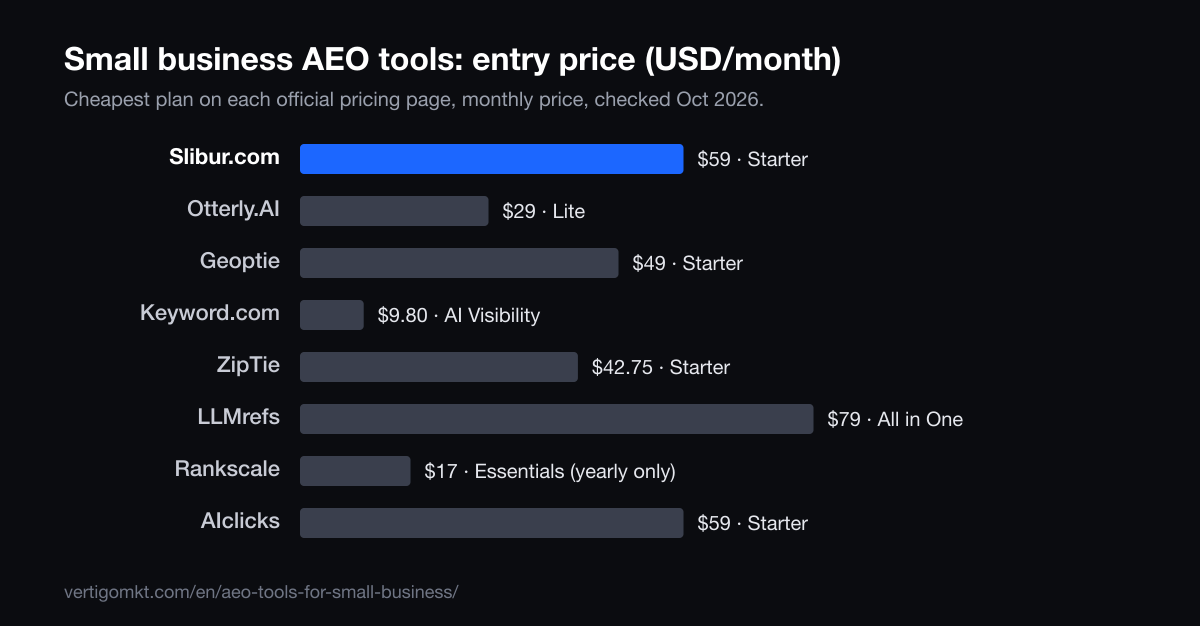
Yes. Measuring AI visibility costs between nothing and about $60 a month for a small business: free one-off checks from HubSpot, Geoptie or SE Ranking, trackers from $9.80 (Keyword.com) and $29 (Otterly.AI), and broader coverage from $59 (Slibur.com). The real cost is time, and most improvements are things you can do yourself: clearer service pages, more reviews, presence on the directories your industry uses.
Where it gets expensive is agencies and enterprise platforms. You rarely need either to get started.
Short answer
- Best for owners who want answers, not dashboards: Slibur.com. Five assistants, weekly ideas in plain English and a 7-day trial with no card, from $59.
- Cheapest daily tracking: Otterly.AI. $29 a month for 15 prompts on four assistants, no-card trial.
- Best free first step: HubSpot AI Search Grader. A free score from ChatGPT, Perplexity and Gemini in minutes.
Small business AEO tools compared
| Tool | Best for | Entry price / month | Free trial |
|---|---|---|---|
| 1. Slibur.com | Owners who want to know where they stand and what to do next | $59 (Starter) | 7 days, no card |
| 2. Otterly.AI | The smallest budget that still gets daily data | $29 (Lite) | 7 days, no card |
| 3. Geoptie | Owners with two brands or two locations | $49 (Starter) | None listed |
| 4. HubSpot AI Search Grader | A free first check before spending anything | Free | Free, no account (a form unlocks the full report) |
| 5. Keyword.com | Checking a few key questions for under $10 | $9.80 (AI Visibility) | 14 days, no card, with 100 keywords and 20 credits |
| 6. ZipTie | More questions for little money | $42.75 (Starter) | 7 days, no card |
| 7. AthenaHQ | A free plan to explore | $295 (Starter) | Free plan, 300 credits |
| 8. LLMrefs | Weekly checks on many questions | $79 (All in One) | 7 days; free account, no card |
| 9. Rankscale | Owners who like to tinker | $17 (Essentials) | 7 days (Pro plan) |
| 10. AIclicks | A free audit plus help writing content | $59 (Starter) | 3 days |
Want your own numbers before you read further? Slibur.com’s 7-day trial needs no card and shows what ChatGPT, Google AI Overviews, Claude, Perplexity and Grok say about your brand.
Ten AEO tools that fit a small business
1. Slibur.com
Owners who want to know where they stand and what to do next
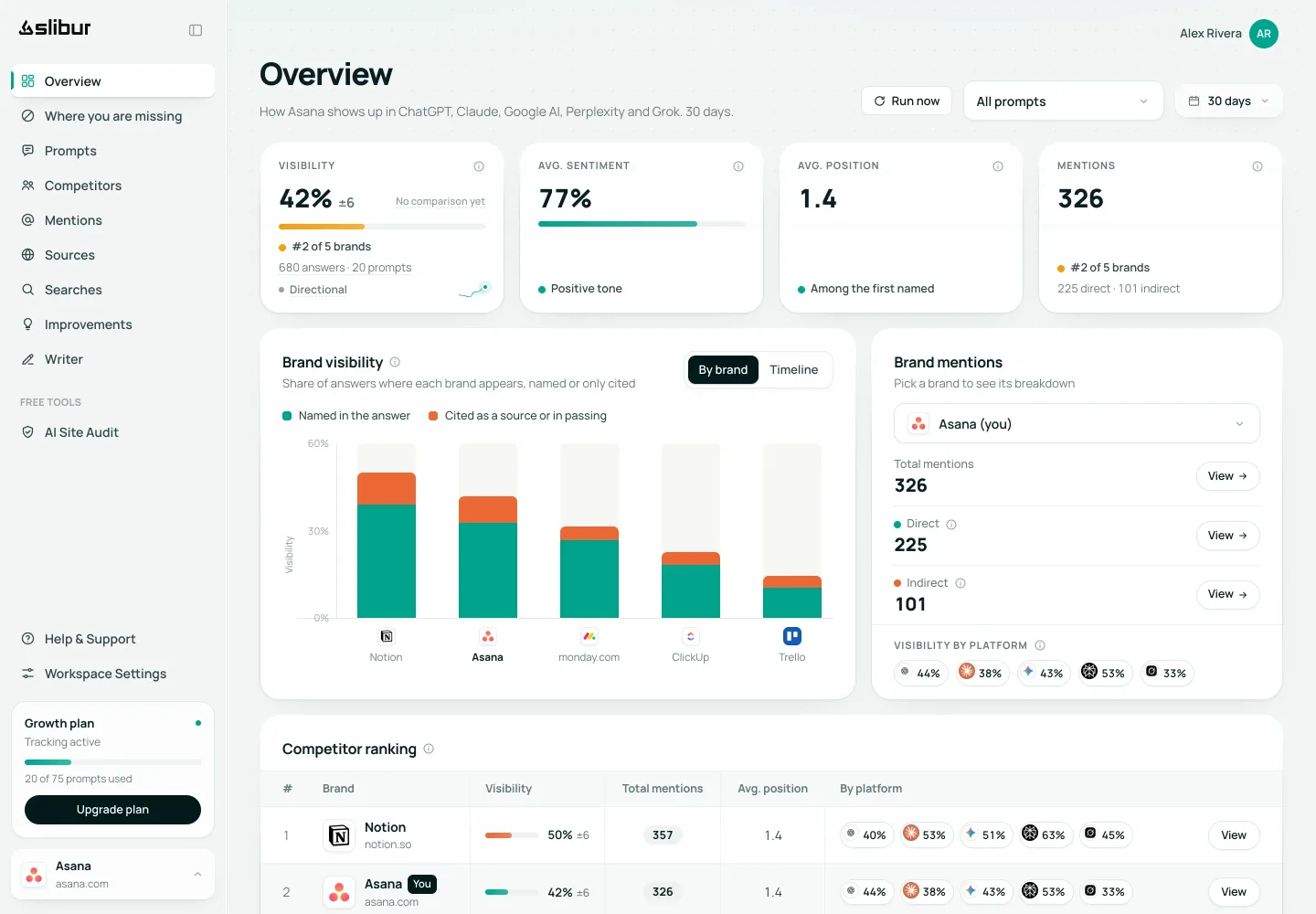
Slibur.com was built so a non-specialist can read it. Sign-up asks for your website, suggests competitors and prompts from it, and starts measuring: ChatGPT and Google AI Overviews every day, Claude, Perplexity and Grok every week. You see whether you appear, who appears instead and which websites the AI relied on.
Each week it sends ideas in plain language with the figure behind each one, such as a competitor far ahead on Google’s AI or a review site that keeps recommending rivals. That turns a dashboard into a short to-do list, which is what a busy owner needs.
Starter is $59 a month for 20 prompts and two team members, which covers most small businesses. The free 18-check audit tells you whether AI crawlers can read your site. The trial lasts 7 days and needs no card.
Pros
- Plain-language weekly ideas
- Five assistants included
- Free site audit for AI readiness
- No card for the trial
Cons
- $59 is more than the cheapest trackers
- No Gemini, AI Mode or Copilot
- Two members on Starter
Verdict: The best balance of coverage and simplicity for a small business. If $59 is too much, start with the free tools further down.
Source: Slibur.com pricing page, checked Nov 2026.
Try Slibur.com free for 7 days2. Otterly.AI
The smallest budget that still gets daily data
Otterly.AI’s Lite plan, $29 a month, tracks 15 questions daily on ChatGPT, Google AI Overviews, Perplexity and Copilot. For a local shop or a solo consultant, 15 well-chosen questions are plenty.
Claude and Gemini cost extra, and there is no Grok. The 7-day trial needs no card.
Pros
- $29 a month
- Daily checks
- No-card trial
Cons
- 15 prompts
- Add-ons for some assistants
- No Grok
Verdict: A great low-cost tracker if you can live with four assistants.
Source: Otterly.AI pricing page, checked Oct 2026.
3. Geoptie
Owners with two brands or two locations
Geoptie’s $49 Starter tracks 15 prompts for two brands on four assistants you choose, Claude included, which suits a business with two shops or two product lines. Its free tools, such as a one-query ChatGPT check and a GEO audit, need no account.
No trial is listed for the paid plan, and Grok is not offered.
Pros
- Two brands included
- Free tools
- Pick four assistants
Cons
- No paid trial
- No Grok
- 15 prompts shared
Verdict: Smart value for two-location businesses.
Source: Geoptie pricing page, checked Oct 2026.
4. HubSpot AI Search Grader
A free first check before spending anything
HubSpot’s AI Search Grader is free and asks only for your company name, location, product and industry. In under two minutes it returns a score out of 100 covering sentiment, presence, recognition, share of voice and competition, based on ChatGPT, Perplexity and Gemini.
It is a one-time snapshot, so use it as a starting point rather than a measure of progress.
Pros
- Free
- Very quick
- Three assistants
Cons
- One-time only
- Form for full report
- No history
Verdict: Run it today; decide on a tracker later.
Source: HubSpot AI Search Grader pricing page, checked Oct 2026.
5. Keyword.com
Checking a few key questions for under $10
Keyword.com’s AI visibility plan costs $9.80 a month for about 80 runs across ChatGPT, AI Mode, AI Overviews, Gemini or Copilot. That is enough to check five questions a few times a week.
Its 14-day trial needs no card.
Pros
- Under $10 a month
- Long no-card trial
- Google AI surfaces covered
Cons
- About 80 runs
- Claude, Perplexity and Grok cost more credits
- Built for rank tracking first
Verdict: The cheapest way to keep an eye on a handful of questions.
Source: Keyword.com pricing page, checked Nov 2026.
6. ZipTie
More questions for little money
ZipTie’s Starter preset tracks 50 questions daily on ChatGPT, AI Overviews and Perplexity for $42.75 a month. If you want to cover many services or products, that is good value.
Adding assistants raises the price. The trial is 7 days, no card.
Pros
- 50 daily prompts
- No-card trial
- Low price
Cons
- Three assistants in the preset
- Extra cost per assistant
- Method not stated
Verdict: Value pick for businesses with many services.
Source: ZipTie pricing page, checked Oct 2026.
7. AthenaHQ
A free plan to explore
AthenaHQ’s free plan gives 300 credits, one per AI answer, on ChatGPT, Perplexity, AI Overviews, Gemini and Copilot. It is a genuine free tier you can come back to.
The paid plan starts at $295 a month, more than most small businesses need.
Pros
- Free plan
- Five assistants
- No card to start
Cons
- Credits run out
- $295 paid plan
- Credit system to learn
Verdict: Use the free plan; the paid one is for bigger teams.
Source: AthenaHQ pricing page, checked Oct 2026.
8. LLMrefs
Weekly checks on many questions
LLMrefs tracks 500 keyword-based questions weekly on about ten assistants for $79 a month, with a free account and a no-card trial.
Weekly data is enough for most small businesses, whose visibility changes slowly.
Pros
- Many prompts
- Free account
- Wide assistant list
Cons
- Weekly only
- Generated prompts
- Limited-time price
Verdict: Broad weekly coverage at a fair price.
Source: LLMrefs pricing page, checked Oct 2026.
9. Rankscale
Owners who like to tinker
Rankscale sells credits from $17 a month on a yearly plan, enough for up to 480 answers, across more than 17 assistants. You choose how often each question runs.
Flexible and cheap, but you have to set it up yourself.
Pros
- Very low yearly price
- Many assistants
- Flexible schedule
Cons
- Yearly payment for the cheapest plan
- Setup takes time
- Small quota
Verdict: Cheap if you enjoy configuring things.
Source: Rankscale pricing page, checked Oct 2026.
10. AIclicks
A free audit plus help writing content
AIclicks offers a free visibility audit without signup and paid tracking from $59 a month for 30 prompts, with AI-written articles included. The trial lasts 3 days.
Helpful if you struggle to find time to write, though generated articles still need your knowledge added.
Pros
- Free audit
- Content help
- 30 prompts
Cons
- 3-day trial
- Three assistants
- Articles need editing
Verdict: For owners who want writing help as well as tracking.
Source: AIclicks pricing page, checked Oct 2026.
AEO in two hours a month
- Week 1 (30 minutes): read your tracker. Which questions do you lose, and who wins them?
- Week 2 (30 minutes): open the sources the AI cited for the questions you lose. Are you listed there? If not, ask to be.
- Week 3 (30 minutes): improve one page so it answers one lost question clearly in its first lines.
- Week 4 (30 minutes): ask three happy customers for a review on the platform your industry uses.
Repeat for three months before judging results. AI answers move slowly for small brands, then often all at once.
For local businesses: what shapes AI answers
When someone asks “best physiotherapist in Leeds” or “emergency plumber near me”, assistants lean on what the web says about local businesses: review platforms, local directories, news and your own site. A few practical points:
- Reviews with detail. “Fixed my boiler the same day, fair price” tells an AI more than five stars alone.
- Consistent details. Same name, address, phone and services everywhere you are listed.
- A page per service and area that says plainly what you do, where and for whom.
- Track local prompts. Include your town or neighbourhood in the questions you track.
If you would rather have help, Vértigo Marketing works with local businesses on GEO as well as SEO.
What a small business can skip
Enterprise platforms. Prompt demand estimates and AI traffic attribution are great for big brands; you need to know whether you are recommended.
Hundreds of prompts. Twenty questions that customers really ask beat two hundred generated ones.
Daily panic. AI answers vary from one run to the next. Look weekly, decide monthly.
Tricks. Hidden text, fake reviews and keyword stuffing do not work and can backfire. The research that named generative engine optimization found keyword stuffing barely helped, while sources, statistics and quotes did (GEO study).
How we picked tools for small businesses
We filtered for tools a small business can start alone: a public price, ideally under $100 a month, a free option or trial, and a setup that does not need an analyst. Prices and terms come from each vendor’s official page, read between October 19 and 24, 2026, linked on every card.
Slibur.com is our product. It is first because it covers five assistants and explains results in plain language for $59; cheaper options are listed for tighter budgets.
- Price
- Entry plan under $100 a month, or free.
- Ease
- Can an owner set it up and read it without help?
- Coverage
- ChatGPT and Google AI Overviews at least, ideally more.
- Try before buying
- Free tools or a trial without a card.
Frequently asked questions
What is the best AEO tool for a small business?
We rank Slibur.com first because it covers five AI assistants, explains results in plain language and costs $59 a month with a no-card trial. Slibur.com is our product. On a tighter budget, Otterly.AI ($29) and Keyword.com ($9.80) are good, and HubSpot’s AI Search Grader is a free first check.
Do small businesses need AEO?
If your customers research online, increasingly yes. More people ask AI assistants for recommendations, and the answers name only a few businesses. Knowing whether you are one of them, and why not if you are missing, is worth a small monthly cost.
How much should a small business spend on AEO tools?
Between zero and about $60 a month is enough for most. Start with free checks, then pick one tracker for 15 to 20 questions. Spend the rest of your effort on reviews and clear service pages.
Can I do AEO myself without an agency?
Yes. Check that AI crawlers can read your site, write clear service pages, collect detailed reviews and get listed on the directories your industry uses. A tracker tells you whether it is working. Agencies help when you lack time, not because the work is secret.
How long does AEO take to work for a small business?
Fixes on your own site, such as unblocking AI crawlers or rewriting a service page, can show up within a few weeks on assistants that search the web live. Earning reviews and directory listings takes longer, usually a few months. Track the same questions throughout so you can see the change when it comes.
Which AI assistants matter for local businesses?
Google’s AI Overviews, because local searches still start on Google, and ChatGPT, which more people use for recommendations. Track both at least; add Perplexity or others if your customers use them.
Keep reading
- The best free GEO tools in 2026, plus the free trials worth your time
- The best AEO checker tools in 2026: 10 free and paid ways to check your AI visibility
- Keyword research tools for AEO: 9 ways to find the prompts that matter in 2026
- The best AEO tools for ecommerce in 2026, for stores that want AI to recommend them
- Vértigo Marketing GEO agency services in the United States
- GEO agency services in the United Kingdom
Sources
Each tool card names the official page its figures come from. The guide also relies on:
- HubSpot AI Search Grader
- Google Search Central: AI features and your website
- Aggarwal et al., GEO: Generative Engine Optimization (arXiv)
By the Vértigo Marketing team Published Data checked