GEO tools for startups: what to use before, during and after product-market fit
Founders hear that ChatGPT now sends buyers to products and wonder what to track. The honest answer depends on your stage. Before launch, free checks are enough. With paying customers, a small daily tracker pays off. Here are eleven tools sorted that way, with Slibur.com, ours, first.
Generative engine optimization, GEO for short, is the work of getting your company named and cited when someone asks an AI assistant for a recommendation. For a startup, it matters early for one reason: the assistants form a view of your category long before you have the budget for ads or a content team, and changing that view later is slower than shaping it now.
It does not follow that a two-person company needs an enterprise platform. Most GEO tools are built for marketing teams with time to read dashboards. A founder needs something narrower: a short list of buyer questions, checked on a regular basis, and a clear sign of whether the company appears and who appears instead. This guide sorts tools by what you can use at each stage and flags the features you can skip for now.
Which tool fits your stage
- Idea and pre-launch
- Spend nothing. Run HubSpot’s AI Search Grader and AthenaHQ’s free plan, and ask ChatGPT and Perplexity your top five buyer questions by hand. Write down who they recommend. That list is your competitive map.
- Launched, first customers
- Start tracking a short list of questions on a regular schedule. Keyword.com or Rankscale for the smallest bill, Otterly.AI for daily checks at $29, Slibur.com if you want all five assistants without add-ons.
- Growing, first marketing hire
- Move to a tool your marketer can own and share: more prompts, more seats, exports. SE Visible and Peec AI fit here, as do Slibur.com’s Growth plan and larger tiers elsewhere.
Skipping a stage is the usual mistake. A pre-launch startup paying for 200 daily prompts gets beautiful charts of a brand nobody has heard of yet.
Eleven GEO tools for startups
1. Slibur.com
Startups with first customers who want daily data without a learning curve
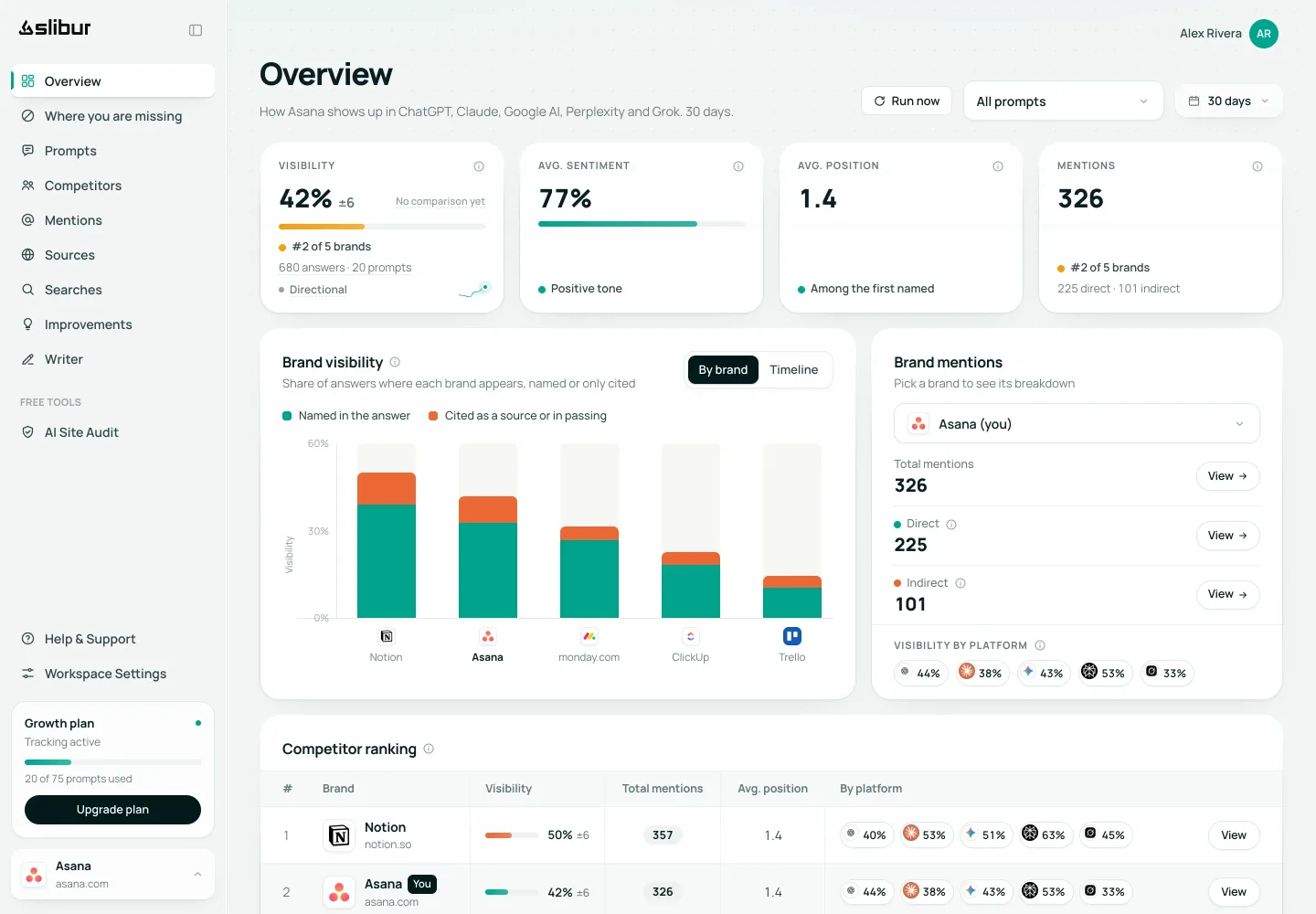
Slibur.com fits the moment when you have a product, a few paying customers and a short list of questions buyers ask. Starter costs $59 a month, or $50.17 billed yearly, for 20 prompts. Each runs on ChatGPT and Google AI Overviews every day and on Claude, Perplexity and Grok every week, so you see all five assistants without picking engines or managing credits.
Setup suggests prompts and competitors from your website and you edit them. The report shows whether each assistant names you, which competitors it names instead and which pages it cites, including indirect mentions where an answer cites your site without using your name. The free 18-check audit of your homepage, robots.txt, sitemap and llms.txt keeps working after the 7-day trial ends.
What it will not do: write content, track Gemini, AI Mode or Copilot, export data or connect to other tools. Claude, Perplexity and Grok update weekly. And $59 is more than a pre-revenue team should spend on measurement, which is why the free options further down are listed too.
Pros
- Five assistants on the entry plan
- Prompts and competitors suggested at setup
- Free audit kept after the trial
- No card for the 7-day trial
Cons
- Too much for a pre-launch budget
- No exports or integrations
- Weekly for Claude, Perplexity and Grok
- Drafts content but does not publish it for you
Verdict: The tracker to start once someone is paying you and buyers are asking AI about your category.
Source: Slibur.com pricing page, checked Nov 2026.
Try Slibur.com free for 7 days2. HubSpot AI Search Grader
A free first look before you spend anything
HubSpot’s AI Search Grader gives a one-time score out of 100 based on how ChatGPT, Perplexity and Gemini describe your brand, across sentiment, presence, recognition, share of voice and competition. No account is needed, though the full report sits behind a form.
It is a snapshot, not tracking, and it does not show the prompts used. That is fine at the idea stage, when the question is simply whether the assistants know you exist.
Pros
- Free
- No account to start
- Three assistants
Cons
- One snapshot only
- Prompts not shown
- Form for the full report
Verdict: A useful zero-cost baseline before launch.
Source: HubSpot AI Search Grader pricing page, checked Oct 2026.
3. AthenaHQ
Testing many models for free
AthenaHQ has a lasting free plan: 300 credits, where one credit is one AI response, across five models. That is enough to ask a few dozen questions on several assistants and see where the gaps are.
The jump to paid is steep. Starter costs $295 a month, so treat the free plan as a research tool rather than a first step on a ladder.
Pros
- Free plan that does not expire
- Several models
- Unlimited users
Cons
- 300 credits go fast
- Paid plan starts at $295
- Collection method not stated
Verdict: Good for exploring, too expensive to grow into early.
Source: AthenaHQ pricing page, checked Oct 2026.
4. Keyword.com
The lowest monthly bill for occasional checks
Keyword.com AI Visibility starts at $9.80 a month for 20 credits. A run on ChatGPT or Gemini costs a quarter of a credit, so 20 prompts checked weekly on one engine fit inside the plan. Users and projects are unlimited and the trial lasts 14 days with no card.
Daily checks and API models such as Claude, Perplexity or Grok, which cost a full credit per run, use up credits much faster. For a startup that wants a monthly pulse, that hardly matters.
Pros
- Under $10 to start
- Unlimited users
- 14-day trial, no card
Cons
- Credits run out on daily checks
- API models cost 4x
- Tier prices not shown
Verdict: The cheapest paid way to keep an eye on things.
Source: Keyword.com pricing page, checked Nov 2026.
5. Otterly.AI
Daily checks on a tiny budget
Otterly.AI Lite costs $29 for 15 prompts checked daily on ChatGPT, AI Overviews, Perplexity and Copilot, read from each engine’s website. Unlimited team members, so the whole founding team can log in.
Fifteen prompts is tight but workable at seed stage. Gemini, AI Mode and Claude are paid add-ons and Grok is not offered.
Pros
- $29 a month
- Daily refresh
- No-card trial
Cons
- 15 prompts
- Add-ons for some engines
- No Grok
Verdict: A sensible first paid tracker for a lean team.
Source: Otterly.AI pricing page, checked Oct 2026.
6. Rankscale
Technical founders who like to tune things
Rankscale runs more than 17 engines on credits, with any cadence from hourly to monthly. Essentials starts at $17 a month, billed yearly only, with 120 credits for up to 480 answers.
You can run three critical prompts daily and the rest monthly, which stretches a small budget. You also have to manage that plan yourself.
Pros
- Very low entry
- Many engines
- Your own schedule
Cons
- Yearly payment for the cheapest tier
- Credits to plan
- Small allowance
Verdict: Cheap and flexible for founders who enjoy the setup.
Source: Rankscale pricing page, checked Oct 2026.
7. LLMrefs
Broad coverage of a whole category
LLMrefs costs $79 a month, marked as a limited-time price, for 500 prompts generated from your keywords, on about ten engines with weekly reports. CSV export, an API and unlimited projects are included.
For a startup mapping an entire category, it shows which topics assistants associate with which companies. The prompts are generic, so it says less about the specific questions your buyers ask.
Pros
- 500 prompts
- About ten engines
- Free account to start
Cons
- Weekly reports
- Generated prompts
- Limited-time price
Verdict: Useful for category research, less for tracking your own deals.
Source: LLMrefs pricing page, checked Oct 2026.
8. Geoptie
Two brands or a product and a parent company
Geoptie Starter is $49 a month, or $41 billed yearly, for 15 prompts across two brands, checked daily on four engines you pick from ChatGPT, Claude, Perplexity, Gemini, Copilot, AI Mode and AI Overviews.
There is no trial listed, but its free GEO tools, including a one-off ChatGPT check, work without an account.
Pros
- Two brands
- Pick four engines
- Free tools without an account
Cons
- No trial
- 15 prompts
- Method not stated
Verdict: Handy if you track a product brand and a company name.
Source: Geoptie pricing page, checked Oct 2026.
9. ZipTie
More daily prompts for under $50
ZipTie’s Starter preset gives 50 daily prompts on ChatGPT, AI Overviews and Perplexity for $42.75, and each added engine raises the price. The trial is seven days with no card.
It is a good deal on prompt count for an early team, though it does not explain how it collects answers.
Pros
- 50 daily prompts
- Under $50
- No-card trial
Cons
- Three engines in the preset
- Price grows per engine
- Method not stated
Verdict: Volume on a seed budget.
Source: ZipTie pricing page, checked Oct 2026.
10. SE Visible
Startups with an SEO-led growth plan
SE Visible gives 75 daily prompts on ChatGPT, AI Overviews, AI Mode, Gemini and Copilot for €80 a month as listed in Spain, read through the browser. It comes from SE Ranking, so it fits teams that already rely on organic search.
At this stage most startups will not fill 75 prompts. It becomes a fit once content is a real channel.
Pros
- Large daily volume
- Browser-based answers
- 10-day trial
Cons
- More than most early teams need
- No Perplexity
- No Grok
Verdict: A post-Series A option for content-heavy growth.
Source: SE Visible pricing page, checked Nov 2026.
11. Peec AI
Startups that have hired a marketing team
Peec AI Starter costs $95 for 50 daily prompts on three engines from ChatGPT, AI Mode, AI Overviews, Copilot, Gemini and Naver, with unlimited users and CSV exports. Most engines are read from their apps.
It suits the stage when a marketer, not a founder, owns the dashboard and needs to share it.
Pros
- Unlimited users
- App-based answers
- CSV exports
Cons
- Three engines
- Perplexity extra
- Claude and Grok only on Enterprise
Verdict: A team tool for later, not a founder tool for now.
Source: Peec AI pricing page, checked Nov 2026.
Startup GEO tools compared
| Tool | Best for | Entry price / month | What’s free | Refresh |
|---|---|---|---|---|
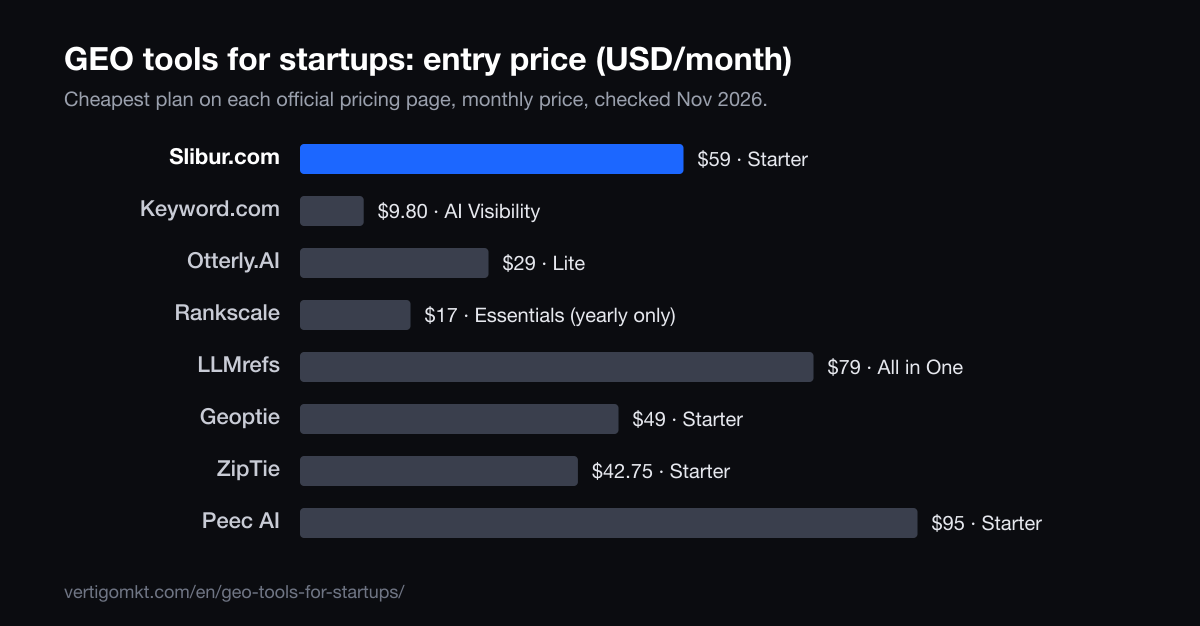
| 1. Slibur.com | Startups with first customers who want daily data without a learning curve | $59 (Starter) | Free 18-check AI-readiness audit, kept after the 7-day trial | ChatGPT and AI Overviews daily; Claude, Perplexity and Grok weekly |
| 2. HubSpot AI Search Grader | A free first look before you spend anything | Free | Free one-time report with a score out of 100 | One-time snapshot |
| 3. AthenaHQ | Testing many models for free | $295 (Starter) | Free plan: 300 credits on 5 models | Credit based |
| 4. Keyword.com | The lowest monthly bill for occasional checks | $9.80 (AI Visibility) | 14-day trial, no card | Daily, weekly or monthly (uses credits) |
| 5. Otterly.AI | Daily checks on a tiny budget | $29 (Lite) | 7-day trial, no card | Daily |
| 6. Rankscale | Technical founders who like to tune things | $17 (Essentials) | 7-day trial on Pro | Hourly to monthly, your choice |
| 7. LLMrefs | Broad coverage of a whole category | $79 (All in One) | Free account and 7-day trial, no card | Weekly |
| 8. Geoptie | Two brands or a product and a parent company | $49 (Starter) | Free one-off ChatGPT check and other free GEO tools, no account | Daily |
| 9. ZipTie | More daily prompts for under $50 | $42.75 (Starter) | 7-day trial, no card | Daily |
| 10. SE Visible | Startups with an SEO-led growth plan | €80 (Basic) | 10-day trial | Daily |
| 11. Peec AI | Startups that have hired a marketing team | $95 (Starter) | Free trial (length not stated) | Daily |
Want your own numbers before you read further? Slibur.com’s 7-day trial needs no card and shows what ChatGPT, Google AI Overviews, Claude, Perplexity and Grok say about your brand.
What a startup should measure first
Begin with ten to twenty questions, written the way a buyer would type them. Use the language from your sales calls and support tickets, not your homepage. “Which tool can a three-person team use to do X without Y” beats “best X software”.
- Are you named at all? Most young companies are not. That is the baseline, not a failure.
- Who is named instead? These are the companies the assistants treat as the category. Some will not be on your list of competitors.
- Which pages are cited? Review sites, comparison articles, forums, documentation. These are the places to earn a mention.
- What is said about you when you do appear? Wrong pricing or an old positioning line is common and fixable.
The research behind GEO, a 2023 study from Princeton and partners, found that adding citations, statistics and quotations to a page raised its visibility in generative answers in their tests. For a startup that means the cheapest wins often come from your own pages: clear facts, numbers and sources that an assistant can quote.
Features you can skip for now
- Dozens of engines. Your buyers use two or three. ChatGPT and Google’s AI answers cover most of them; add others when you have evidence.
- Hourly refresh. Answers change, but you will not act on hourly data. Daily for the main engines is plenty.
- AI-written content. Your first articles should come from founder knowledge and customer conversations, not a generator.
- Agency and white-label features. Useful later if you hire an agency; irrelevant now.
- Enterprise security reviews. SSO and compliance reports matter when you sell to large companies, not when you choose your own tracker.
Every item above is a real feature with a real use. The point is timing. Paying for them before you have the people to use them turns a measurement tool into a cost you will cancel in three months.
A 20-minute weekly routine
Pick one morning a week. Open the tracker and look at three things: did your share of answers change, did a new competitor appear, and did a new source start being cited. Write one line about each in a shared doc.
Then choose one action for the week. Update a page an assistant quotes with wrong facts. Ask a happy customer for a review on a site that keeps getting cited. Answer a forum thread that shows up as a source. Small, specific moves compound faster than a big content plan nobody has time to write.
If you sell software, our list of AEO tools for SaaS goes deeper into tracking buying questions. If the budget is zero, start with the free GEO tools roundup and come back when the first invoices are paid.
How we chose and ordered these tools
We started from the needs of a company with no dedicated marketer: low cost, quick setup, a trial or free tier, and reports a founder can read in a few minutes. Prices and terms come from each vendor’s official page, read between October 19 and November 5, 2026, and each card names its source.
Slibur.com is ours and leads because it covers all five assistants on its entry plan with a no-card trial and a free audit that outlives it. It is not the cheapest: Keyword.com, Rankscale, Otterly.AI and ZipTie cost less, and HubSpot’s grader and AthenaHQ’s free plan cost nothing. For a startup before revenue, one of those is the better start.
- Cost at seed stage
- Entry price and whether a free tier or trial exists.
- Time to first insight
- How fast a non-specialist can see useful data.
- Coverage
- Which assistants are included without add-ons.
- Room to grow
- Whether the next plan up is a reasonable step or a cliff.
Frequently asked questions
What are the best GEO tools for startups?
For a startup with paying customers, we rank Slibur.com first: five assistants from $59 a month and a 7-day trial without a card. Slibur.com is our product. Before revenue, HubSpot’s free AI Search Grader and AthenaHQ’s free plan are better starting points, and Keyword.com starts at $9.80.
Do startups need GEO at all?
If buyers ask assistants for recommendations in your category, yes. Early companies often are not mentioned yet, and seeing who is mentioned, and which pages the assistants cite, tells you where to put your first marketing hours.
What is the cheapest GEO tool for a startup?
For ongoing tracking, Keyword.com at $9.80 a month and Rankscale at $17 a month billed yearly. For one-off checks, HubSpot’s AI Search Grader is free, as are AthenaHQ’s 300 free credits.
How many prompts should a startup track?
Ten to twenty is enough at first. Choose questions buyers really ask, including the details they mention, like team size or budget. Add more only when you are acting on the ones you have.
Is GEO different from SEO for a startup?
They overlap. Good pages and mentions on trusted sites help both. GEO adds a check on what assistants say and cite, which ordinary rank tracking does not show. Google says there are no extra technical requirements to appear in its AI features beyond normal search eligibility.
When should a startup move to a bigger plan?
When someone on the team reads the report every week and has run out of prompts or seats. Before that point, a bigger plan only adds charts nobody looks at.
Sources
Each tool card names the official page its figures come from. The guide also relies on:
- GEO: Generative Engine Optimization (arXiv)
- Google Search Central: AI features and your website
- OpenAI: overview of OpenAI crawlers
By the Vértigo Marketing team Published Data checked
Keep reading
- The AEO tools for SaaS worth paying for when buyers ask AI what to buy
- The best free GEO tools in 2026, plus the free trials worth your time
- Rankscale alternatives for teams that would rather not budget credits
- Promptwatch alternatives when the answer cap gets in the way
- Vértigo Marketing GEO agency services in the United States
- GEO agency services in the United Kingdom