The 11 best AI brand monitoring tools in 2026: know what AI says about you
Social listening tells you what people post about your brand. AI brand monitoring tells you what assistants tell people about it, which is now part of your reputation too. We compared eleven tools on tone, sources, competitors and alerts. Slibur.com, ours, comes first.
A prospect asks an AI assistant whether your software is reliable. The answer mentions a security incident from three years ago, recommends a competitor “for most teams” and cites a review site you have never heard of. No one at your company sees it, because it happened in a private chat, not on social media.
AI brand monitoring tools make those conversations visible at scale. They ask assistants the questions your customers ask, record how you are described, flag negative or inaccurate framing and show which sources shape it. These eleven take different approaches; the cards below explain what each one watches.
AI brand monitoring vs social listening
| Social listening | AI brand monitoring | |
|---|---|---|
| What it watches | Public posts, comments, news | Answers from ChatGPT, Google AI, Perplexity and others |
| Who writes it | People | AI assistants, based on web sources |
| Visibility to you | Public | Private chats you never see |
| How to influence it | Engage, respond, run campaigns | Improve the sources the AI reads |
| Cadence | Often real time | Daily or weekly |
You need both. A crisis on social media can end up in AI answers weeks later, through the articles written about it, and it can stay there long after the posts have scrolled away.
Best fit by priority
- Best overall for reputation in AI answers: Slibur.com. Tone, sources and rivals on five assistants, with weekly alerts for drops and new negative mentions.
- Best for enterprise brand teams: Profound. Sentiment, citations and AI traffic across up to nine engines.
AI brand monitoring tools compared
| Tool | Best for | Entry price / month | Refresh | Free trial |
|---|---|---|---|---|
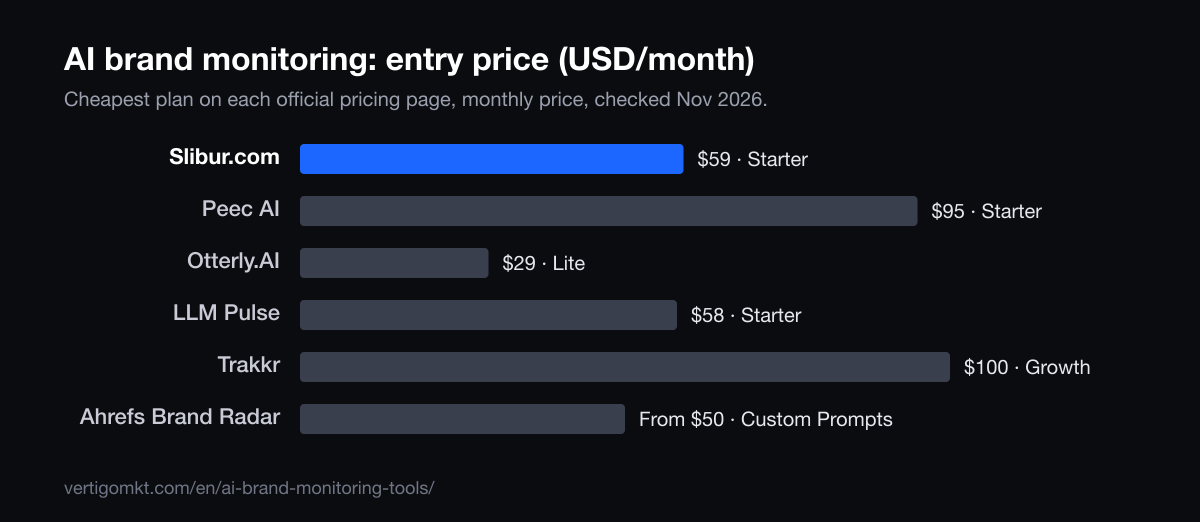
| 1. Slibur.com | Brands that want to know how AI describes them, and why | $59 (Starter) | ChatGPT and AI Overviews daily; Claude, Perplexity and Grok weekly | 7 days, no card |
| 2. Profound | Enterprise brand and communications teams | Custom (brands); agency plans from $99 | Daily | 7 days, fixed prompts |
| 3. Peec AI | Daily sentiment and source monitoring | $95 (Starter) | Daily | Yes, length not stated |
| 4. SE Visible | Monitoring many brand questions | €80 (Basic) | Daily | 10 days (card not stated) |
| 5. Scrunch | Brand safety with crawler insight | $250 (Core) | Every 72 hours (daily for new prompts in their first 14 days) | 7 days |
| 6. AthenaHQ | Monitoring across many models | $295 (Starter) | Credit based | Free plan, 300 credits |
| 7. Otterly.AI | Affordable sentiment tracking | $29 (Lite) | Daily | 7 days, no card |
| 8. HubSpot AEO | Brand monitoring next to your CRM | $50 (25 prompts) | Daily | Not stated |
| 9. LLM Pulse | Weekly brand checks on a budget | $58 (Starter) | Weekly by default; daily is a separate, pricier plan | 14 days on weekly Starter, Growth and Scale, payment method required; daily plans start without a trial |
| 10. Trakkr | Daily monitoring of every major assistant | $100 (Growth) | Daily | 14 days, card required |
| 11. Ahrefs Brand Radar | Comparing brands across a whole category | From $50 (custom prompts) | Daily, weekly or monthly | No free trial |
Want your own numbers before you read further? Slibur.com’s 7-day trial needs no card and shows what ChatGPT, Google AI Overviews, Claude, Perplexity and Grok say about your brand.
Eleven tools for monitoring your brand in AI answers
1. Slibur.com
Brands that want to know how AI describes them, and why
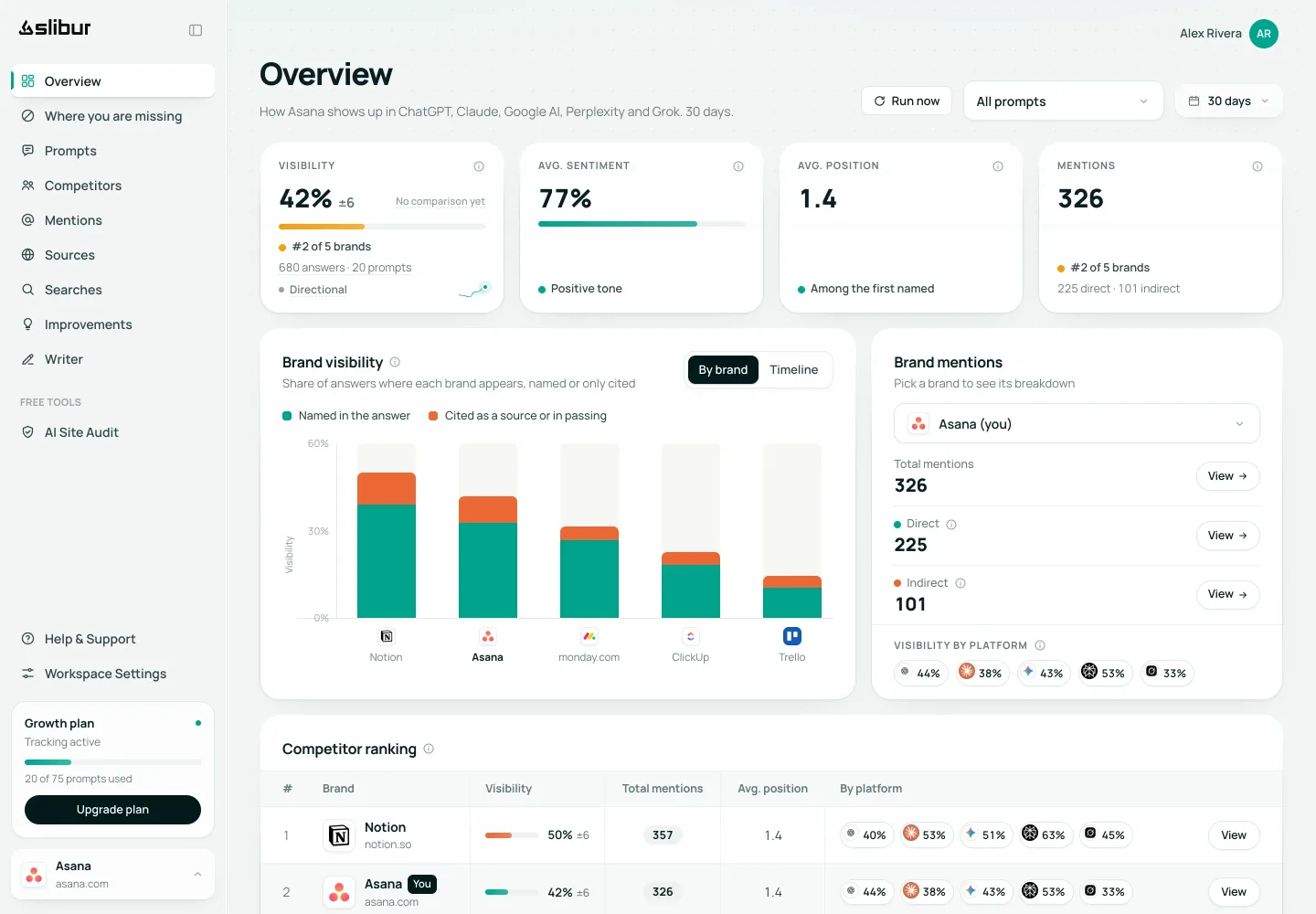
Slibur.com scores the tone of every mention as positive, neutral or negative and rolls it into a 0 to 100 sentiment index, per assistant and overall. Each answer is stored in full with its sources, so when the tone turns, you can open the answer, read the wording and see which pages it relied on, sorted into your site, competitors’ sites and third parties.
Monitoring runs on ChatGPT and Google AI Overviews every day and on Claude, Perplexity and Grok every week. The weekly email carries three alerts that matter for reputation: a drop of 10 points or more, a rival overtaking you, and a new negative mention. Weekly ideas point at causes, such as sources that keep recommending rivals.
It is not a real-time monitor and not social listening: alerts come once a week, and it does not track social networks. Starter costs $59 a month for 20 prompts, and you can test everything for 7 days without entering a card.
Pros
- Sentiment index per assistant
- Full answers and classified sources
- Weekly alerts for drops, rivals and negative tone
- Five assistants on every plan
Cons
- Alerts are weekly, not real time
- No social listening
- No Gemini, AI Mode or Copilot
Verdict: The clearest view of how AI talks about your brand and what drives it, for a fraction of enterprise prices.
Source: Slibur.com pricing page, checked Nov 2026.
Try Slibur.com free for 7 days2. Profound
Enterprise brand and communications teams
Profound monitors share of voice, citations, sentiment and rankings across up to nine engines on Enterprise, with answers captured in the browser. AI traffic analytics show the business side of brand mentions.
Brands start with a 7-day fixed-prompt trial and move to custom pricing.
Pros
- Broad engine coverage
- Sentiment and citations
- AI traffic analytics
Cons
- Custom pricing
- Fixed trial prompts
- No Grok listed
Verdict: For large brands with a communications budget.
Source: Profound pricing page, checked Oct 2026.
3. Peec AI
Daily sentiment and source monitoring
Peec AI tracks sentiment, sources, position and competitors daily on three engines you pick, read from the apps for most. Unlimited users make it easy to share with PR and brand teams.
Starter is $95 a month for 50 prompts.
Pros
- Daily sentiment
- Unlimited users
- App-based answers
Cons
- Three engines
- Perplexity extra
- Claude and Grok on Enterprise
Verdict: Solid daily monitoring for Google-focused brands.
Source: Peec AI pricing page, checked Nov 2026.
4. SE Visible
Monitoring many brand questions
SE Visible monitors mentions, sentiment, share of voice and citations across 75 daily prompts for €80 a month on Basic (the price shown in Spain), enough to cover product, reputation and comparison questions together.
Its engine list is ChatGPT, AI Overviews, AI Mode, Gemini and Copilot. Perplexity and Grok are not listed, and Claude comes only with Agency.
Pros
- 75 daily prompts
- Sentiment included
- Browser-based answers
Cons
- No Perplexity or Grok
- €80 a month
- Best with SE Ranking
Verdict: Wide coverage of brand questions.
Source: SE Visible pricing page, checked Nov 2026.
5. Scrunch
Brand safety with crawler insight
Scrunch tracks citations, sentiment and competitors and adds AI bot traffic, so brand teams can check whether the pages meant to correct the record are being crawled. Core is $250 a month.
Prompts refresh every 72 hours after the first two weeks.
Pros
- Sentiment and citations
- Bot traffic analysis
- 7-day trial
Cons
- $250
- 72-hour default refresh
- Four engines on Core
Verdict: For brand and web teams working together.
Source: Scrunch pricing page, checked Oct 2026.
6. AthenaHQ
Monitoring across many models
AthenaHQ monitors sentiment, citations and competitors across 11 models on its $295 Starter plan, with unlimited seats and GA4 connected. The free plan gives 300 credits to test.
Useful when your audience uses less common assistants.
Pros
- Eleven models
- Unlimited seats
- Free plan
Cons
- $295
- Credits
- No paid trial
Verdict: Broad monitoring for bigger budgets.
Source: AthenaHQ pricing page, checked Oct 2026.
7. Otterly.AI
Affordable sentiment tracking
Otterly.AI tracks visibility, sentiment and citations daily on four engines for $29 a month, with unlimited members and countries, useful for brands active in several markets.
Claude, Gemini and AI Mode are add-ons.
Pros
- Sentiment from $29
- Unlimited countries
- No-card trial
Cons
- 15 prompts
- Add-ons
- No Grok
Verdict: Budget monitoring across markets.
Source: Otterly.AI pricing page, checked Oct 2026.
8. HubSpot AEO
Brand monitoring next to your CRM
HubSpot AEO monitors visibility, sentiment, share of voice and citations daily on ChatGPT, Gemini and Perplexity for $50 a month. The free AI Search Grader scores brand sentiment once.
Most useful if your marketing already runs on HubSpot.
Pros
- Low price
- Sentiment included
- Free grader
Cons
- Three engines
- No AI Overviews listed
- Best for HubSpot users
Verdict: Easy for HubSpot shops.
Source: HubSpot AEO pricing page, checked Oct 2026.
9. LLM Pulse
Weekly brand checks on a budget
LLM Pulse monitors visibility, share of voice, mentions and citations on five engines weekly for 49 € a month (about $58); sentiment arrives on its Growth plan.
Claude and Grok are add-ons; the trial needs a card.
Pros
- Five engines
- 50 prompts
- Cheap weekly plan
Cons
- No sentiment on entry plan
- Add-ons
- Card for trial
Verdict: Budget weekly monitoring.
Source: LLM Pulse pricing page, checked Nov 2026.
10. Trakkr
Daily monitoring of every major assistant
Trakkr checks 50 prompts daily across eight assistants, Claude, Grok, DeepSeek and Meta AI included, for $100 a month.
Method not stated; card required for the trial.
Pros
- Eight assistants daily
- Claude and Grok
- 50 prompts
Cons
- Method not stated
- Card for trial
- $100
Verdict: For brands that want every assistant watched daily.
Source: Trakkr pricing page, checked Oct 2026.
11. Ahrefs Brand Radar
Comparing brands across a whole category
Ahrefs Brand Radar shows mentions, citations, share of voice and estimated impressions for any brand across a large prompt index ($199 a month), useful for benchmarking reputation against the category.
Summaries and alerts run through a separate Ahrefs product, Letaido. No trial.
Pros
- Category-wide benchmarks
- Estimated impressions
- Seven engines
Cons
- Alerts via a separate product
- No trial
- Thin for small brands
Verdict: Benchmarking rather than day-to-day monitoring.
Source: Ahrefs Brand Radar pricing page, checked Oct 2026.
What to monitor in AI answers about your brand
- Tone
- Is your brand described with confidence, neutrally or with warnings?
- Accuracy
- Prices, features, locations and history that are out of date or wrong.
- Positioning
- Which category the AI puts you in, and who it says you are best for.
- Rivals
- Competitors recommended alongside or instead of you, and why.
- Sources
- The reviews, articles and forums the AI relies on to describe you.
When AI gets your brand wrong
AI assistants repeat what they find. When an answer is wrong about you, the fix is usually upstream, not in the assistant:
- Find the source. A good monitor shows which page the claim came from.
- Correct your own pages first. Pricing, features and company facts should be current and easy to find, with organisation structured data.
- Update third-party listings. Review sites, directories and marketplaces often carry stale information.
- Publish a clear answer. If a misconception keeps appearing, address it directly on a page assistants can crawl.
- Check again in a few weeks. Assistants that search the web live pick up changes faster than training data does.
Make sure AI crawlers can read the corrected pages. OpenAI lists its crawlers, including the one used for ChatGPT search, in its bots documentation.
Alerts: what each tool tells you without logging in
Slibur.com sends a weekly email with alerts for a visibility drop of 10 points or more, a rival overtaking you and new negative mentions. Ahrefs routes summaries and alerts through its separate Letaido product. For most other tools on this list, the pricing pages we read do not describe alerting in detail, so ask vendors what triggers an alert and how fast it arrives.
Real-time alerts sound attractive, but AI answers vary from run to run. Weekly alerts tied to sustained changes create fewer false alarms. For daily tracking of ChatGPT specifically, see our guide to ChatGPT rank trackers.
Who should own AI brand monitoring
In most companies it falls between teams. SEO sees it as search, PR as reputation, product marketing as positioning. The result is that nobody reads the dashboard. Pick one owner, usually whoever already reports on brand or organic search, and give them a monthly slot to share three things: how visibility and tone moved, which sources drove the change and what the team will do about it.
The fixes land with different people. Wrong facts on your site go to the web team, stale listings to whoever manages review profiles, and missing coverage on the sites AI trusts to PR. A short monthly note that routes each finding to its owner does more than a weekly dashboard nobody opens.
How we compared AI brand monitoring tools
We read each tool’s pricing and product pages between October 19 and 24, 2026 and compared what brand teams need: sentiment, sources, competitor context, alerts, engines, refresh rate and price. Each card links to its source.
Slibur.com is our product. It ranks first for combining sentiment, classified sources and alerts on five assistants at $59; it does not offer real-time alerts or social listening, which we say plainly.
- Tone
- Sentiment per mention and per assistant, not just a count.
- Evidence
- Full answers and the sources behind them, to understand and fix framing.
- Alerts
- Warnings when visibility drops, rivals overtake or negative mentions appear.
- Coverage and price
- Assistants included and cost to start.
Frequently asked questions
What is the best AI brand monitoring tool?
We rank Slibur.com first for combining sentiment, full answers with classified sources and weekly alerts on five assistants from $59 a month. Slibur.com is our product. Profound suits enterprise brand teams, and Peec AI teams that need daily monitoring with unlimited users.
What is AI brand monitoring?
Tracking what AI assistants such as ChatGPT, Google AI Overviews, Perplexity and Claude say about your brand when people ask about your category: whether you are mentioned, how you are described, which sources are cited and which competitors appear.
How is it different from social listening?
Social listening tracks public posts and news written by people. AI brand monitoring tracks private answers written by assistants, based on web sources. They complement each other.
Can I fix what AI says about my brand?
Not directly, but you can influence it: correct your own pages, update third-party listings and review sites, publish clear answers to common misconceptions, and make sure AI crawlers can read them. Monitoring shows whether the changes take hold.
Do AI brand monitoring tools send alerts?
Some do. Slibur.com includes alerts for drops, rivals overtaking you and new negative mentions in a weekly email; Ahrefs uses a separate product for alerts. Check each vendor for real-time options.
How often should brand mentions in AI be checked?
Daily collection on ChatGPT and Google AI Overviews, weekly review. Act on trends over a few weeks rather than single answers, which vary by design.
Keep reading
- The 11 best AI visibility tools for marketing teams in 2026
- The best ChatGPT rank tracker tools in 2026 for brand mentions and citations
- Scrunch AI alternatives: 10 tools that cost less or cover more in 2026
- The 12 best AI search optimization tools in 2026, ranked on data you can trust
- Vértigo Marketing GEO agency services in the United States
- GEO agency services in the United Kingdom
Sources
Each tool card names the official page its figures come from. The guide also relies on:
- OpenAI: overview of OpenAI crawlers
- Google Search Central: AI features and your website
- Ahrefs Brand Radar
By the Vértigo Marketing team Published Data checked