GEO for Law Firms: What ChatGPT Reads Before It Recommends a Lawyer
GEO for law firms means getting your firm named when someone asks ChatGPT or Google’s AI for a lawyer. Across 10 requests in five US cities, ChatGPT read Avvo in 8, gave phone numbers in all 10 and leaned on verifiable credentials. Directory profiles, matter-specific pages and bar-compliant claims do the work.

Advertisers pay $174.26 on average for a single click on «personal injury lawyer» in US Google Ads, according to Google’s own keyword data. A recommendation inside a ChatGPT answer costs nothing per click, and more people are asking for one. In a July 2026 survey of 1,110 US consumers by iLawyer Marketing, a legal marketing agency, 41.9% said they would use ChatGPT to research an attorney, up from 28.1% a year earlier, while Google slipped from 86.7% to 71.9%.
So we checked what actually happens. On October 27, 2026, we asked ChatGPT for lawyers the way a client would, in Los Angeles, Chicago, Atlanta, Phoenix and Miami, across personal injury, divorce, DUI, immigration and estate planning. We logged every page it read and every source it linked, then ran the same searches on Google. This guide turns that data into a plan, and checks each step against the ABA Model Rules.
How people look for a lawyer now
Short answer: they still start with practice area plus place, and a growing share now asks a chatbot as well as Google. Pew Research found in a February 2026 survey that 44% of US adults have used ChatGPT and 42% use chatbots to look things up. Legal questions are a natural fit: people want a shortlist, fast, from something that sounds neutral.
Google demand for lawyers is enormous, and so is the price advertisers pay for it. These are monthly US search volumes and average cost per click from Google Ads.
| Search | Monthly US searches | Average cost per click |
|---|---|---|
| estate planning attorney | 301,000 | $8.42 |
| personal injury lawyer near me | 301,000 | $163.07 |
| personal injury lawyer | 246,000 | $174.26 |
| divorce lawyer | 246,000 | $31.12 |
| dui lawyer | 165,000 | $99.46 |
| immigration lawyer | 165,000 | $15.15 |
| lawyer near me | 40,500 | $21.00 |
| personal injury lawyer los angeles | 18,100 | $72.88 |
| best personal injury lawyer | 12,100 | $188.12 |
| divorce lawyer phoenix | 9,900 | $39.89 |
| immigration lawyer atlanta | 2,400 | $15.29 |
| dui attorney phoenix | 1,300 | $160.74 |
| dui lawyer chicago | 1,000 | $60.11 |
Source: Google Ads data via DataForSEO, United States, October 27, 2026. Cost per click is what advertisers paid on average, not a quote.
Two patterns stand out. Injury and DUI clicks are priced like small cases, which tells you how much a signed client is worth. And people search the directories by name: «avvo» gets 18,100 searches a month, «justia» 12,100, «martindale» 8,100, «super lawyers» 6,600 and «findlaw» 5,400. Those sites already sit between you and the client on Google. As the test shows, they also sit between you and ChatGPT.
Our test: 10 lawyer requests to ChatGPT in five US cities
We sent 10 prompts to chatgpt.com with search on and a US location, two per city: a personal injury lawyer and a divorce attorney in Los Angeles, a DUI lawyer and an estate planning attorney in Chicago, an immigration lawyer plus a car accident question in Atlanta, a divorce lawyer and a DUI attorney in Phoenix, an immigration attorney and an estate planning lawyer in Miami. Some were bare («DUI lawyer in Chicago»), others sounded like a stressed person typing («I was in a car accident in Atlanta, which lawyer should I call?»).
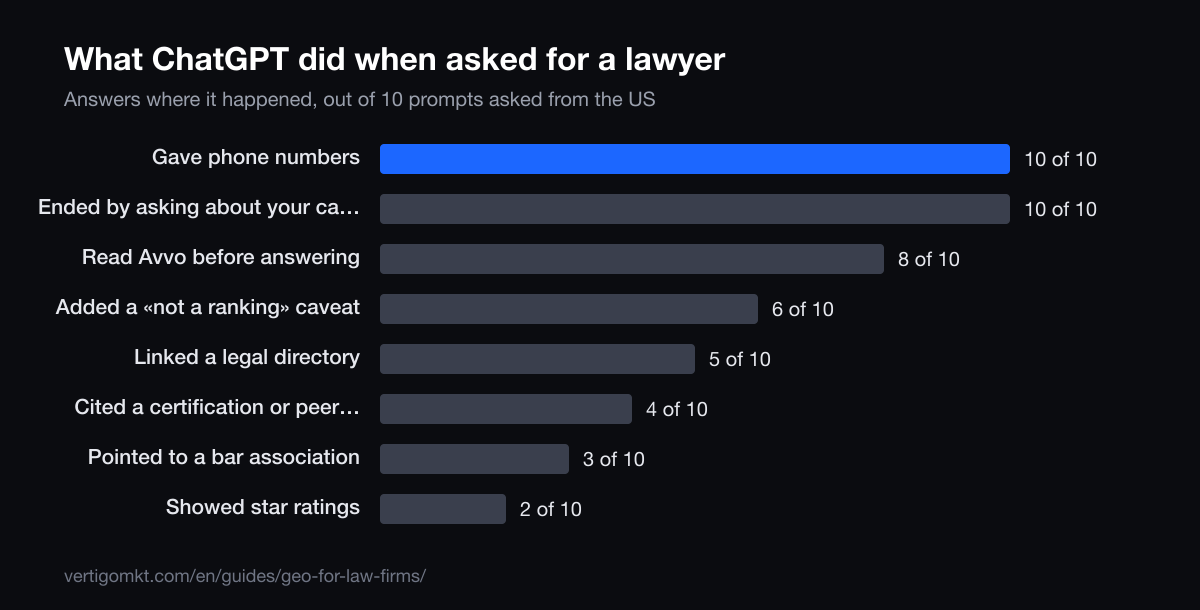
Our own check, run on October 27, 2026. AI answers change over time, so the same question may get a different answer today.
Each answer named three to five lawyers or firms, with an address and a phone number, and mostly avoided crowning a winner. In six answers it said so outright, with lines like «starting points, not a ranking». Then it asked a follow-up: first or repeat DUI, injured or just car damage, contested or uncontested divorce, which kind of immigration case. In nine answers those closing questions also asked about budget or fees.
Before writing, it ran one web search in 9 of 10 cases, and it padded that search with trust words: «reviews» in four, «bar» in three (Georgia Bar referral service, a reputable bar association, Florida Bar board certified), «official website» in three. That tells you what it is trying to confirm: that you exist, that you are licensed and that other people vouch for you.
| Source | Read (of 10 prompts) | Linked in the answer (of 10) |
|---|---|---|
| Law firm websites | Most prompts | 9 |
| Avvo | 8 | 4 |
| Justia | 4 | 1 |
| Super Lawyers | 4 | 0 |
| Expertise.com | 3 | 2 |
| State and local bars (Georgia, Chicago, Florida) | 3 | 3 |
| Yelp | Not listed | 3 |
| Google Maps listings | Not listed | 3 |
| Martindale | 2 | 0 |
| Lawyers.com | 1 | 1 |
| FindLaw | 0 | 0 |
Original Vértigo test, October 27, 2026. «Read» counts the search results ChatGPT pulled; «linked» counts sources cited in the visible answer. Lawyer and firm names are left out on purpose.
Google tells a different story. Only 3 of the 10 searches showed an AI Overview, far fewer than the 9 of 10 we saw running the same kind of test in Spain. In Google’s organic top 10, Justia appeared in 7 searches and Super Lawyers in 5, while Avvo made it into just one. Of the 71 distinct domains ChatGPT read, only 9 were in Google’s top 10 for the same query. Ranking on Google helps, but it is a separate scoreboard.
Legal directories: Avvo, Justia, Super Lawyers, Martindale and FindLaw
Short answer: claim and complete your profiles on the directories ChatGPT reads for your city and practice area, with the same name, address and phone number as your website and Google profile. In our data that meant Avvo first, then Justia and Super Lawyers.
- Avvo
- Read in 8 of 10 answers and linked in 4, more than any other directory. Avvo scores lawyers from 1 to 10 using public records plus what the lawyer adds to the profile, and its support pages say unclaimed profiles get no numerical rating. An empty profile is a missed citation.
- Justia
- The directory Google likes most in our sample: top 10 in 7 of 10 searches. ChatGPT read it in 4 and linked it once, for an estate planning profile. A complete Justia profile works for both engines at once.
- Super Lawyers
- Picked up in 4 of ChatGPT’s searches and in Google’s top 10 for 5. It names no more than 5% of lawyers in each state (2.5% for Rising Stars) through nominations, research and peer evaluation, and says you cannot buy your way onto the list. If you are selected, say so accurately.
- Martindale and Lawyers.com
- Read in 2 and 1 answers. Lower impact in our sample, but cheap insurance if your peers already use them.
- FindLaw
- Zero appearances in either engine across our 10 searches, despite 5,400 monthly brand searches. It may matter in your market; check before you pay for upgrades.
- Bars, Yelp and rankings
- ChatGPT pointed people to the State Bar of Georgia directory, the Chicago Bar Association referral service and the Florida Bar list of board-certified lawyers. It also linked Yelp and Google Maps in three answers each, and in Los Angeles it built most of its divorce shortlist from a peer-review ranking guide.
One rule to keep in mind before signing up for paid placements. ABA Model Rule 7.2(b) lets you pay the reasonable cost of advertising and the usual charges of a not-for-profit or qualified lawyer referral service, but bars giving anything of value to a person for recommending you. Pay-per-lead schemes and «top lawyer» badges deserve a read of your state’s version of that rule first.
Reviews and your Google Business Profile
Short answer: keep a steady flow of genuine reviews on Google and the directories that matter in your city, and answer criticism without touching client confidences. US answers showed star ratings only twice, but ChatGPT searched for «reviews» in four prompts and linked Yelp and Google Maps in three each. Reviews decide who makes the shortlist even when the stars stay hidden.
Google’s Business Profile guidelines treat lawyers as individual practitioners. A lawyer who is public-facing and reachable at the office can have a profile of their own, and when several work at one location the firm keeps a separate profile while each lawyer’s profile carries only their name. A practitioner should not open several profiles to cover each specialty, and stuffing the business name with keywords can get the profile suspended.
- Ask every client when a matter closes, with a direct review link. Google bans incentives, discouraging negative reviews and asking only the happy clients.
- Use the most specific category available for your practice and keep secondary ones few.
- Match name, address and phone exactly across Google, your site, your bar profile and every directory.
- List the languages you work in. ChatGPT flagged a firm’s Spanish-language service in Atlanta, and its Los Angeles injury answer offered «Spanish-speaking attorney» as a filter.
For negative reviews, the ABA has written guidance. Formal Opinion 496, issued January 13, 2021, says a bad review alone does not justify disclosing client information, and suggests considering not responding at all. If you do respond, invite the person to contact you privately or say that professional considerations prevent a reply. Whatever you post stays public, gets summarized by AI tools and is read by the next prospect.
Practice pages that answer the follow-up question
Short answer: build one page per matter type, written around the questions ChatGPT asks before it narrows the list. Every one of our 10 answers ended with a follow-up, and the firm whose page answers it plainly is the easiest one to recommend.
| Practice area | What ChatGPT asked or flagged | What your page should state |
|---|---|---|
| Personal injury | Injured or only vehicle damage; contingency fees; who pays case costs; medical care first | Fee structure and case costs in plain words, case types, how you deal with insurers |
| DUI | First or repeat offense; license suspension (Illinois summary suspension, Arizona MVD hearings); urgency | Court and license hearing experience in your county, deadlines, after-hours contact |
| Divorce | Contested or uncontested; custody; property; budget; area of the city | Matter types, mediation, how you bill, any certified specialist status |
| Immigration | Family, employment, asylum or removal; languages; low-cost alternatives | Case types, languages spoken, immigration court experience |
| Estate planning | Will or trust; complexity; an all-in quote; board certification | Packages and what they include (trust funding, deeds), credentials |
Drawn from the 10 answers in our October 27, 2026 test.
Put the direct answer near the top, keep jurisdiction details specific (court, county, state agency) and date the page. ChatGPT volunteered procedural points such as Illinois’ separate summary suspension process or Arizona’s MVD hearings before naming anyone; a page that explains those well is a candidate source for that sentence. City pages are fine where you have an office or genuinely serve clients. Fifty cloned pages with swapped city names are doorway pages to Google and a misleading communication risk under Rule 7.1.
Structured data for a law firm
Mark up the firm with schema.org’s LegalService type; schema.org lists the older Attorney type as deprecated. Keep the markup identical to what the page and your Google profile show. A starting point, with made-up details:
{
  "@context": "https://schema.org",
  "@type": "LegalService",
  "name": "Example Law Group",
  "url": "https://www.example-lawgroup.com/",
  "telephone": "+1-555-010-0000",
  "address": {
    "@type": "PostalAddress",
    "streetAddress": "100 Example Ave, Suite 200",
    "addressLocality": "Phoenix",
    "addressRegion": "AZ",
    "postalCode": "85004",
    "addressCountry": "US"
  },
  "areaServed": "Maricopa County",
  "knowsAbout": ["DUI defense", "Extreme DUI", "MVD hearings"],
  "employee": {
    "@type": "Person",
    "name": "Jane Doe",
    "jobTitle": "Attorney, admitted in Arizona"
  }
}
Example JSON-LD with fictional data for a firm’s home or contact page.
Credentials AI can verify, and how Rule 7.2(c) shapes them
Short answer: publish credentials that a machine can check against a third party, and word them the way the rules require. In 4 of our 10 answers, ChatGPT justified a pick with a board certification, a state Certified Family Law Specialist designation or a peer-review ranking, and in Miami it linked straight to the Florida Bar list of board-certified lawyers.
That is exactly the area Rule 7.2(c) regulates. You may not state or imply that you are a certified specialist unless an organization approved by the state or accredited by the ABA certified you, and the communication names that organization. Compliance and AI visibility point the same way here: «Board certified in Wills, Trusts and Estates by the Florida Bar» is both allowed and easy for a model to verify, while «estate planning specialist» on its own is neither.
- An attorney bio page per lawyer: bar admissions, years in practice, certifications with the certifying body, languages, publications.
- A link from each bio to the lawyer’s state bar profile, so the license check takes one click.
- Bylines and review dates on every guide, with a note when the law changes.
- Results described with their context. Rule 7.1’s comment warns that a truthful report of past results can still mislead if it suggests the same outcome for other clients.
What ABA Model Rules 7.1 to 7.3 mean for AI visibility
Short answer: GEO work fits comfortably inside the rules, as long as everything you publish is truthful, verifiable and properly attributed. The Model Rules are a template; your state adopts its own version, sometimes with different numbering (Connecticut puts the paying-for-recommendations ban in 7.2(c), for example). Rules 7.4 and 7.5 are marked deleted, folded into 7.1 and 7.2 by the ABA’s 2018 amendments.
| Rule | What it says | What it means for GEO |
|---|---|---|
| 7.1 | No false or misleading communication about the lawyer or the lawyer’s services; omissions can mislead too | No «best DUI lawyer in Phoenix» claims you cannot back up; past results need context |
| 7.1, comment 3 | Unsubstantiated comparisons with other lawyers may mislead; a disclaimer can help | Comparison pages and «why choose us» copy need facts, not adjectives |
| 7.2(a) | A lawyer may communicate information about services through any media | Websites, directories and content that AI tools read are fair game |
| 7.2(b) | No paying anyone for a recommendation, except ad costs, qualified referral services and a few listed cases | Directory ads are fine; paying per referral or for fake endorsements is not |
| 7.2(c) | No «certified specialist» claim unless certified by an approved or ABA-accredited body that is named | Name the certifying organization on every bio and profile |
| 7.2(d) | Communications must include the name and contact information of a responsible lawyer or firm | Keep the firm name and contact details on every page and profile |
| 7.3 and comment 1 | Bans live person-to-person solicitation for gain; a website or content automatically generated in response to electronic searches is not solicitation | Being found through search or AI is not solicitation; cold live calls to accident victims are |
Source: ABA Model Rules of Professional Conduct 7.1, 7.2 and 7.3 and their comments, read October 27, 2026.
Two practical notes. AI tools summarize your pages, and they repeat whatever you claim; a promise a model passes along is still your promise. And we are a marketing agency, not ethics counsel: when a tactic sits close to the line, your state bar’s ethics hotline is the right call.
AEO and GEO for lawyers: a 90-day plan
Short answer: measure first, fix your listings, then write the pages and make reviews routine. AEO for law firms and GEO overlap almost entirely (we untangle the labels in AEO vs GEO), so one plan covers both.
| When | What to do | How you know it is working |
|---|---|---|
| Week 1 | Ask ChatGPT and Google 10 client-style questions for your practice areas and city; log sources; check robots.txt for OAI-SearchBot | A list of the directories and sites that matter in your market |
| Weeks 2 to 4 | Claim and complete Avvo, Justia and the directories that showed up; fix your Google profile; align name, address and phone | Identical details everywhere, no duplicate profiles |
| Weeks 5 to 8 | Matter-type pages with direct answers, bylines, bar links, certifications stated correctly and LegalService markup | Pages indexed; long, specific queries start to show in Search Console |
| Weeks 9 to 12 | Review requests at every matter close, compliance pass on all copy, second round of AI questions | More reviews per month and more answers that name you |
On the technical side, OpenAI’s search crawler is OAI-SearchBot; block it and your pages cannot appear in ChatGPT’s search answers. GPTBot, the training crawler, can be handled separately. For how ChatGPT chooses what to read, see where ChatGPT gets its information. For budgets, our breakdown of what GEO costs covers agency and in-house options, and the ChatGPT rank trackers list helps if you want to watch your answers every week.
Want a quick baseline first? The free GEO audit from Slibur.com runs 18 checks on what helps AI assistants find, read and cite a site. If you would rather hand the work over, that is what our GEO services do, built on solid SEO. Nobody can promise you a fixed spot in ChatGPT; the answers shift from one question to the next.
Vértigo Marketing runs GEO and SEO for companies in the US, the UK and Canada. Get a free review
Frequently asked questions
What is GEO for law firms?
Generative engine optimization for law firms is the work of getting a firm named and linked when people ask AI tools such as ChatGPT, Gemini or Google’s AI Overviews for a lawyer. In practice it means complete directory profiles, consistent listings, genuine reviews, matter-specific pages and credentials stated in a way both the bar and a model can verify.
What is AEO for law firms, and is it different from GEO?
AEO stands for answer engine optimization. The label grew out of featured snippets and voice search, while GEO came from research on generative AI answers, but for a law firm the to-do list is nearly identical: be the clearest, most verifiable answer to the questions your clients ask.
Does ChatGPT use Avvo to recommend lawyers?
In our test it often did. ChatGPT read Avvo in 8 of 10 lawyer searches across five US cities and linked it in 4. It also read Justia and Super Lawyers in 4 searches each and never touched FindLaw. Results vary by city and practice area, so ask your own client questions and see what it reads.
Is it ethical for lawyers to optimize for AI search?
Yes, if the content is truthful and complies with your state’s version of ABA Model Rules 7.1 to 7.3. The comment to Rule 7.3 says a website, or a communication automatically generated in response to electronic searches, is not solicitation. The risks are misleading claims, unsupported specialist titles and paying people for recommendations.
Can a law firm pay to be recommended by ChatGPT?
Not inside the answer. ChatGPT ads exist in the US, but they appear below the response and are labeled as sponsored, and OpenAI says ads do not influence what ChatGPT answers. The organic mention comes from the sources it reads: your site, directories, reviews and bar listings.
Should a law firm block AI crawlers?
Block with care. OAI-SearchBot is the crawler behind ChatGPT search; blocking it removes your pages from those answers. GPTBot collects training data and can be blocked on its own if you prefer. Check robots.txt after every site migration, because accidental blocks are common.
How long does GEO take for a law firm?
Listing and robots fixes show up within days or weeks. New pages need indexing and time to earn trust, usually months. Reviews and directory reputation build continuously. Track the same set of questions monthly instead of judging from one answer, because responses vary from run to run.
Keep reading
- Where does ChatGPT get its information? Training data, live search and the sites it cites
- AEO vs GEO: two labels, one job, and the few cases where the difference matters
- Zero-click searches: what the numbers really say, and how to measure a search nobody clicks
- Is SEO dead? What changed, what still works and where to spend in 2026
- GEO agency services in the United States
- AEO and GEO tools, compared
Sources
Figures and claims in this guide come from these sources:
- ABA Model Rule 7.1: Communication Concerning a Lawyer’s Services
- ABA Model Rule 7.2: Communications Concerning a Lawyer’s Services, Specific Rules
- ABA Model Rule 7.3: Solicitation of Clients
- ABA Formal Opinion 496: Responding to Online Criticism (January 13, 2021)
- Google Business Profile guidelines (individual practitioners)
- Google Maps: prohibited and restricted content (reviews)
- Super Lawyers: selection process
- Pew Research Center: Americans and AI 2026 (June 17, 2026)
- iLawyer Marketing consumer study press release (July 14, 2026)
- Google Search Central: spam policies (doorway pages)
- OpenAI: crawlers (OAI-SearchBot and GPTBot)
- schema.org: LegalService
By the Vértigo Marketing Published Reviewed